The White Noise
Sleep had always been my sanctuary.
I didn’t suffer from insomnia. I didn’t experience sleep paralysis, night terrors, or the sudden, jerking sensation of falling. Once my head hit the mattress, I was a stone dropped into a deep well. I valued that biological shutdown, especially in the weeks following a brutal, drawn-out breakup. The waking hours in the apartment felt hollow and abrasive. Unconsciousness was the only place where I didn’t have to carry the weight of my own life.
I shared a second-floor apartment with Patricia. We operated on completely inverted schedules. Trish worked late shifts at a hospital; I worked early mornings at an architectural firm. We treated the apartment like a time-share, communicating primarily through sticky notes on the refrigerator and the shifting of groceries on the shelves. Most nights, I had the place entirely to myself.
July descended on the city with a suffocating, oppressive heat. The brick building retained the temperature of the sun, baking the interior corridors.
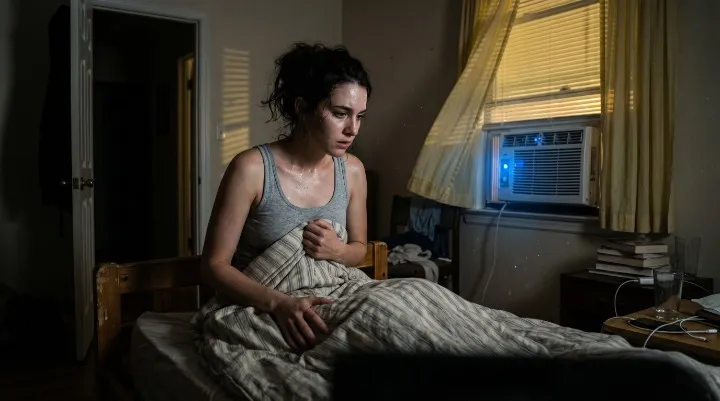
My bedroom had a single, rattling window unit air conditioner. I ran it on the maximum setting every night. The compressor was old and aggressively loud. It drowned out the street traffic, the sirens, and the heavy footsteps of the upstairs neighbors. The mechanical drone became a thick blanket of white noise that sealed me inside my room.
I turned it on, locked my door, and surrendered to the dark.
I didn’t know the noise was acting as a cover.
The Dinner Guest
The first dream arrived on a Tuesday.
It was vivid, possessing a sharp, high-definition texture that my dreams usually lacked. I was sitting at a long, mahogany dining table. My parents, my siblings, and my extended family were gathered around it. The plates were full, the silverware clinked against china, but the room was entirely silent. No one was speaking. No one was eating. They were all staring down at their plates with rigid, paralyzed posture.
I looked up from the table.
Standing in the far corner of the dining room, pressed against the floral wallpaper, was an entity.
It didn’t belong in the architecture of a human dream. It was towering, scraping the plaster ceiling. Its physical texture resembled compressed, flaking ash—a dry, charred silhouette that seemed to absorb the light around it. Protruding from the top of its skull were long, jagged lengths of blackened, calcified bone. They didn’t grow upward like antlers; they curved forward and inward, forming a dense, skeletal cage around a face that possessed no recognizable features.
Its arms hung past its knees, ending in thick, obsidian-like claws that scraped gently against the hardwood.
It was watching me.
I stood up from the dining chair. My family didn’t react. I backed away, my heart hammering a frantic rhythm against my ribs. The entity didn’t walk. It didn’t take a step. It simply displaced space, appearing three feet closer to me without moving its limbs.
I turned and ran. I sprinted out of the dining room, down a hallway that stretched into infinity, throwing myself through a heavy wooden door.
My eyes snapped open.
I was flat on my back in my bedroom. The darkness was absolute. The window AC unit roared, blasting a steady stream of frigid air across my face.
I lay perfectly still. My skin was slick with cold sweat. The adrenaline from the dream pumped violently through my veins, making my fingertips buzz. I stared at the ceiling, waiting for my heart rate to decelerate.
It was just a nightmare. A manifestation of stress.
I rolled onto my side, pulled the heavy duvet over my shoulder, and let the mechanical roar of the compressor drag me back under.
The Draft
The next morning, the alarm woke me at 6:00 AM.
I hit the button on my nightstand, groaning as the harsh morning light bled through the edges of the window shade. I sat up, pushing the heavy blankets aside.
I looked across the room.
My bedroom door was wide open.
I stared at the empty doorway, a cold prickle forming at the base of my neck. I was militant about my door. I closed it before I turned on the AC unit to trap the cold air inside. I never left it open.
I stood up, crossing the room, and stepped out into the hallway. The rest of the apartment was empty and warm. Trish wasn’t home.
I pulled out my phone and sent her a text.
Did you come into my room last night?
The reply came ten minutes later while I was standing in the shower.
No. I worked a double. Just getting on the train now.
I stood under the hot water, trying to construct a rational bridge. I had gotten up to use the bathroom in the middle of the night and simply forgot to pull the door shut. The latch was sticky. The change in air pressure from the AC unit blew it open.
I accepted the lies because the alternative was unacceptable. I couldn’t afford to lose my sanctuary.
The Void
The second dream occurred two nights later.
The environment was different. The family table was gone. I was standing in the center of a perfectly square, windowless room. The walls were constructed of smooth, featureless gray concrete. The air was freezing.
I wasn’t alone.
The entity from the dining room stood in the corner.
Up close, the details of its existence were horrifying. The charred, compressed ash of its skin was constantly shifting, flaking off and reforming like a swarm of dead insects. The skeletal cage of bone around its face vibrated with a low, mechanical hum. Deep within the dark hollow of the cage, two pinpricks of dying, ember-red light locked onto me.
It smelled like sulfur, ozone, and old copper.
It moved.
It didn’t walk. The space between us simply collapsed. One second it was in the corner; the next, it was looming directly over me. The sheer, physical mass of the creature blotted out the ceiling.
I couldn’t move. My feet were cemented to the concrete floor.
The entity raised a long, ash-coated arm. The obsidian claw extended.
It brought the claw down in a swift, vicious arc.
The tip of the blackened bone caught the flesh of my upper thigh. The pain was explosive—a sharp, blinding tear of raw nerve endings and parting muscle. It was a searing, electric agony that defied the muted sensations of a dream.
I screamed.
My eyes snapped open.
The Bleed
I was in my bed. The room was pitch black. The AC unit was rattling in the window, blasting freezing air into the room.
I gasped, sucking in oxygen. My hands instinctively dropped to my legs, expecting to feel the smooth cotton of my pajama shorts.
Instead, my fingers sank into something wet.
The liquid was hot, thick, and incredibly sticky. It soaked the fabric of my shorts and pooled heavily into the creases of the fitted sheet.
The pain didn’t fade with the waking world. It sharpened. A deep, throbbing, excruciating burn radiated from my right thigh.
I didn’t scream. The shock severed the connection between my brain and my vocal cords. I threw the heavy duvet completely off the bed. I swung my legs over the edge of the mattress, my bare feet hitting the hardwood floor.
I stumbled out of the bedroom, leaning heavily against the hallway wall, and slapped the light switch in the bathroom.
The fluorescent bulb flickered and hummed to life.
I looked down at my leg.
My pajama shorts were soaked in a dark, heavy crimson. I gripped the hem of the fabric with shaking, blood-slicked fingers and pulled the material up.
A gash, four inches long and terrifyingly deep, traced a jagged line across the outer curve of my thigh. The edges of the wound were clean, slicing cleanly through the dermis and into the muscle tissue. Fresh blood pulsed sluggishly from the center, running down my leg and dripping off my knee onto the white bathroom tile.
This wasn’t a scraped knee. This wasn’t a scratch from a rough fingernail in the dark.
I stared at the wound in the mirror, the clinical reality of the injury breaking my mind into fractured pieces.
The Audit
I limped down the hallway and slammed my fist against Trish’s bedroom door.
I didn’t wait for an answer. I twisted the knob and pushed it open. Trish groaned, rolling over in her bed, shielding her eyes from the hallway light.
“Trish,” I rasped. My voice sounded thin and broken. “Trish, get up.”
She lowered her hand, squinting at me. Her eyes dropped from my face to my leg. The annoyance instantly vanished, replaced by a sharp, clinical focus.
“What happened?” she demanded, throwing her covers off and stepping toward me.
“I don’t know,” I stammered, the adrenaline causing my jaw to tremble uncontrollably. “I woke up like this.”
She grabbed a towel from the linen closet, pressing it firmly against the gash. “Did you fall? Did you walk into the kitchen island in the dark?”
“I was in bed,” I said. “I was asleep.”
Trish didn’t argue. She operated on pragmatism. She wrapped the towel tight, told me to keep pressure on it, and walked past me, heading straight for my bedroom.
I followed her, limping heavily.
She hit the overhead light in my room. The chaotic violence of the bed was illuminated. The sheets were twisted, soaked in a heavy, dark stain of blood near the center of the mattress.
“You cut yourself on something,” Trish said firmly. She stepped up to the bed. “A loose mattress spring. A piece of glass. Something you brought into the bed.”
She began to systematically dismantle the bedding. She ripped the heavy duvet off, throwing it onto the floor. She stripped the blood-soaked fitted sheet, exposing the bare, white mattress. She ran her hands flat over the fabric, pressing down hard, searching for a sharp edge, a protruding wire, a stray razor blade.
She checked the floor around the bed. She checked the nightstand.
There was nothing. The bed was a perfectly safe, soft environment.
Trish stood up slowly. She looked at the bare mattress, then looked at the deep, bleeding gash on my leg. The pragmatic, logical framework she used to understand the world was failing in real-time.
The window AC unit continued to roar, the compressor rattling the glass pane, filling the room with a deafening, mechanical drone.
Trish turned her head, looking at the unit.
She didn’t say a word. She walked over to the window, reached out, and pressed the heavy plastic power button.
The Occupant
The compressor died instantly. The fan spooled down with a low, mechanical whine.
The silence that rushed into the bedroom was absolute, heavy, and immediate.
I stood in the doorway, holding the bloody towel against my leg. Trish stood by the window, her hand still hovering over the plastic button. We didn’t speak. We barely breathed.
Without the roar of the white noise, the acoustics of the room expanded. I could hear the faint hum of the refrigerator in the kitchen down the hall. I could hear the distant wail of a siren miles away.
And then, I heard it.
It came from directly beneath the center of the bare mattress.
Creak.
It was the distinct, heavy sound of the wooden bed frame bowing under an immense, shifting weight.
Trish froze. Her eyes met mine across the room. All the blood drained from her face, leaving her skin an ashen, terrifying gray.
Creak.
Something was shifting its mass against the floorboards.
Then came the exhalation.
It wasn’t the sound of a burglar holding their breath. It was a long, dry, rattling hiss that vibrated through the hardwood. It sounded exactly like dry, dead leaves crushing under a heavy boot. The smell of sulfur and stale copper instantly bloomed in the stagnant air of the bedroom, rising up from the edges of the box spring.
The dreams hadn’t been dreams. They had been my subconscious mind translating the proximity of a physical, waking horror. The entity from the dining room, the creature from the concrete void—it hadn’t vanished when my eyes opened.
It had simply slid under the bed.
It had been living in my sanctuary. It had been opening my door. It had been listening to the roar of the AC unit, using the white noise to mask the sound of its massive, ash-coated body shifting on the hardwood beneath me while I slept.
Trish didn’t scream. She slowly lowered her hand. She took a silent step backward, moving away from the bed, moving toward the open doorway where I stood.
As she moved, her foot brushed the discarded, heavy duvet lying on the floor.
The fabric rustled.
The reaction from beneath the bed was instantaneous.
A hand shot out from under the box spring.
It gripped the edge of the wooden bed frame. The fingers were impossibly long, the flesh entirely replaced by compressed, flaking black ash. The nails were thick, jagged lengths of chipped obsidian.
The mattress violently heaved upward.
The entity pulled its upper body out from the dark space beneath the frame.
It defied the geometry of the room. Its shoulders were too wide, its neck too long. The skeletal cage of calcified bone protruded from its skull, scraping against the side of the nightstand. Within the hollow dark of the cage, those two ember-red eyes flared to life, locking directly onto Trish.
It opened a mouth that possessed no lips, revealing rows of jagged, broken bone.
A low, clicking vibration rattled in its throat.
The Eviction
I grabbed Trish’s arm.
I didn’t pull her gently. I yanked her with every ounce of panicked, adrenaline-fueled strength in my body. She stumbled backward into the hallway.
I didn’t bother grabbing my keys. I didn’t grab my phone.
We ran.
I ignored the searing agony in my torn thigh, my bare feet slapping loudly against the hardwood. We sprinted down the hallway, hit the heavy front door of the apartment, ripped the deadbolt back, and threw ourselves out into the second-floor corridor of the building.
We sprinted to the neighbor’s door. I slammed my bloody fists against the painted wood, screaming for help, screaming for someone to call the police.
The neighbor, an older man in a bathrobe, opened the door. He took one look at the blood soaking my towel and immediately pulled us inside, locking three deadbolts behind us before reaching for his phone.
While the 911 dispatcher asked for our location, I leaned against the neighbor’s living room wall, gasping for air.
Through the thin drywall separating the apartments, I heard the heavy, distinct sound of our front door slamming shut.
The police arrived in six minutes. They drew their weapons, kicked our front door open, and cleared the apartment.
They found nothing.
The bedroom was empty. The space under the bed contained only a thin layer of dust. The windows were locked from the inside. There was no sign of forced entry. The officers took a report, eyeing my leg with suspicion, quietly asking Trish if I had a history of self-harm.
They left us sitting on the couch in the living room.
I didn’t pack a bag. I didn’t go back into the bedroom to retrieve my clothes. Trish and I walked out of the building that morning and never returned to the lease.
My thigh eventually healed, leaving a thick, raised, jagged scar across the muscle. The physical damage faded into an ache when it rained.
But the psychological eviction was permanent.
I live in a new city now. I live in an apartment on the seventh floor. The architecture of my life has completely changed, but the fundamental reality of my existence remains broken.
I don’t use air conditioning. I don’t use fans. I don’t listen to music with headphones.
I sleep in absolute, unbroken silence. I lie awake for hours, staring at the ceiling, listening to the microscopic settling of the building, terrified of missing a single scrape against the floorboards.
Sleep is no longer a sanctuary. It is a vulnerability. Because I know exactly what happens when the white noise gets too loud.
Dead Air
The ceiling fan chewed lazily at the humid air, its wooden blades clicking faintly with every rotation. It did nothing to break the midnight heat.
I had the sunroom windows cranked open as far as their rusted aluminum tracks would allow, praying for a stray breeze off the massive, ink-black pond that swallowed the back half of our property. None came. The summer air was entirely dead, hanging over the house like a damp woolen blanket. There was only the heavy, suffocating smell of stagnant water, decaying algae, and wet earth baking under the July humidity.
I sat curled into the far corner of the leather sectional, my bare knees pulled tight to my chest, bathed in the pale, flickering blue light of a late-night infomercial. The volume was set to a barely audible hum—just a murmur of synthesized voices and canned applause designed to fill the void.
The rest of the house sat directly behind me in pitch-black silence.
It was a sprawling, three-story monument to my parents’ bank accounts, a place of vaulted ceilings, excessive, unused space, and long, echoing hardwood hallways. With them out of town for the week on a business trip, the sheer size of the house didn’t feel like a luxury. It felt like a mausoleum. During the day, the tall windows let in the sun, making the marble countertops and pristine white walls feel open and airy. But at night, without the hum of my mother’s voice or the quiet, reassuring thud of my father’s footsteps upstairs, the architecture seemed to expand, stretching into deep, impenetrable shadows that swallowed the ambient light.
Outside, the cicadas had been screaming a steady, deafening chorus for hours. It was the white noise of summer in the deep suburbs.
Then, abruptly, they stopped.
Not a gradual fade. A sudden, synchronized cessation of noise, as if a switch had been flipped in the woods. The silence that rushed in to replace the hum was absolute. It pressed against the window screens, heavy and unnatural, making my ears ring.
A moment later, the surface of the water broke.
Displacement
It wasn’t a sharp, sudden sound. It wasn’t the frantic, shallow thrashing of a Canada goose taking flight, or a mallard violently defending its territory in the reeds, or a snapping turtle slipping off a sun-baked rock into the shallows.
It was a heavy, rhythmic drag.
Gadoosh.
A long, agonizing pause. The sound of water settling back into itself, lapping softly against the muddy bank.
Gadoosh.
My thumb clamped down rigidly on the television remote. The screen flashed to black. The synthesized voices vanished in an instant.
The sudden quiet of the empty house swelled to fill the void, pressing hard against my eardrums. I sat perfectly still, my muscles locking into place, holding my breath to keep my own chest from making a sound.
My mind scrambled, cycling blindly through rationalizations to keep the panic at bay. A deer swimming across. A stray dog that slipped in. A dead branch falling from the weeping willow.
But the acoustics were entirely wrong. The rhythm was too consistent, too deliberate. This was the undeniable sound of something massive displacing dozens of gallons of water with every movement. It sounded like a slow, exhausted breaststroke.
I lowered my legs from the couch. The leather peeled away from the sweat on my bare skin with a quiet, sticky sound that seemed deafening in the silence. I crept toward the open window, stepping carefully to avoid the floorboards I knew would creak. I leaned forward until the tip of my nose was inches from the wire mesh.
Beyond the edge of the wooden deck, the tree line was a solid wall of absolute black. There were no streetlights out here. No neighbors for a quarter of a mile in any direction. Just the dark water and the dense, suffocating woods.
Then, woven beneath the slow churn of the water, a vibration rattled against the window screen.
A hum.
It was low, guttural, and completely tuneless. It was a man’s voice, dragging a steady, broken melody across the flat, dark surface of the pond. He wasn’t humming a song I recognized. It was just a discordant string of low notes, vibrating with a wet, gravelly timber.
It didn’t sound like someone calling out for help. It didn’t sound lost or drowning. It sounded entirely careless, entirely at home in the black water at one in the morning.
Someone was out there. Swimming in the dead of night.
The Perimeter
A cold bead of sweat formed at the base of my neck, tracing a slow, icy path down the line of my spine. The heat of the sunroom suddenly felt suffocating, as if all the oxygen had been burned out of the air.
The prickle of deep, primal intrusion washed over my skin, raising the hairs on my arms. This was private property. Whoever was out there had bypassed the locked gates of the subdivision, walked through acres of dense, unlit woods, and bypassed the security signs just to reach the water in our backyard.
I swallowed hard. My throat felt like sandpaper. My hands were shaking as I reached for the heavy brass handle of the sliding glass door. I twisted the lock, slid the heavy pane open, and stepped out onto the wooden deck.
The humidity hit me like a physical blow, instantly pasting my thin cotton shirt to my shoulder blades. The wood under my bare feet was still warm from the afternoon sun, retaining a deep, baked-in heat.
I walked to the edge of the railing, peering out into the darkness, straining my eyes against the black. I scanned the flat expanse of the pond, looking for a silhouette, a reflection, anything.
Nothing. The water was a void.
But I could hear the parting of the surface, the slow push of water against flesh, and that rhythmic, mindless humming. It was louder out here. Much louder. The acoustics of the water were playing tricks on me, or the swimmer was much closer to the bank than I had originally thought.
I reached blindly inside the doorway, running my hand along the textured drywall until my fingers found the plastic panel of the light switches. I slammed my palm against the far right switch—the backyard floodlights.
Twin cones of harsh, halogen yellow violently carved out a fifty-foot perimeter of the pond. The light illuminated the muddy bank, the tall stalks of the cattails, and a wide semicircle of green, stagnant water.
Instantly, the water stilled.
The humming snapped off.
It didn’t fade out into the distance, tapering off as the swimmer realized they were caught. It was choked off in the back of a throat, cut so abruptly it felt as if the air itself had been violently vacuumed from the yard.
Gentle, concentric ripples pushed outward toward the reeds, catching the harsh yellow glare of the halogens. The water lapped softly against the mud.
But whoever had been out there was gone.
There was no splashing retreat toward the opposite shore. No panicked thrashing. No sound of footsteps dragging up onto the muddy bank and retreating into the woods.
They had simply sunk. Dropped silently below the dark, oily surface.
Waiting just beyond the edge of the light.
Blind
My lungs seized. The instinct to run hit me so hard my vision briefly blurred at the edges, a rush of blood pounding in my ears. I took a stumbling step backward, my heel catching slightly on a raised nail in the deck. I threw my weight backward, grabbed the handle of the glass door, and pulled it shut with far more force than necessary.
I threw the deadbolt. It locked with a loud, metallic clack that echoed down the empty hallways of the house.
My hand hovered over the light switch. If I left the halogens on, I could see the yard. I could see the perimeter. But the glass door turned into a mirror from the outside when the lights were on. Anyone standing in the dark out there could see exactly where I was, perfectly illuminated in the sunroom, while I would be staring blindly at my own reflection.
I hit the switch. I killed the floodlights.
The room plunged into a blinding, suffocating darkness.
I stood frozen with my back pressed against the drywall, gripping my phone in my pocket until the rigid plastic edges dug painfully into my palm. I squeezed my eyes shut, then opened them wide, waiting for my pupils to dilate, staring blindly into the blackness of the sunroom.
I listened to the frantic, panicked thud of my own pulse beating against the sides of my neck. The silence of the house felt heavier now, oppressive, as if the walls were leaning inward.
Hhhccch.
The sound was wet. A loose, rattling inhale that caught on a buildup of phlegm.
It wasn’t coming from the pond.
It wasn’t coming from the woods.
It was coming from the open window screen. Less than two feet from my right shoulder.
The Intrusion
My knees simply gave out. I didn’t crouch; my legs turned to water, and I dropped straight to the hardwood floor. The impact bit sharply into my joints, but I didn’t make a sound as I flattened my body against the baseboards.
I pressed both hands tightly over my mouth, biting down hard on my own knuckles to stifle the gasp clawing its way up my throat. I tasted copper. I made myself as small as physically possible in the dark, curling my spine, terrified that the fabric of my shorts would rustle against the floorboards.
The breathing continued on the other side of the thin wire mesh.
Slow. Deep. Deliberate.
Hhhhccch. A pause. A long, slow exhale that fluttered against the screen.
The smell hit me a second later. It wasn’t just the scent of the pond. It was the heavy, nauseating stench of wet, rotting soil, dead fish, and unwashed, feverish skin. It seeped through the screen, heavy and warm, clinging to the inside of my nose, coating the back of my throat like an oily film. I could feel the slight, terrifying displacement of warm air brushing against my exposed shoulder with every exhalation.
Then, the rasp of vocal cords tearing through the absolute silence.
“I see you.”
The voice was a low, scraping whisper, dripping with thick, wet malice. It didn’t sound like a question. It didn’t sound angry or aggressive. It sounded deeply, horrifyingly amused.
My chest caved in. I couldn’t draw oxygen. My mind scrambled, grasping blindly at any rational anchor, terrified that if I didn’t speak, if I didn’t prove I wasn’t entirely alone, the glass door would simply shatter inward.
“Paul?” I choked out. The neighbor’s name scraped my dry throat, weak and pathetic. My voice trembled violently. “Paul, is that you?”
Silence.
A heavy, dripping drop of water fell onto the deck outside.
Then, a wet, heavy slap against the deck boards.
And another.
Bare feet. Peeling away from the window screen, making a slow, dragging cadence across the wood. Slap. Slap. Slap. Moving away from the glass, heading slowly toward the wooden stairs that led down to the yard.
The Crawl
I laid there against the baseboards until my joints locked, terrified that any scrape of my clothing against the floor would bring the dragging footsteps back to the window. I didn’t blink. My eyes burned in the dark. I didn’t breathe until my lungs burned. I just listened to the oppressive silence of the house pressing down on me from the empty floors above.
When the adrenaline finally burned through the paralysis, leaving my limbs shaking and hollow, I moved.
I didn’t stand up. I couldn’t trust my legs to hold my weight. I crawled.
I stayed on my hands and knees, keeping my head far beneath the sightline of the windows, dragging myself out of the sunroom and into the long, echoing hallway. The hardwood gave way to the cold marble of the kitchen. The sudden drop in temperature against my palms was a shock.
The sheer size of the open-concept kitchen felt terrifyingly exposed. I was a target in the center of an empty room. I reached blindly up onto the granite island, my fingers frantically tracing the smooth surface until they found the heavy wooden block near the sink.
I pulled out an eight-inch butcher knife.
The cold, heavy steel grounded me. The weight of the black handle in my palm was the first real, tangible thing I had felt in what seemed like hours. I held it in a white-knuckle grip, the blade trembling slightly in the dark.
My phone vibrated violently in my pocket, buzzing against my thigh.
I flinched, nearly dropping the blade, biting back a whimper. I pulled the phone out, shielding the screen against my stomach to hide the glow from the windows. The harsh white glare illuminated a small, stark patch of the marble floor.
It was a text from my dad. I had texted him twenty minutes ago, back when the splashing first started, back when I thought it was just a strange animal.
Turn the lights on. Secure the perimeter. Make sure all the doors are locked. Call the police if you see anyone.
I stared at the glowing words. Secure the perimeter. It was the clinical, composed advice of a man three states away, a man sitting in a hotel room who didn’t know about the smell of the swamp water, or the wet, rattling inhale pressed against the window screen.
I stood up. My legs felt like lead, heavy and unresponsive. The knife trembled in my grip, the broad steel blade catching the ambient silver light of the moon bleeding through the kitchen skylight.
What Remains
I crept back down the hallway, staying pressed flat against the wall, sliding my shoulders along the expensive wallpaper until I reached the threshold of the sunroom. The glass door was still intact. The deadbolt was still turned. The darkness outside was an impenetrable wall.
I reached around the doorframe, my fingers finding the plastic panel, and slammed my hand against the floodlight switch.
The yellow halogens roared back to life, instantly flooding the deck and the pond with harsh, unforgiving light.
The deck was empty.
There was no one standing on the wood. No silhouette pressed against the glass.
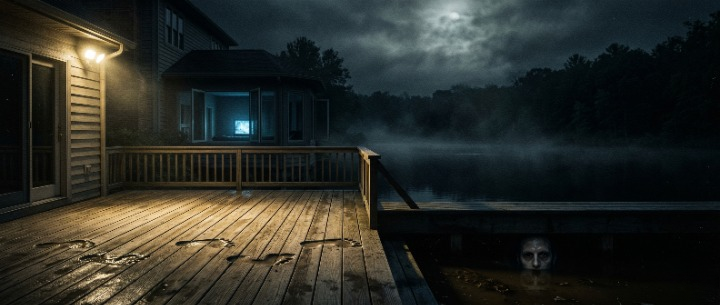
But stamped directly into the dry, gray planks were massive, soaking wet footprints.
They were impossibly large, pooling with dark, muddy water. They led up from the top of the stairs. They walked directly to the window where I had been hiding. A large, dark puddle had formed exactly where the man had stood, right where his breath had passed through the screen.
From there, the wet prints trailed off, dragging across the center of the deck, turning sharply toward the far railing that overlooked the muddy embankment.
I swallowed the bitter taste of bile rising in my throat. I wiped my sweaty palm against my shorts and shifted my grip on the heavy knife handle. I stepped forward, unlocking the deadbolt with a loud click, and slid the glass door open. The humid air immediately wrapped around my throat, choking me.
I followed the footprints.
I kept the knife raised in front of me, my bare feet sticking to the damp, muddy spots left behind on the wood. The moisture was freezing cold against my soles.
The footprints stopped right at the edge of the railing.
They didn’t lead toward the far stairs. They didn’t show signs of a struggle, or someone vaulting over the edge to jump down into the yard. They just ended, the dirty water pooling against the bottom rail and dripping slowly onto the ground below.
I stepped up to the edge. The halogens cast long, distorted shadows across the lawn, but the area directly beneath the deck was swallowed by an overhang, completely obscured by the thick wooden lattice and the sharp angle of the light above.
I leaned over the wood, gripping the railing so tightly my knuckles turned white with my left hand, the knife trembling violently in my right.
I looked down into the narrow, shadowed strip of mud beneath the floorboards.
He hadn’t left.
He was crouched in the absolute, pitch-black darkness below the deck.
I couldn’t see a torso. I couldn’t see arms, or legs, or the color of his clothes. I could only see the top half of a waterlogged, impossibly pale face protruding from the blackness, hovering inches above the wet soil.
Deep-set, unblinking eyes stared straight up at me.
The skin of his wide forehead was slick with green pond scum, catching a faint, sickly sliver of the yellow halogen light filtering through the floorboards.
He wasn’t breathing heavily. He wasn’t tensed, preparing to spring forward and grab my ankles. He wasn’t hiding.
He didn’t scramble away when my shadow crossed his face. He didn’t flinch or blink against the sudden glare of the lights above.
He simply remained perfectly, horrifyingly still, half-buried in the wet earth and the deep shadows. He didn’t make a single sound. He just watched me. A silent, terrifying promise anchored in the mud, waiting with endless, inhuman patience for me to finally turn my back.
Dead Air
The ceiling fan chewed lazily at the humid air, its wooden blades clicking faintly with every rotation. It did nothing to break the midnight heat.
I had the sunroom windows cranked open as far as their rusted aluminum tracks would allow, praying for a stray breeze off the massive, ink-black pond that swallowed the back half of our property. None came. The summer air was entirely dead, hanging over the house like a damp woolen blanket. There was only the heavy, suffocating smell of stagnant water, decaying algae, and wet earth baking under the July humidity.
I sat curled into the far corner of the leather sectional, my bare knees pulled tight to my chest, bathed in the pale, flickering blue light of a late-night infomercial. The volume was set to a barely audible hum—just a murmur of synthesized voices and canned applause designed to fill the void.
The rest of the house sat directly behind me in pitch-black silence.
It was a sprawling, three-story monument to my parents’ bank accounts, a place of vaulted ceilings, excessive, unused space, and long, echoing hardwood hallways. With them out of town for the week on a business trip, the sheer size of the house didn’t feel like a luxury. It felt like a mausoleum. During the day, the tall windows let in the sun, making the marble countertops and pristine white walls feel open and airy. But at night, without the hum of my mother’s voice or the quiet, reassuring thud of my father’s footsteps upstairs, the architecture seemed to expand, stretching into deep, impenetrable shadows that swallowed the ambient light.
Outside, the cicadas had been screaming a steady, deafening chorus for hours. It was the white noise of summer in the deep suburbs.
Then, abruptly, they stopped.
Not a gradual fade. A sudden, synchronized cessation of noise, as if a switch had been flipped in the woods. The silence that rushed in to replace the hum was absolute. It pressed against the window screens, heavy and unnatural, making my ears ring.
A moment later, the surface of the water broke.
Displacement
It wasn’t a sharp, sudden sound. It wasn’t the frantic, shallow thrashing of a Canada goose taking flight, or a mallard violently defending its territory in the reeds, or a snapping turtle slipping off a sun-baked rock into the shallows.
It was a heavy, rhythmic drag.
Gadoosh.
A long, agonizing pause. The sound of water settling back into itself, lapping softly against the muddy bank.
Gadoosh.
My thumb clamped down rigidly on the television remote. The screen flashed to black. The synthesized voices vanished in an instant.
The sudden quiet of the empty house swelled to fill the void, pressing hard against my eardrums. I sat perfectly still, my muscles locking into place, holding my breath to keep my own chest from making a sound.
My mind scrambled, cycling blindly through rationalizations to keep the panic at bay. A deer swimming across. A stray dog that slipped in. A dead branch falling from the weeping willow.
But the acoustics were entirely wrong. The rhythm was too consistent, too deliberate. This was the undeniable sound of something massive displacing dozens of gallons of water with every movement. It sounded like a slow, exhausted breaststroke.
I lowered my legs from the couch. The leather peeled away from the sweat on my bare skin with a quiet, sticky sound that seemed deafening in the silence. I crept toward the open window, stepping carefully to avoid the floorboards I knew would creak. I leaned forward until the tip of my nose was inches from the wire mesh.
Beyond the edge of the wooden deck, the tree line was a solid wall of absolute black. There were no streetlights out here. No neighbors for a quarter of a mile in any direction. Just the dark water and the dense, suffocating woods.
Then, woven beneath the slow churn of the water, a vibration rattled against the window screen.
A hum.
It was low, guttural, and completely tuneless. It was a man’s voice, dragging a steady, broken melody across the flat, dark surface of the pond. He wasn’t humming a song I recognized. It was just a discordant string of low notes, vibrating with a wet, gravelly timber.
It didn’t sound like someone calling out for help. It didn’t sound lost or drowning. It sounded entirely careless, entirely at home in the black water at one in the morning.
Someone was out there. Swimming in the dead of night.
The Perimeter
A cold bead of sweat formed at the base of my neck, tracing a slow, icy path down the line of my spine. The heat of the sunroom suddenly felt suffocating, as if all the oxygen had been burned out of the air.
The prickle of deep, primal intrusion washed over my skin, raising the hairs on my arms. This was private property. Whoever was out there had bypassed the locked gates of the subdivision, walked through acres of dense, unlit woods, and bypassed the security signs just to reach the water in our backyard.
I swallowed hard. My throat felt like sandpaper. My hands were shaking as I reached for the heavy brass handle of the sliding glass door. I twisted the lock, slid the heavy pane open, and stepped out onto the wooden deck.
The humidity hit me like a physical blow, instantly pasting my thin cotton shirt to my shoulder blades. The wood under my bare feet was still warm from the afternoon sun, retaining a deep, baked-in heat.
I walked to the edge of the railing, peering out into the darkness, straining my eyes against the black. I scanned the flat expanse of the pond, looking for a silhouette, a reflection, anything.
Nothing. The water was a void.
But I could hear the parting of the surface, the slow push of water against flesh, and that rhythmic, mindless humming. It was louder out here. Much louder. The acoustics of the water were playing tricks on me, or the swimmer was much closer to the bank than I had originally thought.
I reached blindly inside the doorway, running my hand along the textured drywall until my fingers found the plastic panel of the light switches. I slammed my palm against the far right switch—the backyard floodlights.
Twin cones of harsh, halogen yellow violently carved out a fifty-foot perimeter of the pond. The light illuminated the muddy bank, the tall stalks of the cattails, and a wide semicircle of green, stagnant water.
Instantly, the water stilled.
The humming snapped off.
It didn’t fade out into the distance, tapering off as the swimmer realized they were caught. It was choked off in the back of a throat, cut so abruptly it felt as if the air itself had been violently vacuumed from the yard.
Gentle, concentric ripples pushed outward toward the reeds, catching the harsh yellow glare of the halogens. The water lapped softly against the mud.
But whoever had been out there was gone.
There was no splashing retreat toward the opposite shore. No panicked thrashing. No sound of footsteps dragging up onto the muddy bank and retreating into the woods.
They had simply sunk. Dropped silently below the dark, oily surface.
Waiting just beyond the edge of the light.
Blind
My lungs seized. The instinct to run hit me so hard my vision briefly blurred at the edges, a rush of blood pounding in my ears. I took a stumbling step backward, my heel catching slightly on a raised nail in the deck. I threw my weight backward, grabbed the handle of the glass door, and pulled it shut with far more force than necessary.
I threw the deadbolt. It locked with a loud, metallic clack that echoed down the empty hallways of the house.
My hand hovered over the light switch. If I left the halogens on, I could see the yard. I could see the perimeter. But the glass door turned into a mirror from the outside when the lights were on. Anyone standing in the dark out there could see exactly where I was, perfectly illuminated in the sunroom, while I would be staring blindly at my own reflection.
I hit the switch. I killed the floodlights.
The room plunged into a blinding, suffocating darkness.
I stood frozen with my back pressed against the drywall, gripping my phone in my pocket until the rigid plastic edges dug painfully into my palm. I squeezed my eyes shut, then opened them wide, waiting for my pupils to dilate, staring blindly into the blackness of the sunroom.
I listened to the frantic, panicked thud of my own pulse beating against the sides of my neck. The silence of the house felt heavier now, oppressive, as if the walls were leaning inward.
Hhhccch.
The sound was wet. A loose, rattling inhale that caught on a buildup of phlegm.
It wasn’t coming from the pond.
It wasn’t coming from the woods.
It was coming from the open window screen. Less than two feet from my right shoulder.
The Intrusion
My knees simply gave out. I didn’t crouch; my legs turned to water, and I dropped straight to the hardwood floor. The impact bit sharply into my joints, but I didn’t make a sound as I flattened my body against the baseboards.
I pressed both hands tightly over my mouth, biting down hard on my own knuckles to stifle the gasp clawing its way up my throat. I tasted copper. I made myself as small as physically possible in the dark, curling my spine, terrified that the fabric of my shorts would rustle against the floorboards.
The breathing continued on the other side of the thin wire mesh.
Slow. Deep. Deliberate.
Hhhhccch. A pause. A long, slow exhale that fluttered against the screen.
The smell hit me a second later. It wasn’t just the scent of the pond. It was the heavy, nauseating stench of wet, rotting soil, dead fish, and unwashed, feverish skin. It seeped through the screen, heavy and warm, clinging to the inside of my nose, coating the back of my throat like an oily film. I could feel the slight, terrifying displacement of warm air brushing against my exposed shoulder with every exhalation.
Then, the rasp of vocal cords tearing through the absolute silence.
“I see you.”
The voice was a low, scraping whisper, dripping with thick, wet malice. It didn’t sound like a question. It didn’t sound angry or aggressive. It sounded deeply, horrifyingly amused.
My chest caved in. I couldn’t draw oxygen. My mind scrambled, grasping blindly at any rational anchor, terrified that if I didn’t speak, if I didn’t prove I wasn’t entirely alone, the glass door would simply shatter inward.
“Paul?” I choked out. The neighbor’s name scraped my dry throat, weak and pathetic. My voice trembled violently. “Paul, is that you?”
Silence.
A heavy, dripping drop of water fell onto the deck outside.
Then, a wet, heavy slap against the deck boards.
And another.
Bare feet. Peeling away from the window screen, making a slow, dragging cadence across the wood. Slap. Slap. Slap. Moving away from the glass, heading slowly toward the wooden stairs that led down to the yard.
The Crawl
I laid there against the baseboards until my joints locked, terrified that any scrape of my clothing against the floor would bring the dragging footsteps back to the window. I didn’t blink. My eyes burned in the dark. I didn’t breathe until my lungs burned. I just listened to the oppressive silence of the house pressing down on me from the empty floors above.
When the adrenaline finally burned through the paralysis, leaving my limbs shaking and hollow, I moved.
I didn’t stand up. I couldn’t trust my legs to hold my weight. I crawled.
I stayed on my hands and knees, keeping my head far beneath the sightline of the windows, dragging myself out of the sunroom and into the long, echoing hallway. The hardwood gave way to the cold marble of the kitchen. The sudden drop in temperature against my palms was a shock.
The sheer size of the open-concept kitchen felt terrifyingly exposed. I was a target in the center of an empty room. I reached blindly up onto the granite island, my fingers frantically tracing the smooth surface until they found the heavy wooden block near the sink.
I pulled out an eight-inch butcher knife.
The cold, heavy steel grounded me. The weight of the black handle in my palm was the first real, tangible thing I had felt in what seemed like hours. I held it in a white-knuckle grip, the blade trembling slightly in the dark.
My phone vibrated violently in my pocket, buzzing against my thigh.
I flinched, nearly dropping the blade, biting back a whimper. I pulled the phone out, shielding the screen against my stomach to hide the glow from the windows. The harsh white glare illuminated a small, stark patch of the marble floor.
It was a text from my dad. I had texted him twenty minutes ago, back when the splashing first started, back when I thought it was just a strange animal.
Turn the lights on. Secure the perimeter. Make sure all the doors are locked. Call the police if you see anyone.
I stared at the glowing words. Secure the perimeter. It was the clinical, composed advice of a man three states away, a man sitting in a hotel room who didn’t know about the smell of the swamp water, or the wet, rattling inhale pressed against the window screen.
I stood up. My legs felt like lead, heavy and unresponsive. The knife trembled in my grip, the broad steel blade catching the ambient silver light of the moon bleeding through the kitchen skylight.
What Remains
I crept back down the hallway, staying pressed flat against the wall, sliding my shoulders along the expensive wallpaper until I reached the threshold of the sunroom. The glass door was still intact. The deadbolt was still turned. The darkness outside was an impenetrable wall.
I reached around the doorframe, my fingers finding the plastic panel, and slammed my hand against the floodlight switch.
The yellow halogens roared back to life, instantly flooding the deck and the pond with harsh, unforgiving light.
The deck was empty.
There was no one standing on the wood. No silhouette pressed against the glass.
But stamped directly into the dry, gray planks were massive, soaking wet footprints.
They were impossibly large, pooling with dark, muddy water. They led up from the top of the stairs. They walked directly to the window where I had been hiding. A large, dark puddle had formed exactly where the man had stood, right where his breath had passed through the screen.
From there, the wet prints trailed off, dragging across the center of the deck, turning sharply toward the far railing that overlooked the muddy embankment.
I swallowed the bitter taste of bile rising in my throat. I wiped my sweaty palm against my shorts and shifted my grip on the heavy knife handle. I stepped forward, unlocking the deadbolt with a loud click, and slid the glass door open. The humid air immediately wrapped around my throat, choking me.
I followed the footprints.
I kept the knife raised in front of me, my bare feet sticking to the damp, muddy spots left behind on the wood. The moisture was freezing cold against my soles.
The footprints stopped right at the edge of the railing.
They didn’t lead toward the far stairs. They didn’t show signs of a struggle, or someone vaulting over the edge to jump down into the yard. They just ended, the dirty water pooling against the bottom rail and dripping slowly onto the ground below.
I stepped up to the edge. The halogens cast long, distorted shadows across the lawn, but the area directly beneath the deck was swallowed by an overhang, completely obscured by the thick wooden lattice and the sharp angle of the light above.
I leaned over the wood, gripping the railing so tightly my knuckles turned white with my left hand, the knife trembling violently in my right.
I looked down into the narrow, shadowed strip of mud beneath the floorboards.
He hadn’t left.
He was crouched in the absolute, pitch-black darkness below the deck.
I couldn’t see a torso. I couldn’t see arms, or legs, or the color of his clothes. I could only see the top half of a waterlogged, impossibly pale face protruding from the blackness, hovering inches above the wet soil.
Deep-set, unblinking eyes stared straight up at me.
The skin of his wide forehead was slick with green pond scum, catching a faint, sickly sliver of the yellow halogen light filtering through the floorboards.
He wasn’t breathing heavily. He wasn’t tensed, preparing to spring forward and grab my ankles. He wasn’t hiding.
He didn’t scramble away when my shadow crossed his face. He didn’t flinch or blink against the sudden glare of the lights above.
He simply remained perfectly, horrifyingly still, half-buried in the wet earth and the deep shadows. He didn’t make a single sound. He just watched me. A silent, terrifying promise anchored in the mud, waiting with endless, inhuman patience for me to finally turn my back.