The Upstairs Architecture
The house in Suffolk County was a structural patchwork. It had been built, expanded, and haphazardly renovated over decades, resulting in a floor plan that felt deeply disjointed.
The top floor had originally been a separate, self-contained apartment. Before I was born, my father rented it out to an elderly widow. When she passed away, my parents knocked down a single partition wall at the base of the stairs and absorbed the space back into the main house. They designated the entire upper level as a shared bedroom for my older brother, Luke, and me.
I was seven years old. To a child, the geography of that top floor was terrifyingly expansive.
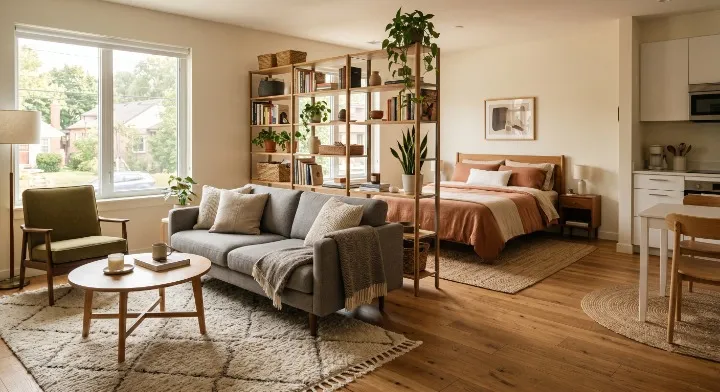
You reached it by climbing a steep, narrow staircase that turned sharply at the halfway point, completely cutting off your line of sight to the ground floor. At the top of the stairs, a long hallway stretched into the dark. On the left was the massive bedroom Luke and I shared—the widow’s former living room. Straight ahead was a clawfoot bathtub in a drafty, tiled bathroom. On the right, perfectly preserved, was the widow’s spare kitchen and a small, empty guest bedroom.
My parents never ripped out the spare kitchen. The peeling floral linoleum, the disconnected gas stove, and the rusted enamel sink sat in perpetual shadow, directly across the hall from where we slept. The air up there always felt different from the rest of the house. It was stale, holding a trapped, dry heat that tasted faintly of old wallpaper paste and dried lavender.
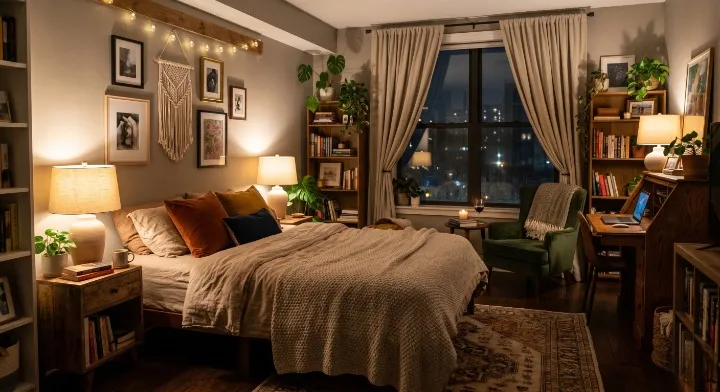
The bedroom itself was too large. It swallowed the light from the single overhead fixture. On opposite sides of the room were two deep, parallel crawl-in closets. They didn’t have standard doors. They were low, rectangular cutouts in the drywall that extended far back into the eaves of the roof. We used them to store a mountain of plastic toys, board games, and outgrown clothes.
Looking back into those dark, sloping voids always made my stomach drop.
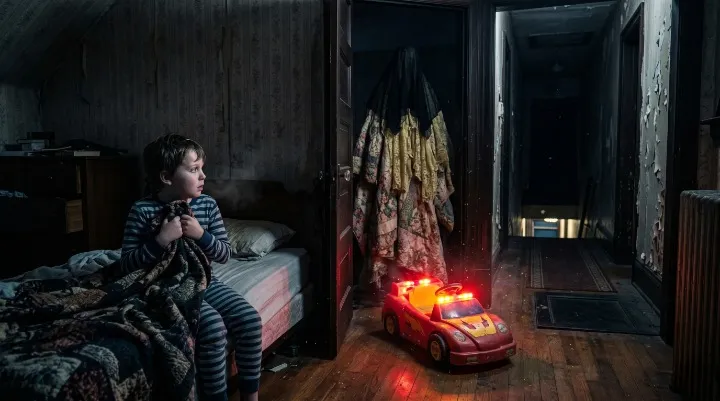
Among the clutter was a plastic race car. It was a cheap, heavy, battery-operated hand-me-down from Luke. It featured a row of rigid plastic buttons on its roof. When pressed, an internal speaker would emit a burst of heavily distorted, static-laced audio—the screech of tires, a revving engine, or a tinny, ten-second loop of synthesized rock music. Simultaneous with the audio, bright red and yellow LEDs mounted in the chassis would flash in a rapid, blinding strobe sequence.
It was an obnoxious, abrasive object. We hadn’t played with it in years. It sat buried in the back of the right-side closet, slowly gathering dust.
Until the first night it woke us up.
The Strobe
It was late November. The radiators clanked and hissed, fighting the bitter cold radiating off the single-pane windows.
Luke and I were in our respective twin beds, separated by a wide expanse of braided rug. I was awake, staring at the ceiling, listening to the wind rattle the glass.
Without a single precursor, the silence shattered.
VROOOOM. SCREEECH.
The distorted, deafening sound of the electronic engine revving exploded from the absolute center of the bedroom.
Simultaneously, the harsh red and yellow LEDs ignited. They flashed in a rapid, frantic strobe sequence, throwing violent, erratic shadows against the walls and the ceiling. The cheap speaker buzzed with static as the toy cycled through its pre-programmed audio sequence.
I vaulted upright, pulling my blanket tight against my chest. The flashing lights illuminated the plastic chassis of the race car, sitting perfectly still in the dead center of the braided rug.
My heart hammered against my ribs. I couldn’t process how it had gotten out of the closet. I couldn’t process what had pressed the rigid plastic button.
From the other side of the room, Luke burst into laughter.
It was a loud, mocking sound. He sat up in his bed, pointing at me through the strobing red light.
“Look at your face!” he wheezed, throwing a pillow at me. “You look like you’re going to cry!”
“I didn’t do it!” I yelled, my voice cracking with genuine panic. “How did it turn on?”
“You probably kicked it out of the closet earlier and the battery is dying,” Luke dismissed, wiping his eyes. He climbed out of bed, walked to the center of the room, and kicked the plastic toy roughly.
The audio cut out. The lights died. The bedroom plunged back into the heavy, suffocating dark.
“Go to sleep, baby,” he muttered, climbing back under his covers.
I lay back down. I didn’t sleep. I kept my eyes locked on the dark shape of the car sitting on the rug until the sun came up.
The Relocation
A few weeks passed. The incident faded, filed away by my brain under the fragile category of mechanical failure.
Then came the thud.
It happened at 2:00 AM. A heavy, blunt impact against the floorboards, loud enough to rattle the picture frames on the walls.
I jolted awake. Luke sat up at the exact same moment. The ambient hum of the house was completely dead. We sat in the pitch black, listening.
Click.
The tinny, synthesized rock music began to blare.
But it wasn’t coming from the center of the room. It was coming from the deep, far corner of the bedroom, tucked closely beside the opening of the left-side crawl space.
The red and yellow LEDs strobed wildly, casting long, distorted shadows of the bedframes against the opposite wall.
“Luke,” I whispered, the fear seizing my throat, turning the word into a dry rasp. “Make it stop.”
Luke didn’t laugh this time. He sat rigidly in his bed, staring at the flashing lights. He tried to project an air of superiority, but I could hear the tremor in his voice.
“There’s a ghost in the room,” he whispered back, clearly trying to scare me to mask his own unease.
It worked. The sheer terror of the flashing lights in the dark, combined with the heavy thud, broke my remaining composure.
I scrambled out of bed, hit the hardwood floor, and bolted.
I sprinted down the long, dark hallway, ignoring the open doorway of the spare kitchen, and threw myself down the steep stairs. I hit the ground floor and ran directly into my parents’ bedroom, sobbing hysterically.
My mother sat up, alarmed. My father threw off the covers, his face hardening with immediate exhaustion and irritation.
I babbled about the noise, the thud, and the lights turning on by themselves.
My father sighed heavily, grabbed a flashlight from his nightstand, and marched up the stairs. I followed closely behind my mother, refusing to go up alone.
When we reached the top floor, my father hit the overhead light.
The bedroom was painfully bright. The toy car sat in the far corner, silent and dark. Luke was sitting on his bed, looking defensive.
“Knock it off, Luke,” my father said sharply, pointing the flashlight at him. “Stop scaring your brother.”
“I didn’t touch it!” Luke protested immediately. “I was in bed! How could I press the button from across the room?”
“I don’t care,” my father snapped. “Both of you, go to sleep. If I have to come up here again, the toy goes in the garbage.”
He turned off the light and walked back down the stairs. My mother kissed my forehead, told me it was just my imagination, and followed him.
I climbed back into bed. The room felt immense, cold, and entirely unsafe. My parents had offered no protection. They had simply applied logic to an illogical room, leaving me to survive the rest of the night with the object still sitting in the corner.
The Surrender
Two months later, Luke was invited to a weekend sleepover.
For the first time since we moved upstairs, I had the massive, echoing bedroom entirely to myself.
Without the physical presence of my brother—without the sound of his breathing, the shifting of his mattress, or the buffer of another human body—the top floor felt alien. The sheer volume of empty space surrounding me was crushing. The silence was absolute, a heavy pressure ringing against my eardrums.
I had long since taken the plastic race car and buried it in the spare kitchen across the hall. I had shoved it under the rusted enamel sink, hiding it behind a stack of empty cardboard boxes, entirely out of sight.
My mother tucked me in at 9:00 PM.
Before she left, I grabbed her wrist. I begged her not to close the door. I needed the visual connection to the hallway. I needed to see the sliver of light filtering up from the staircase.
She smiled sympathetically, kissed my cheek, and left the heavy wooden door wide open.
I rolled onto my side, pulling the blankets up to my chin. I stared out the open doorway. From my pillow, I had a direct line of sight down the dark hallway, straight past the open archway of the spare kitchen.
The house settled. The hours dragged on. I lay perfectly still, my eyes burning, refusing to close them.
At exactly 1:15 AM, the temperature on the top floor plummeted.
The dry, trapped heat evaporated, replaced instantly by a freezing, heavy draft that smelled overwhelmingly of camphor, dried lavender, and embalming fluid. It was the sharp, medicinal stench of old decay.
Then, I heard the noise.
It originated from the spare kitchen across the hall.
It was a slow, heavy rustling. It didn’t sound like footsteps. It sounded like an immense weight of thick, damp upholstery fabric dragging across the peeling linoleum floor.
Shhhhk. Shhhhk.
The sound moved from the kitchen archway and out into the dark hallway.
My lungs locked. The oxygen in the room felt entirely depleted. I couldn’t move. My gaze was fixed permanently on the open doorway of my bedroom.
A sharp, mechanical click echoed in the silence.
VROOOOM. SCREEECH.
The synthesized, distorted audio of the toy race car exploded in the hallway.
The harsh red and yellow LEDs ignited, casting frantic, spinning strobe lights against the hallway drywall.
The toy car did not sit still.
I watched, completely paralyzed by a cold, blinding terror, as the plastic race car rolled slowly forward. It moved with deliberate, even pacing, the small plastic wheels turning smoothly against the hardwood floor.
It rolled out of the hallway shadows, crossed the threshold of my bedroom, and stopped dead in the center of the doorway.
The lights flashed violently, illuminating the hallway behind it.
The Matriarch
The toy hadn’t moved on its own.
Something had pushed it.
Looming in the dark hallway, directly behind the flashing plastic toy, was a towering, impossible mass.
It did not possess the anatomy of a human being. It was a suffocating, hulking silhouette draped entirely in layers of heavy, rotting floral quilts and yellowed, moth-eaten lace. The fabrics were draped haphazardly over an immense, hunched bulk, trailing heavily on the hardwood floor.
The stench of camphor and stale medicine poured off it in waves, thick enough to taste.
It didn’t stand on legs. The bottom of the mass was just a pooling mound of decaying textiles.
Slowly, an appendage emerged from the folds of the heavy quilts.
It was an arm, thick and swollen, bound tightly from the elbow to the fingertips in soiled, yellowed medical gauze. The bandages were stained with old, dark fluids. The limb moved with a stiff, hydraulic slowness, extending downward toward the toy car.
The bandaged hand rested gently on the roof of the plastic car, the wrapped, bulbous fingers covering the rigid buttons.
It had pushed the toy down the hall. This towering, rotting mass of fabric and decay had been playing with the car, rolling it into my room like a grotesque mockery of a child.
The entity slowly raised its head.
It wore a wide-brimmed, black mourning hat, draped in a heavy veil of thick black mesh. But the veil didn’t cover a face.
Behind the mesh, there was only a deep, sunken concavity. The fabric of the veil was sucked inward with every rattling, wheezing breath it took, revealing a terrifying, hollow void filled entirely with shifting, gray dust. Where eyes should have been, two dull, tarnished brass buttons were sewn directly into the fraying fabric of the void, catching the frantic, strobing red flashes of the toy car’s LEDs.
The entity didn’t step into the room. It simply lingered in the doorway, its bandaged hand resting on the toy, its brass-button eyes locked onto my paralyzed form in the bed.
It exhaled. A cloud of fine, gray dust plumed from behind the mourning veil, drifting into my bedroom and settling onto the carpet.
The sheer wrongness of its existence—the suffocating weight of its grief, its age, and its rotting stagnation—pressed against my brain like a physical vice. It wasn’t there to attack me. It was simply claiming the space. It was occupying the top floor, asserting its terrifying permanence in the dark.
The paralysis finally snapped.
The Fracture
I screamed.
It was a raw, deafening shriek that tore my vocal cords and echoed violently against the acoustic ceiling. I kicked the blankets away, scrambling backward until my spine slammed hard against the headboard, pulling my knees to my chest, screaming continuously without drawing breath.
The brass buttons fixed in the dark void of the veil didn’t blink. The heavy, bandaged hand slowly pulled back, retreating into the rotting floral quilts.
The mass of fabric simply seemed to fold inward, collapsing seamlessly into the shadows of the hallway as the heavy thud of my father’s footsteps hammered up the wooden stairs.
The overhead light flicked on, flooding the bedroom with blinding yellow light.
My father burst into the room, chest heaving, his eyes scanning wildly for an intruder. My mother was right behind him, pushing past him to rush to my bed. She wrapped her arms around my shaking shoulders, pulling me tight against her chest.
I couldn’t speak. I could only point a trembling, rigid finger at the open doorway.
The plastic race car sat perfectly still on the threshold, its red and yellow lights still strobing, the tinny rock music buzzing through the cheap speaker.
My father stared at it. He looked down the empty hallway. He checked the bathroom. He checked the spare kitchen.
He found nothing. No draft, no open windows, no intruder.
But as he walked back to the doorway, he stopped. He looked down at the toy car. He looked at the floorboards leading from the spare kitchen to the threshold. He didn’t speak, but his jaw tightened. The anger in his posture vanished, replaced by a sudden, rigid tension.
He saw what I saw. He saw the thick, undisturbed layer of fine gray dust coating the hardwood. He smelled the overwhelming, undeniable stench of camphor and embalming fluid lingering heavily in the air.
He didn’t yell at me. He didn’t tell me it was my imagination.
He bent down, grabbed the plastic race car by the chassis, and walked downstairs.
I heard the heavy, metallic clang of the outdoor trash can lid slamming shut in the backyard.
I slept in my parents’ bed that night. A week later, my father moved my twin mattress down to the ground floor, converting a small office into my new bedroom. We never spoke about the decision. We never spoke about the smell, or the dust, or the car.
But the silence was a confirmation.
The top floor belonged to the house. The boundary had been drawn. And I learned, with absolute, terrifying certainty, that not every space we occupy is truly empty when the lights go out.