
The Anchor
The cherry of the cigarette burned a fierce, solitary orange against the heavy backdrop of the 3:00 AM dark.
I leaned my forearms against the wrought-iron railing of my second-story balcony. The metal was damp, coated in a fine, sticky layer of summer humidity that never quite burned off during the day. I took a slow drag, pulling the harsh, dry smoke deep into my lungs. I held it there, letting the nicotine act as a temporary chemical anchor, before exhaling a thin gray plume out into the stagnant air.
My therapist called the smoking a secondary symptom of the insomnia. She told me I was using the ritual to manually segment hours that otherwise blurred into a single, exhausting continuum.
She wasn’t wrong. When you routinely pass the seventy-two-hour mark without entering REM sleep, the waking world loses its density. Reality becomes a paper diorama. The neighborhood I lived in—a wealthy, secluded subdivision where houses sat on sprawling, isolated quarter-acre plots—only amplified the dissociation. By midnight, the entire grid shut down. There was no traffic, no ambient city noise, no movement. It was an environment designed entirely for rest, which only made my inability to achieve it feel like a profound biological failure.
I flicked a column of gray ash over the railing. It drifted down, disappearing into the manicured shrubs below.
I looked across the property line.
My neighbor’s house was a heavy, slate-gray colonial. He lived alone. In the two years I had occupied my house, I had never spoken a word to him, never seen a guest walk up his driveway, and never seen a piece of mail in his hands. His routine was marked only by the navy blue BMW permanently parked on his asphalt.
Except for the last four nights.
For the last four nights, a matte-black utility van had been parked directly behind the BMW. It bore no commercial logos. The rear windows were completely blacked out with interior metal grating. Its presence was a deviation. In my sleep-starved state, that minor deviation had become a fixation.
I took another drag of the cigarette. The tip flared.
The motion-sensor floodlight above my neighbor’s garage suddenly clicked on, casting a conical beam of harsh white LED light over the driveway.
The heavy front door of the colonial opened. My neighbor stepped out.
He was wearing thick canvas coveralls and heavy rubber industrial gloves that reached his elbows. He didn’t look up at the moon. He didn’t stretch. He turned back into the doorway, bent his knees, and hoisted a long, heavy object over his shoulder.
It was wrapped tightly in an industrial black tarp, secured at intervals with bands of silver duct tape. It was roughly the length of a golf bag, but the physics of how he carried it betrayed its density. His spine curved under the weight. The thick rubber soles of his boots dragged slightly against the concrete porch. Whatever was inside the tarp was dead weight, heavy enough to strain the ligaments in his neck.
He walked to the back of the utility van. He reached out with one heavily gloved hand, turned the handle, and pulled the rear door open.
He hefted the black bag inside. The heavy suspension of the van groaned audibly, the chassis dipping a full inch toward the asphalt as the cargo hit the metal floorboard.
He slammed the door shut. He walked around to the driver’s side, climbed in, and turned the ignition. The engine idled low and rich. He shifted into gear and rolled slowly down the driveway, the tires crunching softly against the gravel shoulder before turning onto the main road.
I stood on the balcony. The cigarette burned down to the filter, the heat singing the calluses on my index finger.
I dropped the butt onto the concrete and crushed it beneath my heel.
The Transit
I didn’t debate the ethics of following him. The rational part of my brain—the part that weighed risks, understood boundaries, and feared consequences—was dormant, buried under layers of sleep deprivation. I was operating on a desperate, hollow need for a narrative. I needed something solid to anchor my drifting reality. The heavy tarp, the dead of night, the deviation in the routine—it was a thread, and my numbness demanded I pull it.
I went downstairs, grabbed my keys off the kitchen island, and stepped out into the humid night.
I got into my sedan. I didn’t turn on the headlights. I shifted into drive and let the car roll slowly down my driveway, coasting on the idle until I reached the main street. I flicked the headlights onto their lowest setting and accelerated.
The red glow of the utility van’s taillights was a quarter-mile ahead, turning sharply onto County Road 9.
I kept my distance, allowing the darkness to swallow the space between us. I drove with the windows rolled down. The hot wind rushing through the cabin drowned out the sound of my own tires.
We drove for twenty minutes. The manicured lawns and identical streetlights of the subdivision rapidly gave way to the unlit perimeter of the state forest. The trees closed in on both sides of the asphalt, their heavy branches creating a dark, suffocating canopy that blocked out the stars.
The red taillights ahead of me suddenly blinked out.
He hadn’t turned the van off. He had veered off the paved road entirely.
I slowed down, the brake pads squealing softly. I pulled the steering wheel to the right, easing my tires onto a narrow, deeply rutted dirt path cut straight into the tree line. The path hadn’t been graded in decades. Heavy, overgrown brush scraped loudly against the passenger-side doors.
I killed my headlights entirely.
I drove by the pale, ambient moonlight filtering through the pines, my tires crawling over exposed roots and deep washouts. The air coming through the windows shifted. The scent of pine needles gave way to a sharp, metallic odor. It smelled like old asphalt and oxidized iron.
The dirt path widened, emptying into a massive, unnatural clearing in the woods.
I eased the brake pedal down, bringing the car to a silent stop behind a thick wall of overgrown blackberry bushes. I shifted into park and cut the engine.
The Breach
I opened the car door, keeping my hand pressed firmly against the latch so it wouldn’t click. I stepped out onto the dirt.
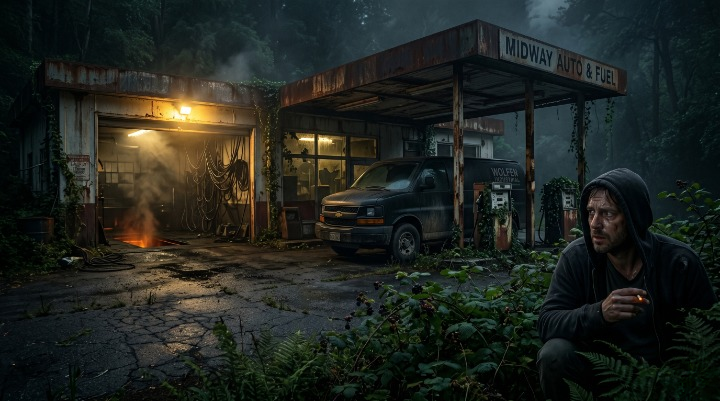
The clearing was dominated by an abandoned, mid-century gas station.
It was a decaying monument to a forgotten highway infrastructure. The skeletal remains of an aluminum awning stretched over two heavy, rectangular fuel pumps. The glass on the analog dials was shattered. Thick, aggressive vines of poison ivy had swallowed the concrete support pillars, pulling the structure slowly back into the earth.
The main building was a square block of cinderblock and grimy, wire-reinforced glass.
Parked directly under the rusted awning, facing the garage bays, was the black utility van. The driver’s side door was open. My neighbor was gone.
I left the cover of the blackberry bushes. I walked with agonizing, deliberate care, placing the soft rubber soles of my shoes only on patches of bare dirt, avoiding the dry, brittle leaves and the scattered debris of broken bottles.
The silence out here was not peaceful. It felt like an evacuation. There were no crickets. There were no frogs in the drainage ditches. The entire ecosystem seemed to have retreated from the clearing.
I reached the rusted fuel pumps. The smell of raw, ancient gasoline was overpowering, rising up from the cracked concrete pad. It burned the back of my throat, mixing with a deeper, sweeter stench that I couldn’t immediately identify.
I stepped up onto the raised concrete curb surrounding the main building.
The large, plate-glass windows of the storefront were caked in decades of grime, dust, and dried algae. I couldn’t see inside. The darkness beyond the glass was impenetrable.
I pressed my face against the pane, cupping my hands around my eyes to block out the moonlight.
Nothing. Just the vague, shadowy outlines of collapsed shelving units and an overturned counter.
I needed to see the back room. The compulsion was no longer just curiosity; it was a physical weight in my chest. I walked around the side of the building, my hand trailing along the rough cinderblock.
I stopped at a smaller, reinforced security window near the rear garage bays. The glass here was entirely opaque with dirt.
I looked down at my feet. Lying in the weeds near the foundation was a heavy, rusted iron bolt, likely dropped from the awning decades ago. It was the size of a railroad spike.
I picked it up. The oxidized metal was rough and abrasive against my palm.
I looked at the window. The rational mind screamed at me to drop the bolt and walk away. But the rational mind felt miles away, buried under a week of sleepless fog. I needed a conclusion to the night. I needed an anchor.
I swung the iron bolt forward.
CRASH.
The reinforced glass spider-webbed, held together for a fraction of a second by the internal wire mesh, before caving inward with a deafening, shattering cascade. The heavy shards hit the concrete floor inside with a sound like breaking ice.
I took a step back, dropping the iron bolt, waiting for the piercing, electronic shriek of a security alarm. I waited for my neighbor to come sprinting out of the back room.
Neither happened.
The Parasite
Instead, a sound began to build from directly beneath the cracked concrete foundation of the gas station.
It wasn’t a mechanical siren. It was a low, resonant, tectonic rumble. It vibrated through the soles of my shoes, traveling up the bones of my legs. It sounded like the agonizing groan of a massive steel hull buckling under deep-sea pressure.
Then, the true smell of the station hit me.
The odor of old gasoline vanished, entirely consumed by a sudden, suffocating stench of boiling crude oil, burning rubber, and rotting marrow. It was a dense, physical wave of putrescence that immediately caused my eyes to water and my stomach to violently contract.
Something was moving inside the garage bay.
I didn’t run. The primal shock locked my feet to the concrete curb. I stared through the jagged, broken hole in the security window.
A wave of blistering, suffocating heat poured out through the broken glass, pressing against my face. It felt like standing before an open industrial furnace.
The darkness inside the room began to shift.
It didn’t step into the moonlight. It poured into it.
The entity was a colossal, asymmetrical mass of industrial decay and corrupted biology. It possessed no discernible limbs, no face, no recognizable earthly anatomy. It was a towering, undulating mound of hardened, brittle black carbon and raw, pulsing, exposed tissue.
It moved by displacing its own massive, heavy bulk across the floor, the hardened carbon plates of its exterior scraping loudly against the concrete.
Embedded deep within the shifting, oily black flesh were the digested remains of the environment it had consumed over the decades. Rusted license plates, jagged shards of safety glass, and twisted tangles of steel rebar jutted out of its mass like metallic tumors. It looked as though the subterranean fuel tanks beneath the station had somehow grown a pulse, mutating the earth and the architecture into a living, parasitic organism.
Protruding from the upper ridge of its shifting torso were dozens of thick, frayed steel cables. They writhed and whipped through the air with violent, autonomous energy, acting as heavily sensitized antennae. They sparked faintly as they brushed against the metal doorframes.
The mass dragged itself toward the broken window.
Thick, viscous, jet-black oil wept continuously from the deep fissures in its carbon plating, leaving a heavy, staining slick on the floor behind it. The concrete hissed and steamed where the fluid landed.
It reached the cinderblock wall. The mass surged upward, lifting a section of its body to the level of the shattered window.
A vertical fissure split open in the center of its bulk.
It wasn’t a mouth. It was a jagged, tearing fault line lined with hundreds of rusted iron bolts, broken spark plugs, and shattered glass fragments serving as crude, grinding implements.
The fissure opened wide, releasing another blast of blistering heat. The cables on its back whipped violently. It let out a sound—a deafening, mechanical screech that perfectly mimicked the sound of sheet metal tearing in a high-speed collision.
It had felt the sudden change in air pressure from the broken glass. It was searching for the breach.
My lungs were entirely empty. I stood frozen on the other side of the wall, inches from the grinding, rusted fault line. A single drop of the hot, black oil splashed through the broken window, landing on the toe of my shoe. It burned through the canvas instantly, searing the skin beneath.
I bit down on the inside of my cheek, the sharp, metallic taste of my own blood keeping me from screaming.
Through the broken glass, deeper inside the station, a harsh, yellow halogen work light suddenly clicked on.
My neighbor walked into the garage bay.
He wasn’t holding a weapon. He wasn’t running. He walked with a calm, practiced, entirely deferential posture.
He was carrying the heavy black tarp over his shoulder.
The entity’s frayed steel cables instantly snapped toward him. The grinding, metallic screech died down, replaced by a low, eager, vibrating thrum that shook the dust from the ceiling tiles.
My neighbor walked directly up to the undulating mass of carbon and oil. He didn’t flinch against the blistering heat or the suffocating stench.
He unzipped the heavy industrial tarp.
He gripped the bottom edge and tilted it upward.
A massive, heavy pile of raw, butchered meat—whole deer carcasses, judging by the crushed antlers and the sheer volume of the blood—slid out of the tarp and hit the concrete floor with a heavy, wet slap.
The entity descended upon it.
The mass of carbon and rusted metal collapsed over the pile. The jagged, glass-lined fissure opened and clamped down. It didn’t bite or chew. It simply ground the bone and the meat into a dark, liquid paste, absorbing the organic matter directly into its oily bulk. The sound of crushing bone mixed with the hiss of boiling oil.
My neighbor took a step back, folded the empty tarp neatly over his arm, and watched it feed.
He was the caretaker. He was keeping the subterranean parasite tethered to the abandoned fuel tanks.
The Withdrawal
I didn’t sprint for the tree line.
Panic is loud. Panic kicks up gravel and breaks dry branches.
I engaged a deep, cold, absolute detachment. My survival depended on executing a series of perfect, microscopic movements.
I slowly shifted my weight backward, lifting my right foot. I stepped off the raised concrete curb, placing the sole of my shoe onto the dirt with agonizing care. I didn’t break eye contact with the broken window until I was ten feet away from the building.
I turned my body. I walked back toward the overgrown blackberry bushes.
Every step was calculated. I kept my breathing shallow, inhaling only through my nose to muffle the sound of my own lungs. The heavy, wet sounds of bone grinding against rusted iron echoed from the station, masking the faint crunch of the dirt beneath my feet.
I reached my sedan.
I opened the driver’s side door, easing the handle up to prevent the metal latch from clicking. I slid into the seat. I kept the door slightly ajar, avoiding the loud, percussive slam of shutting it.
I inserted the key into the ignition. I didn’t turn it all the way. I turned it just enough to unlock the steering column. I shifted the car into neutral.
I opened the door, stepped out, and placed my hands flat against the A-pillar. I pushed.
The heavy sedan rolled slowly backward, the tires compressing the soft dirt. I pushed the car fifty yards down the dark, rutted path, putting a dense wall of pine trees between my vehicle and the clearing. My shoulder ached, sweat stinging my eyes.
When the station was entirely out of sight, I climbed back into the driver’s seat. I pulled the door shut. I turned the ignition. The engine fired, a low, quiet hum.
I didn’t turn the headlights on until I reached the paved asphalt of County Road 9.
I drove home in absolute, unbroken silence.
The Inheritance
The morning sun broke over the subdivision, burning off the sticky summer humidity.
I was standing on my balcony. I had not slept. I was wearing the exact same clothes. The burn mark on my canvas shoe was hard and black.
I held a fresh cigarette between my fingers. The cherry glowed orange in the daylight.
Down below, the quiet of the cul-de-sac was broken by the arrival of three heavily marked police cruisers. They pulled aggressively into my neighbor’s driveway, boxing in the navy blue BMW.
Six officers stepped out. They didn’t knock. They used a heavy steel ram to breach the front door of the colonial.
Ten minutes later, they dragged my neighbor out onto the driveway. He was in handcuffs. He didn’t struggle. He didn’t yell. His face was entirely blank, his eyes staring straight ahead at the asphalt as they pushed him into the back of a cruiser.
An investigator stood by the trunk of the BMW, speaking into a radio. I didn’t need to hear the frequency to know what had happened. My 911 call from a burner phone three hours ago had been highly specific regarding the location of the missing hikers in the county. I hadn’t mentioned the gas station. I had only mentioned the colonial.
The police cars backed out of the driveway, their sirens silent, and drove away. They left the heavy front door of the house splintered and wide open.
I stood on the balcony, watching the empty driveway.
I took a slow drag of the cigarette. The smoke filled my lungs, grounding me.
The police had arrested a serial killer. They believed they had solved a problem. They believed they had removed a monster from the ecosystem.
They didn’t know about the black utility van still parked out in the woods. They didn’t know about the abandoned gas station, or the cracked foundation, or the heavy, rusted fuel tanks beneath the concrete.
I looked down at the gray ash accumulating on the tip of my cigarette.
The caretaker was gone. The parasite was currently digesting its final delivery.
In a week, the meat would be gone. In a week, the towering mass of carbon, oil, and rusted metal would drag its immense bulk out of the garage bays. The frayed steel cables would whip the air, tasting the wind, searching for a new source of protein. It wouldn’t stay in the woods. It would follow the scent of the van back to the subdivision.
I flicked the ash over the railing.
I didn’t feel the crushing, numb exhaustion of my insomnia anymore. The apathy was gone. For the first time in months, my mind was entirely clear, focused, and still.
I turned around, walked back into my house, and picked up my car keys from the kitchen island.
I had to go to the hardware store. I needed to buy thick rubber industrial gloves, a roll of silver duct tape, and heavy canvas tarps.
Someone had to keep it fed.