The Currency of Secrets
The air inside the Tap House tasted of stale yeast, spilled lime juice, and damp sawdust.
It was a Tuesday night, which meant the crowd was thin and the ambient noise was manageable—just the low, thudding bass of the jukebox and the sharp, echoing crack of billiard balls colliding. I stood at the edge of the green felt table, rolling a piece of blue chalk over the leather tip of my pool cue. The chalk dust coated the creases of my palms, dry and abrasive.
I was nineteen, a sophomore, and nominally a brother of the Pike fraternity. On paper, my life was exactly what it was supposed to be. In reality, a hollow, echoing exhaustion had been hollowing out my chest for months. The fraternity basement parties, the forced camaraderie, the endless, mechanical pursuit of girls I didn’t actually want to talk to—it had all turned into a heavy, suffocating script. I was playing a role, terrified that if I stopped reciting my lines, the people around me would realize there was absolutely nothing underneath.
I took a sip of my tequila. It was cheap, burning a hot, chemical trail down my esophagus. I checked my phone. The screen illuminated my face in the dim bar lighting.
Yel: Just parked. Walking in.
I had matched with her on Tinder three days ago. Her profile was sparse—three photos, heavy eyeliner, no bio. I didn’t care. I just needed the validation of the transaction. I needed someone to sit across from me and prove that I existed.
The heavy wooden door of the bar pulled open, letting in a brief rush of damp California night air. She walked in.
She was shorter than her photos suggested, wearing a heavy black leather jacket over a thin slip dress. Her dark hair was pulled back tightly. She didn’t scan the room with the hesitant, nervous energy of a blind date. Her eyes locked onto me immediately, flat and entirely devoid of anxiety.
She walked over, pulling a high wooden stool out from the high-top table next to the pool rack.
“You’re early,” she said. Her voice was surprisingly low, lacking the upward inflection I was used to hearing.
“You’re late,” I replied, forcing the easy, arrogant smirk I had practiced in the mirror for years. I set the pool cue down. “Tequila?”
“Double,” she said, resting her forearms on the sticky wood of the table.
We drank. We didn’t play pool. The conversation was stilted, lacking the usual getting-to-know-you rhythm. She didn’t ask about my major, my fraternity, or my hometown. She just drank, matching me shot for shot, her eyes tracking the microscopic movements of my face. The alcohol hit my bloodstream quickly, blurring the edges of my peripheral vision and wrapping my brain in a thick, warm layer of cotton.
At some point, the physical distance between us collapsed. We were sitting side-by-side on the heavy wooden bench of a corner booth. The leather upholstery was cracked and peeling, scratching against the back of my neck.
“Give me your phone,” she said.
She didn’t wait for an answer. She reached out, her cool, dry fingers brushing against my palm, and pulled the device from my grip. She unlocked it—I had carelessly typed my passcode in front of her twice already—and opened the Instagram app. She typed her own handle into the search bar, tapped the follow button, and tossed the phone back onto the table.
It landed with a sharp clatter. The screen stayed illuminated.
My phone vibrated. A direct message notification dropped down from the top of the screen.
I looked at it, the alcohol slowing my processing speed. It was from her account.
I opened the message. It was a photo. Explicit, brightly lit, and highly compromising.
I blinked, the tequila making my eyes heavy. I looked up at her. She was sitting three inches away from me, her thigh pressing against mine. She hadn’t taken the photo in the bathroom. It was pre-loaded. Prepared.
“Your turn,” she said.
The rational part of my brain—the part that understood digital permanence, risk, and basic self-preservation—was deeply submerged under six shots of cheap liquor. The hollow part of my chest, the part desperate for validation, took the wheel.
I didn’t question the bizarre, clinical nature of sitting next to a woman in a bar and exchanging digital pornography instead of speaking. I lifted the phone. I took the photo. I pressed send.
She looked at her screen. A slow, thin smile stretched across her face. It didn’t reach her eyes.
“My place,” she said.
The Transit
The interior of the Uber smelled intensely of artificial pine air freshener and old cigarette smoke.
I rested my head against the cold glass of the passenger window. The neon lights of the college bars streaked past, bleeding into long, smeared lines of color. The further we drove, the darker the streets became. The manicured lawns and bright streetlamps of the university bubble gave way to the heavy, industrial shadows of deep Oakland.
Chain-link fences topped with razor wire rolled past. Blocky, windowless warehouses sat in absolute darkness. The transition in the environment was stark, but the alcohol kept my anxiety perfectly anesthetized.
Yel sat on the opposite side of the backseat. She hadn’t spoken a single word since we got into the car. She was staring straight ahead, her hands folded neatly in her lap. The predatory, intense energy from the bar had entirely evaporated, replaced by a rigid, mechanical stillness.
The car pulled to a stop in front of a narrow, three-story brick apartment building. The street was a dead zone. The streetlights had been shot out or burned out long ago.
We got out. The heavy thud of the car doors slamming echoed off the brick facades. The Uber accelerated away instantly, its taillights disappearing around the corner, taking the only source of illumination with it.
Yel walked up the cracked concrete steps to the front door. She didn’t look back to see if I was following.
She pulled a heavy brass key from her jacket pocket, slid it into the lock, and pushed the door open.
The Deadbolt
I followed her over the threshold.
The hallway inside was pitch black. The air was incredibly dense, tasting of old copper pipes, stale sweat, and damp carpeting.
“Can you hit a light?” I slurred slightly, my shoulder bumping heavily against the drywall.
Yel didn’t answer. She simply stepped aside, moving smoothly into the shadows to my right.
I took two more steps into the apartment.
Behind me, the heavy wooden door slammed shut. The sound was deafening in the enclosed space. A heavy, industrial deadbolt slid into place with a brutal, metallic CLACK.
The ambient noise of the street was instantly severed.
A sharp, brilliant white light flared to life directly above my head.
The sudden illumination burned my dilated pupils. I threw my hands up, squinting through the harsh glare. The alcohol haze evaporated in a fraction of a second, burned away by a massive, blinding surge of pure adrenaline.
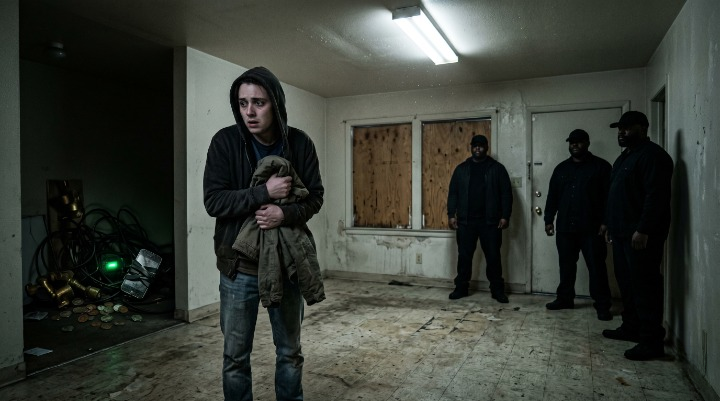
I wasn’t in a hallway. I was in the center of a wide, barren living room. There was no furniture. The windows were entirely boarded up with thick sheets of unpainted plywood, secured with heavy steel lag bolts.
Yel was gone. She had slipped out a secondary door that was now closed.
I was not alone.
Three men stood in a semicircle, blocking the path back to the front door.
They were massive. They didn’t possess the inflated, cosmetic bulk of gym lifters; they possessed the dense, heavy architecture of men who did manual labor and understood violence. Two of them wore ribbed white tank tops, their arms covered in heavy, faded black ink. Their heads were shaved to the skin. They stood with their arms crossed, their faces completely devoid of expression.
The third man stood in the center. He wore a faded denim jacket. He had a thick, dark beard and deep-set eyes that carried a terrifying, unblinking calm.
I froze. The saliva in my mouth dried instantly. My brain frantically tried to map the room, searching for an exit, a weapon, a mistake. There was nothing. I was boxed in.
“Phone,” the bearded man said. His voice was a low, gravelly rasp.
He didn’t yell. He didn’t raise his hands. He simply held out his right palm.
I didn’t argue. I didn’t try to fight. The sheer physical reality of the three men overwhelmed any cinematic fantasies of resistance. I reached into my pocket with trembling fingers, pulled out my phone, and placed it onto his open palm.
“Wallet. Keys,” he commanded.
I handed them over. The two men behind him stepped forward, their heavy boots thudding against the linoleum. They patted down my pockets with rough, invasive efficiency, checking my socks and my waistband. Finding nothing else, they stepped back.
The bearded man tapped the screen of my phone. He looked at me, raising a single eyebrow.
I gave him the passcode. My voice was a weak, pathetic croak.
He unlocked the device. He didn’t search through my contacts. He didn’t look at my banking app. He opened the Instagram messages. He pulled up the photos from the bar.
He turned the screen around, showing me the explicit image I had sent thirty minutes ago.
“Elena,” the bearded man said slowly, his voice echoing in the barren room, “is seventeen years old. She celebrates her eighteenth birthday in four months.”
The floor seemed to drop out from underneath my feet. The oxygen was sucked from the room. A cold, suffocating weight crushed my chest.
“That makes this,” he tapped the glass of the screen, “a felony. The kind of felony that puts a college boy in a concrete box for a decade. The kind that makes the evening news. The kind that ruins a family name.”
“I didn’t know,” I choked out, the panic rising in my throat like bile. “I swear to God, she didn’t tell me.”
“Ignorance is not an affirmative defense,” he replied smoothly. He lowered the phone. “But we are not the police. We are businessmen. And you are going to open a new market for us.”
He reached into the pocket of his denim jacket. He pulled out a small, heavy ziplock bag filled with a dense, white powder. He tossed it. It landed heavily at my feet.
“You are going to distribute our product to the Pike house, and then to the rest of the Greek row,” he said. “You will be our sole point of contact. You will move the weight, and you will bring us the cash. If you refuse, if you go to the police, or if you attempt to leave the university… Elena’s age, and your photographs, will be sent to the local precinct, the university dean, and your mother.”
I stared at the bag on the floor. I was trapped. It was a perfect, inescapable snare.
“Now,” the bearded man said, stepping to the side. “We need to make the contract binding. You need to meet the Auditor.”
The Auditor
When the bearded man shifted his weight, he revealed the far, dark corner of the room that my panicked eyes had skipped over.
Sitting in the shadows, resting on a reinforced steel industrial chair, was a fourth figure.
I hadn’t noticed it because it hadn’t taken a breath. It hadn’t shifted its weight. It lacked the microscopic, continuous movements of a living organism.
The bearded man walked over to the corner, holding my unlocked phone. He held it out, offering it to the shadow.
The entity sitting in the chair leaned forward into the harsh, overhead light.
My vocal cords paralyzed. My mind violently rejected the visual input, trying to shatter the image into something comprehensible.
It was roughly the shape and size of a massive, broad-shouldered man, but it possessed no biological flesh. It was constructed entirely out of heavy, tarnished currency and oxidized metal. Thousands of rusted copper coins, blackened silver pieces, and bent brass keys were woven together by thick, weeping strands of raw, red muscle tissue.
The muscle pulsed sluggishly, pushing a thick, black fluid between the gaps in the metal coins. It smelled like a burning circuit board, mixed with the heavy, nauseating stench of oxidized blood and hot pennies.
It had no arms. Instead, protruding from its heavy, metallic shoulders were bundles of thick, black, industrial coaxial cables. The cables writhed and twisted with a sickening, snake-like autonomy.
It had no head. Resting in the cavity between its broad, coin-plated shoulders was an antique, heavily tarnished brass phonograph horn. The wide bell of the horn pointed directly at me.
The bearded man didn’t flinch. He simply placed my illuminated cell phone directly into the mass of writhing black cables.
The cables instantly snapped around the device, wrapping it in a tight, suffocating grip. The sharp, cracking sound of the glass screen shattering echoed in the room. The cables didn’t just break the phone; they burrowed into it, the black wires sliding directly into the lithium battery and the motherboard.
The red muscle tissue binding the creature’s metal body pulsed violently. The tarnished coins shifted and scraped against each other, producing a deafening, metallic shriek that set my teeth on edge.
The creature was absorbing the data. It was feeding on the leverage.
Deep within the wide bell of the brass phonograph horn, a dim, sickly green light began to glow.
A sound emerged from the horn. It wasn’t a voice. It was a heavily distorted, metallic playback of audio files.
It was my voice.
“Yeah, I’m at Tap House… No, she’s not here yet…” The audio was perfectly replicated from a voicemail I had left an hour ago, but the pitch was shifted down, warped and stretched until it sounded demonic.
Then, the audio shifted. It was a playback of a video I had taken on my phone three years ago. The sound of my mother laughing at a Thanksgiving dinner. The audio was pristine, echoing out of the rusted brass horn, filling the barren Oakland apartment with the ghosts of my own memories.
The creature had everything. It had my contacts. It had my location history. It had the biometric data of my face. It had swallowed my digital soul, anchoring the blackmail to something deeply, terrifyingly unnatural.
The writhing black cables suddenly released their grip.
A small, compressed cube of crushed glass, twisted metal, and melted plastic dropped onto the linoleum floor. My phone had been reduced to a dense, unrecognizable pellet.
The creature leaned back into the shadows. The green light in the horn faded. The metallic scraping of the coins ceased.
The bearded man picked up the crushed pellet of my phone and slipped it into his pocket. He walked back over to me. He held out my leather wallet and my dorm keys.
“The Auditor has your file,” the bearded man said calmly. “It knows where you sleep. It knows where your mother sleeps. Do you understand the terms of the arrangement?”
I looked at the massive, oxidized monstrosity sitting in the dark corner. I looked at the bag of white powder resting by my shoes.
I couldn’t fight three men. I couldn’t fight a machine built of bloody coins and stolen memories.
I nodded slowly. The motion felt like lowering my head onto an executioner’s block.
“Pick it up,” he commanded.
I bent down. My knees cracked in the silence. I picked up the heavy plastic bag of powder. I took my wallet and my keys from his hand.
The bearded man stepped aside, clearing the path to the front door.
“We will contact you on a secure line tomorrow,” he said. “Get out.”
The Return
I didn’t sprint out of the building.
There was no adrenaline left to fuel a run. The terror had calcified into a heavy, crushing despair. I walked to the heavy oak door, my hands numb and shaking. I grabbed the brass deadbolt, threw it back, and pulled the door open.
The damp, freezing Oakland air washed over my face.
I stepped out onto the cracked concrete steps. The heavy wooden door clicked shut behind me.
I walked down the dark, empty street, holding the bag of powder tightly against my chest inside my jacket. The silence of the city felt entirely different now. It wasn’t empty. It was occupied. Every shadow stretching across the pavement, every flicker of a broken streetlight, felt like the gaze of the brass horn tracking my movements.
I eventually found a main avenue. I walked for two miles before I found a 24-hour convenience store. I used the last twenty dollars in my wallet to bribe a guy at the gas pumps into letting me use his phone to call a cab.
An hour later, the taxi dropped me off at the edge of the university campus.
I walked up the manicured brick pathway leading to the Pike fraternity house. The massive, faux-colonial columns loomed over the expansive front lawn. The windows on the ground floor were dark, but faint music thumped from the basement. It was a monument to privilege, consequence-free living, and shallow brotherhood.
I walked up the steps. I didn’t go to the front door.
I sat down on the top step, resting my elbows on my knees. The cold brick seeped through my jeans.
I reached into my jacket and pulled out the heavy bag of white powder. I stared at it under the pale glow of the porch light.
I could throw it in the bushes. I could walk into the house, pack a duffel bag, and get on a bus to the other side of the country. I could go to the police and beg for immunity.
But I closed my eyes, and I heard the distorted, metallic playback of my mother’s laughter echoing out of a rusted brass horn. I smelled the hot pennies and the oxidized blood. The machine had my file. The machine knew the coordinates of my life.
There was no escape route. The trap hadn’t been built to hold me in a room; it had been built to bind me to a function.
I unzipped the heavy plastic bag. I stared down at the powder.
I stood up, slid the bag back into my pocket, and opened the heavy front door of the fraternity house, stepping inside to go to work.