The Architecture of Isolation
The house was a mid-century ranch at the dead end of a tree-lined cul-de-sac. It was small, drafted with the architectural simplicity of a bygone decade, and entirely mine.
Securing the lease was supposed to be the final boundary line drawn between my past and my adulthood. I had spent the first twenty-two years of my life in a crowded, volatile household where closed doors were treated as insults and privacy was a luxury we couldn’t afford. I wanted a space where the perimeter was absolute.
The house offered exactly one selling point that mattered to me: the front door.
It was a massive, original slab of solid oak. It featured no decorative glass panes, no side windows to peer through, and no peephole. It was a heavy, impenetrable wooden shield. From the inside of the house, once the oak slab was shut and the brass deadbolt was thrown, you were completely severed from the outside world. It was a physical manifestation of the word no.
For the first two weeks, the isolation was a deeply healing quiet.
On the fifteenth night, the boundary was tested.
The Impact
The knock did not sound like knuckles against wood.
It sounded like a heavy, blunt object—a rubber mallet or the heel of a work boot—striking the exact center of the oak slab.
Thud. Thud. Thud.
The impact was so forceful that the physical vibration traveled through the hardwood floors and into the soles of my socks.
I was sitting in the living room, reading under the warm glow of a floor lamp. The noise shattered the 1:00 AM silence. I didn’t jump. I didn’t gasp. My body simply locked into a state of absolute, rigid paralysis.
I didn’t try to rationalize it. I didn’t tell myself it was a falling branch or the settling of the foundation. The acoustics of intent are unmistakable. Someone was standing on my porch, and they wanted me to know they were there.
I set the book on the coffee table. I stood up, my joints stiff, and walked silently toward the entryway. I stepped exclusively on the outer edges of the floorboards, avoiding the center planks. I reached the door and pressed my back flat against the drywall next to the frame.
I held my breath and leaned my ear toward the varnished oak.
I listened for the shuffle of boots on the concrete. I listened for the rustle of a jacket, or the scrape of a zipper.
There was nothing.
I stood pressed against the wall for twenty minutes, the adrenaline leaving a hot, metallic taste on the back of my tongue. The digital clock on the microwave eventually ticked to 1:35 AM. I didn’t sleep.
The Graphite
The morning sun cast a bright, deceptive warmth over the front lawn.
I stood in the entryway, dressed for work, gripping the brass deadbolt. In the daylight, the terror of the previous night felt deeply embarrassing. I threw the deadbolt, turned the knob, and pulled the heavy oak door open.
The exterior glass storm door was shut.
Stuck to the outside of the glass, positioned exactly at my eye level, was a perfectly square, faded yellow sticky note.
I pushed the storm door open and peeled the paper off.
Written in the center was a single word.
Hello.
It wasn’t written in blood. It wasn’t painted in tar. It was written with a heavy carpenter’s pencil. The author had pressed the graphite down with such brutal, sustained force that the lead had torn through the top layer of the paper, leaving deep, physical grooves in the yellow square.
A cold knot coiled in my stomach. The intimacy of the message paired with the violent force of the handwriting was sickening.
I crumpled the paper and threw it into the kitchen trash. I didn’t call the police. I didn’t call my family. Calling for help meant admitting I couldn’t handle the isolation. It meant surrendering the independence I had just fought to secure. I locked the house and drove to work.
The Compromise
The second knock came at 9:00 PM.
I was standing at the kitchen island, chopping garlic. The radio played softly over the refrigerator.
Thud. Thud. Thud.
The chef’s knife slipped, biting a shallow, clean line across the pad of my left index finger. I dropped the knife onto the cutting board with a loud clatter.
The rhythm was identical. The force was unchanged.
I backed away, pressing my spine against the kitchen counters. I wrapped a paper towel tightly around my bleeding finger, staring down the hallway at the solid oak door.
The illusion of control evaporated. I was entirely blind. I had no idea who was standing out there, what they were holding, or what they wanted. The door wasn’t keeping me safe; it was keeping me ignorant.
I picked up my cell phone and called my father.
He answered on the second ring. I explained the knocks and the note. His voice instantly adopted the clipped, clinical tone of a retired patrol officer. He didn’t offer sympathy. He offered protocol. He told me to lock the deadbolt, check the window latches, and stay out of the sightlines. He said he was leaving his house immediately.
An hour later, his truck pulled into the driveway.
The Watch
The tension in the house was suffocating. My father brought his issued revolver and a heavy canvas duffel bag. He methodically swept the perimeter of the property, checking the dirt beneath the windows with a heavy Maglite.
He found nothing. The concrete porch held no clues.
He took a seat in the heavy armchair in the living room, facing the front door. He ordered me to go to the back bedroom and get some sleep. He promised he would sit in the chair until dawn. He spoke to me with the firm, patronizing authority he used when I was twelve. I hated the tone, but I obeyed it.
I retreated to my bedroom, leaving the door cracked open. I laid down on the mattress, fully clothed, staring up at the white ceiling.
At 2:00 AM, the central air conditioning clicked off. The house settled into a deep, heavy quiet.
Skrrrch.
It was a sharp, metallic scrape. It was coming from the front entryway.
I slid off the mattress. I crept to the cracked bedroom door and peered down the hallway.
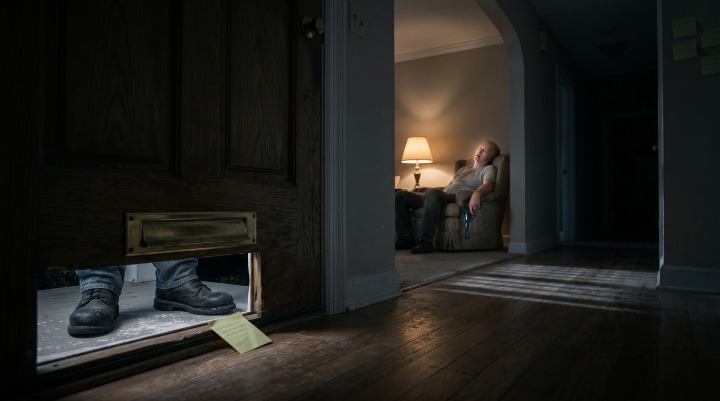
The living room was dark. My father was sitting in the armchair, his head tilted back against the upholstery. The slow, rhythmic rise and fall of his chest indicated deep sleep.
I looked past him, toward the front door.
The oak slab was closed. The brass deadbolt was horizontal.
But at the very bottom of the door, built directly into the wood, was a wide, brass mail slot.
The heavy brass flap was slowly pushing inward.
The Canvas
I sank to my knees on the hardwood floor. I didn’t wake my father. The fear pinned my vocal cords tight against my throat.
A cold draft poured through the open slot, carrying the distinct smell of wet plaster, stale sweat, and damp canvas.
I lowered my head to the floor, peering straight down the dark hallway, looking directly into the open sliver of the mail slot.
The porch light was off. The moonlight illuminated the concrete.
A pair of heavy, steel-toed work boots knelt on the welcome mat. The denim jeans covering the knees were heavily caked in dried, white plaster dust.
The man lowered his head, bringing his face into the narrow frame of the slot.
He wasn’t wearing a mask. He was wearing a heavy, opaque canvas sack pulled entirely over his head. The thick material was gathered at his throat and secured with a thick, black plastic zip-tie, pulled ruthlessly tight. There were no eye holes cut into the fabric. The canvas was stained with old oil and dark, unidentifiable fluids.
He was completely blind. He was operating entirely by touch and sound.
His hands were massive, encased in thick rubber industrial gloves. He held a stack of yellow sticky notes. He pressed a heavy carpenter’s pencil against the top note, his hand moving in rigid, mechanical jerks as he wrote.
He peeled the note off the stack. He reached forward, his thick rubber fingers finding the open brass slot.
He slid the note through. It fluttered to the hardwood floor inside my house.
The man didn’t pull away. He pressed the blank, featureless canvas of his bagged head directly against the open slot.
He inhaled.
It was a long, wet, rattling intake of breath. He was smelling the air inside the house. He was smelling the living room.
The brass flap snapped shut.
The Exit
I gasped. The sound tore out of my throat, harsh and loud.
My father woke instantly. His eyes snapped open, his hand dropping to the revolver resting on his thigh.
“Dad,” I choked out, pointing a shaking finger at the door.
He didn’t ask questions. He stood up, crossed the living room in three strides, threw the deadbolt, and ripped the oak door open. He stepped out onto the porch, leveling the weapon into the darkness.
“Police! Show your hands!” he roared.
The porch was empty.
There was no man in canvas. There were no footsteps retreating across the lawn. There was only the quiet, humid summer night and the faint outline of plaster dust pressed into the fibers of the welcome mat.
My father cleared the yard. He called the local precinct. Two squad cars arrived, their spotlights sweeping the tree line. The officers found nothing. They took a report, spoke to my father in hushed, professional tones, and left.
My father returned to the living room. He didn’t look at me. He walked straight to the back bedroom, grabbed my duffel bag, and began shoving my clothes into it.
“We’re leaving,” he said, his voice flat. “I’ll deal with the landlord on Monday. You aren’t staying here another hour.”
I sat on the edge of the mattress, my hands resting in my lap. I didn’t argue. The illusion of my independence had been entirely dismantled.
He zipped the bag shut. He hoisted it over his shoulder.
“The door did its job,” he said, offering a weak, authoritative comfort. “The lock held. You were safe inside.”
He turned and walked out into the hallway, heading for his truck.
I stood up. The bedroom was quiet. I reached for the wall switch to turn off the overhead light.
I looked up.
The ceiling was entirely yellow.
Hundreds of square sticky notes overlapped each other, edge to edge, pressed completely flat against the white drywall. They stretched from the corners of the closet to the window frame above my bed. They all bore the exact same heavy, indented graphite scrawl.
I turned off the light.