The Escape
The C-wing corridor was a blinding, deafening tunnel of fluorescent lights and slammed lockers.
Emma was walking beside me, her voice a continuous, rapid-fire stream of complaints about a botched biology lab and an upcoming weekend shift at the mall. I wasn’t processing a single word. My head was down, my vision focused entirely on the scuffed linoleum tiles passing beneath my frayed canvas sneakers.
Living in the foster system requires an exhausting amount of bandwidth. My current placement was a house where the adults communicated entirely through heavy silences, aggressive sighs, and unpredictable outbursts. Surviving that environment meant keeping my nervous system constantly dialed to a low-level panic. By the time Friday afternoon rolled around, my battery was entirely dead. The noise of the high school hallway felt like physical blows against my skull.
I just needed a single moment of absolute quiet. I needed to stand in a room where no one was looking at me, expecting something from me, or preparing to yell at me.
As we passed the cafeteria, my stomach knotted sharply. I stopped walking.
I told Emma I needed the restroom. She stopped mid-sentence, sighed, and let her heavy canvas backpack slide off one shoulder. She leaned back against the painted cinderblock wall and pulled out her phone, her thumb instantly scrolling.
“I’ll wait here,” she muttered, not looking up from the screen.
I turned away from the current of students and pushed my weight against the heavy wooden door marked with raised, white plastic letters: GIRLS.
The Echo Chamber
The transition from the hallway to the bathroom was violently jarring.
I stepped inside. The heavy pneumatic arm at the top of the door hissed loudly, dragging the heavy wood shut behind me. The metal latch clicked into the strike plate with a resounding, solid thud.
The sudden severance from the ambient, chaotic noise of the corridor was absolute.
The bathroom was entirely empty. It was a massive, sterile room built to handle the volume of a crowded public school, but at this exact moment, I had it entirely to myself. A long row of ten porcelain sinks lined the left wall, mounted beneath a single, unbroken stretch of mirrored glass. On the right, ten beige metal stalls stood in perfect, uniform alignment.
The air in here was a distinct ten degrees colder than the hallway. It carried the sharp, chemical sting of industrial pink soap and concentrated floor bleach. Near the back wall, a single fluorescent tube light flickered erratically, casting a rapid, stuttering strobe effect over the pale beige tiles.
I bypassed the first nine stalls. I always chose the handicap stall at the very end of the row. It offered the largest footprint, the thickest walls, and a brief, pathetic illusion of true privacy.
I stepped inside and pulled the heavy beige metal door shut. I slid the deadbolt to the right. It locked into the latch with a hollow, echoing clunk that bounced sharply off the tiled walls.
I slipped my backpack off my shoulders, letting it rest on the stainless steel grab bar. I unbuttoned my jeans, sat down, and finally let my shoulders drop.
I closed my eyes. I let the back of my head rest against the cold, painted cinderblock wall behind the toilet. I took a deep, ragged breath, holding the frigid, bleach-scented air in my lungs for a long count of five. I relished the total isolation. I let the tension bleed out of my jaw.
Then, the heavy wooden door at the entrance of the bathroom groaned open.
The Vacuum
I didn’t open my eyes. I just let out a quiet, frustrated exhale through my nose. My stolen moment of isolation was over.
I listened to the heavy pneumatic arm hiss a second time as the main door swung shut. The heavy metal latch clicked into the strike plate.
I waited for the sound of rubber sneakers squeaking against the wet tile. I waited for the heavy thwump of a backpack being dropped carelessly onto the floor, or the sudden rush of water from one of the automatic sinks, or the sharp, echoing snap of a metal stall door being yanked open.
None of those sounds came.
There was only a sudden, suffocating silence.
But it wasn’t the empty, hollow silence from a moment ago. The barometric pressure in the room had fundamentally shifted. The faint, steady draft of cold air pouring from the overhead AC vent suddenly died, as if something massive had stepped in front of the grate, entirely displacing the airflow in the room.
My eyes snapped open.
I sat perfectly still on the plastic seat, my hands resting lightly on my knees. I didn’t take a breath. I strained my ears, listening so hard the pulse in my neck began to thud loudly against my eardrums.
There were no footsteps. No rustling fabric. No clearing of a throat.
My brain scrambled to build a rational bridge. A teacher stepped in to check for kids skipping class. They didn’t see any feet under the first few stalls, and now they are standing perfectly still, listening for movement.
I decided to wait them out. I wasn’t going to make a single sound until they gave up and left.
I stood up slowly, shifting my weight carefully to ensure the soles of my sneakers didn’t squeak against the tile. I pulled up my jeans, my fingers moving with agonizing, deliberate slowness to avoid the metallic jingle of the zipper tab.
I turned around to face the beige metal door of the stall. I kept my head down, my eyes level with the deadbolt. Someone had used a black Sharpie to write a tiny, cramped message next to the lock.
I reached out, my trembling fingers hovering just an inch over the metal slide of the deadbolt.
The Eclipse
The ambient light inside the stall vanished.
The gap between the top of the metal stall door and the drop ceiling was nearly three feet wide, allowing the harsh fluorescent light from the main room to bleed in and illuminate the small space. But in a fraction of a second, that light was entirely eclipsed.
A shadow, thick, absolute, and impossibly wide, fell completely over me.
The temperature in the small, enclosed space didn’t drop. It spiked.
A wave of feverish, sickening heat radiated down from the ceiling, pressing against my scalp and the back of my neck. The sterile smell of industrial bleach was instantly obliterated by a heavy, suffocating stench. It smelled like copper pennies left in the sun, mixed with the sickeningly sweet, rotting odor of overripe fruit turning to mush.
My hand froze in the air, hovering paralyzed over the lock.
The hairs on the back of my neck stood straight up. The primal, deeply buried survival instinct that resides in the brainstem seized complete control of my central nervous system, locking my muscles in place.
Do not move. Do not make a sound. You are trapped.
I didn’t turn my head. I didn’t dare look up at the wide gap above the door.
Very, very slowly, I lowered my eyes. I looked down at the pale linoleum floor beneath my own feet.
I was wearing my beat-up, white canvas Converse.
Standing directly behind me, so close that the scuffed, worn leather was physically touching the white rubber heel of my left shoe, was another pair of feet.
They were massive men’s dress shoes. They were a dark, rotting brown, deeply creased across the toe box and covered in a thick, undisturbed layer of gray, powdery dust.
There was no physical way those shoes could have entered the stall. The metal door was locked. I was standing inches from it. I had not heard a single scrape against the floor, a single footstep, or the squeak of a hinge.
But they were there. Resting silently on the tile, perfectly parallel, pointing directly at the back of my calves.
My lungs locked. A hot, blinding terror spiked through my chest, radiating down my arms and turning my fingertips totally numb.
I couldn’t turn around. If I turned around, the space was so tight that my nose would press directly into its chest.
The Reflection
Mounted securely to the cinderblock wall on my right was a large, commercial stainless steel toilet paper dispenser. The polished, curved metal acted like a dark, warped funhouse mirror.
I didn’t turn my neck. I only shifted my eyes to the right, looking deep into the distorted reflection of the chrome.
I saw what was standing behind me.
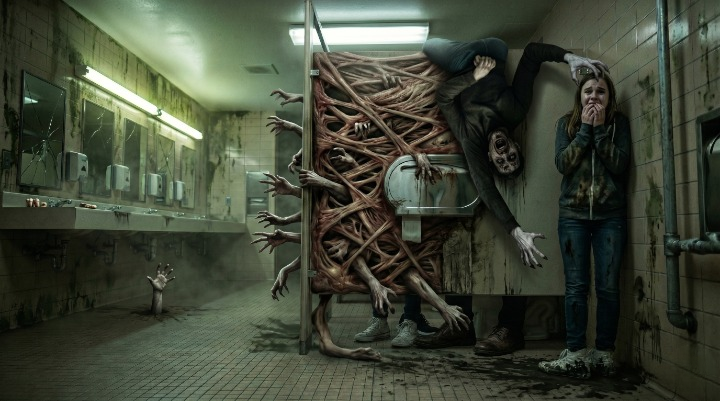
It wasn’t a tall man. It wasn’t a skeletal creature folded into the corners. It was a bloated, impossibly wide mass of flesh, entirely filling the rear half of the handicap stall.
The entity was stuffed into a heavy, moth-eaten wool overcoat that looked decades old. The coat was stretched to the tearing point, the fabric bulging and straining. But the mass beneath the coat wasn’t static. It was writhing.
It moved organically, shifting and undulating as if the heavy wool was barely containing dozens of smaller, separate masses fighting for space inside.
Its shoulders sloped heavily, rising up to support a head that hovered uncomfortably close to my left ear.
I stared at the reflection of its face in the chrome, my mind violently rejecting the visual data.
It didn’t have a skull. It didn’t have eyes, a nose, a mouth, or even a jawline. The head was a completely smooth, featureless canvas of bruised, doughy flesh. It looked like a blank mannequin head molded out of sickening, purple-yellow wax.
But the surface wasn’t still.
Beneath the waxy, featureless skin, shapes were constantly pushing outward. I watched in absolute, paralyzed horror as the distinct, unmistakable impression of a human hand pressed against the inside of the creature’s face, stretching the bruised flesh outward before sinking back into the mass.
Then, the impression of a mouth pushed through the surface—a wide, distended jaw opening in a silent, agonizing scream, stretching the blank skin tight over unseen teeth, before subsiding back into the smooth, doughy canvas.
It was radiating a feverish, blistering heat against my back.
It wasn’t breathing. It wasn’t making a single sound. It was simply existing in the space directly behind me, its blank, shifting face hovering two inches from my neck, the writhing mass of its body entirely blocking my exit.
It didn’t reach out to grab me. It didn’t strike. It simply occupied the stall, filling the enclosed space with its impossible, bloated mass and its sickening, sweet stench.
It was a monument of impossible physics. It had slipped into a locked room without displacing the air. It was a violation of reality, standing so close I could feel the microscopic vibrations of the screaming faces pushing against the inside of its head.
My vision began to tunnel, the edges of the bathroom blurring into dark gray fuzz. The lack of oxygen was causing my brain to shut down. My knees began to tremble. I was going to pass out. I was going to collapse directly backward into the terrifying, writhing mass of the heavy wool coat.
The Severance
The heavy wooden door of the main bathroom violently swung open, slamming hard against the rubber wall stop with an explosive BANG.
“Hey! Are you drowning in there?!”
Emma’s voice echoed loudly, bouncing aggressively off the tiles, sharp with teenage impatience.
The instant her voice shattered the absolute silence, the air pressure inside the stall violently snapped back to normal.
The massive, crushing shadow completely vanished from the ceiling. The blistering, feverish heat instantly evaporated, replaced entirely by the cold draft of the AC vent and the sterile smell of pink soap.
I gasped.
I sucked in a massive, ragged lungful of air, my chest heaving so violently my ribs cracked against each other. I stumbled forward, my balance completely gone, and slammed my forehead against the beige metal door of the stall. I caught myself with both hands, my palms slapping loudly against the painted steel.
I whipped around, pressing my back flat against the door, my eyes wide, wild, and frantic.
The stall was completely empty.
There were no massive, dusty leather shoes on the tile. There was no bloated, writhing overcoat. There was only the white porcelain toilet, the cinderblock wall, and the chrome dispenser.
“Hello?” Emma called out again, her footsteps finally squeaking against the wet linoleum as she walked toward the sinks. “You alive?”
I couldn’t speak. My throat felt like it had been scrubbed with wire.
I reached blindly behind me, fumbling with the deadbolt. I threw the latch and shoved the heavy metal door open. I stumbled out of the stall, my knees buckling slightly, and caught myself heavily against the edge of the sink counter.
I turned on the cold water. I shoved my shaking hands under the stream, splashing the freezing water onto my face, trying to wash away the phantom sensation of the feverish heat radiating against my neck.
I looked up into the long, unbroken mirror above the sinks.
Emma was standing near the paper towel dispenser. She wasn’t looking at her phone. She wasn’t rolling her eyes or complaining about the wait.
She was staring directly at my reflection in the mirror.
Her face was completely drained of blood. Her skin was a sickly, chalky white. Her jaw hung slightly unhinged, her eyes wide with a look of absolute, unadulterated horror.
The Continuance
I reached out with a trembling, wet hand and turned off the faucet. The water dripped silently into the stainless steel basin.
“What?” I managed to croak out. My voice was a weak, broken rasp. “What’s wrong?”
Emma swallowed hard. Her hands were shaking violently as she gripped the heavy canvas straps of her backpack. She didn’t look away from my eyes in the mirror.
“I… I came in a few seconds before I yelled,” she whispered, her voice barely carrying over the low hum of the fluorescent lights.
I grabbed the edge of the counter. The cold porcelain grounded my hands.
“The door didn’t make a sound,” Emma continued, her voice cracking, a single tear spilling over her eyelashes and cutting a track down her pale cheek. “I walked right up to your stall to bang on the door. I looked under the gap.”
She raised a trembling finger, pointing at the gap beneath the beige metal door of the handicap stall.
“There was someone else in there with you,” she breathed, her chest heaving with panicked, shallow breaths. “I saw their shoes. They were huge, dark brown leather. And…”
She choked on the word, taking a terrified step backward toward the main door.
“And something was dripping from under the coat,” she sobbed. “A thick, dark fluid… it was pooling around the heels of your sneakers.”
My stomach plummeted, a violent free-fall into absolute dread. I looked down at the floor. The linoleum beneath my shoes was perfectly clean. Dry.
The hallucination theory was dead. The hope that my exhausted, fractured mind had simply suffered a panic attack was entirely gone.
It had been a physical, horrifying reality. It had occupied the space. It had stood over me, shifting and writhing in its heavy coat, bleeding an impossible fluid onto the floor before vanishing into thin air.
BZZZZZZZ.
The harsh, electronic shriek of the bell rang out through the PA speaker mounted above the bathroom door.
It was loud. It was jarring. It was the universal signal that fifth period was starting.
Immediately, the muffled, chaotic roar of hundreds of students flooding into the hallway bled through the heavy wooden door. The sound of lockers slamming. The sound of shouting, laughing, and normal, everyday life continuing its relentless march forward.
Emma and I stood frozen in the sterile bathroom.
There was no dramatic escape. There was no collapsing into the safety of an adult’s arms. We were in a high school. We were in the middle of a Friday afternoon.
I looked at Emma’s terrified face. She looked at mine.
The monster was real. It existed in the same building where we took algebra and ate lunch. It could bypass locks. It could stand inches behind you without displacing the air.
And the bell had just rung.
I reached down, picked up my backpack from the floor with shaking hands, and slung it over my shoulder. We didn’t say a word. We just turned toward the heavy wooden door, pushed it open, and walked back out into the deafening, crowded hallway.