The Drift
The neon sign of the bar, Ruya, bled a distorted, fuzzy crimson into the deep puddles pooling on the uneven Berlin cobblestones.
I stood under the canvas awning, the fabric sagging under the weight of the relentless, freezing October downpour, and patted down the front pockets of my denim jacket. Flat. I jammed my freezing, stiff hands into the front pockets of my jeans. Only a crushed paper receipt and a few loose, cold Euro coins scraped against my knuckles.
My apartment keys were gone.
The realization didn’t hit me with a jolt of panic. It settled into the center of my chest with a dull, heavy inevitability. When you spend three years running from a fractured, toxic family, floating aimlessly across the globe trying to outrun a deeply ingrained sense of total uselessness, you start to expect the world to lock you out. It felt less like an accident and more like a consequence.
I was twenty-one years old, a senior in college technically, but emotionally I was a ghost haunting my own life. I had spent the last five hours inside Ruya, drowning the relentless static in my head with cheap German pilsner, trying to forget that I had absolutely no direction, no home to return to, and no one waiting up for me anywhere in the world.
Now, I didn’t even have a bed.
The interior bar lights flicked off behind me. The heavy wooden door deadbolted from the inside with a solid, unforgiving, metallic clack.
I pulled my collar up against the biting wind, stepped off the curb, and walked out into the downpour. The cold water instantly soaked through the thin, worn denim of my jacket, plastering the freezing fabric to my shivering shoulder blades.
It was nearly 3:00 AM. A replacement set of keys was a logistical impossibility. A hotel was out of the question; my bank account was running on absolute fumes.
I began to walk. The streets of Berlin at this hour were an absolute, echoing void. The historic stone facades of the buildings loomed overhead like the towering walls of a canyon, their dark, unlit windows watching me stagger blindly down the sidewalks. The alcohol was a heavy, warm sludge moving sluggishly through my veins, but the freezing rain was rapidly sobering me up, replacing the dull numbness with a sharp, biting physical misery.
I needed shelter. Just a dry patch of concrete to wait out the sunrise.
The Concrete Sanctuary
I heard the river before I saw it. The low, rhythmic, churning slosh of the River Spree grinding against its concrete embankments.
I followed the heavy sound down a sloping, graffiti-covered pedestrian pathway that ducked beneath a massive, multi-lane concrete bridge. The transition from the open street to the underpass was immediate and jarring. The deafening hiss of the rain abruptly stopped, replaced by the heavy, echoing, hollow drip of water leaking through the expansion joints in the concrete ceiling fifty feet above.
The air down here was thick. It smelled heavily of ozone, rotting river algae, stale urine, and wet iron.
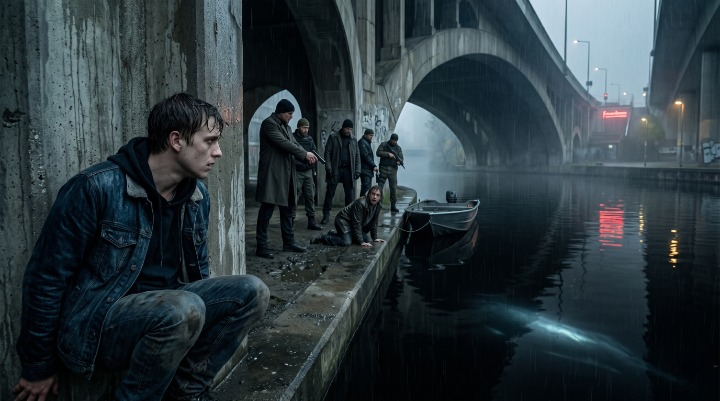
I stumbled over a rusted, overturned shopping cart and found a dry alcove tucked high up on the angled concrete embankment, completely shielded by the deep shadow of a massive stone support pillar. I sat down heavily, my legs giving out. The cold of the concrete seeped instantly through my wet jeans, biting painfully into my thighs, but I was finally out of the driving rain.
I pulled my knees tight to my chest, wrapped my arms securely around my shins, and buried my face in my wet denim sleeves.
The physical exhaustion of the alcohol dragged me down almost immediately. The sound of the black river rushing past the embankment below turned into a heavy, hypnotic white noise, pulling me beneath the surface of consciousness.
I drifted into a dark, heavy, dreamless sleep.
The Transaction
Thrum-thrum-thrum.
The sound bypassed my conscious mind and vibrated directly in the bones of my jaw. It was a low, mechanical idle. An outboard motor, running low, deep, and stealthy in the water.
My eyes snapped open.
The darkness under the bridge was nearly absolute, save for the sickly, pale yellow glow of a distant streetlamp bleeding over the edge of the concrete railing far above.
I didn’t move a single muscle. My spine was perfectly rigid against the cold stone pillar.
Across the narrow stretch of the black river, a small, flat-bottomed aluminum skiff had silently glided up to the opposite embankment. A man stood at the stern, killing the motor. The nose of the boat bumped softly against the concrete retaining wall with a dull thud.
Two men stood waiting on the shore. Three more were in the boat.
I held my breath. The alcohol had completely burned out of my system, leaving me hyper-aware, my senses painfully, terrifyingly dialed in.
Drug deal. The thought flashed through my mind, brilliant, sharp, and terrifying.
I was watching an honest-to-God underworld transaction unfold. Five men, wearing dark trench coats and heavy leather boots, operating in absolute, disciplined silence at three in the morning under a deserted bridge.
One of the men on the shore stepped forward. He knelt, grabbing a heavy, braided rope tossed from the bow of the boat, and tied it off tightly to a rusted iron cleat embedded in the concrete. The men in the boat began to haul luggage over the gunwales. Not small packages. Massive, heavy, military-style canvas duffel bags and two sleek, silver briefcases that caught the ambient yellow light.
My German was awful. I only knew how to order a beer and ask for the bathroom. But I didn’t need to speak the language to read the heavy, suffocating tension in the air. The body language across the river was universally hostile. The men on the shore stood with their broad shoulders squared, their hands buried deep in the pockets of their coats. The men in the boat moved with frantic, terrified urgency, tossing the bags onto the concrete.
I squeezed my eyes shut, silently begging myself to merge with the concrete pillar behind me. Do not move. Do not breathe. Just let them finish the exchange and leave.
Suddenly, the hushed, guttural whispers shattered.
One of the men on the shore—a massive silhouette with a shaved head—barked a sharp, furious, barking command in German.
He didn’t reach down for a silver briefcase. He pulled his hand sharply from his coat pocket, raising a heavy, matte-black handgun. The faint yellow light from the streetlamp caught the dull, oiled slide of the weapon as he leveled it directly at the chest of the man standing in the center of the boat.
The air under the bridge turned to ice.
The man in the boat threw his hands up instantly. He began to babble. Fast, high-pitched, desperate German. His voice cracked, echoing loudly off the concrete arches above. He was begging. He kicked one of the briefcases forward with his boot, offering it, pleading with his hands raised high in surrender.
The man with the gun didn’t flinch. He barked another harsh order, gesturing violently toward the shore with the barrel of the weapon.
The other two men in the boat moved. But they didn’t draw weapons to defend their partner. They turned on their own guy.
They grabbed the man who was begging. They pulled his heavy coat aggressively off his shoulders. They ripped his shirt down the middle, the fabric tearing loudly in the quiet night. They were stripping him. In the freezing October rain, at gunpoint, they forcefully stripped the man down to his bare skin.
I watched, paralyzed, my stomach turning to heavy lead. I was about to watch a cartel execution. I was going to see a man take a bullet to the head and get unceremoniously dumped into the Spree.
But no gunshot rang out.
Instead, the two men dragged the naked, violently sobbing victim out of the aluminum boat. They didn’t pull him up onto the dry concrete of the embankment. They pushed him to his knees right at the water’s edge, leaving him half-submerged in the freezing, thick black river mud.
Then, the strangest, most terrifying thing happened.
The four armed men—the two on the shore and the two standing in the boat—all took a synchronized, deliberate step backward.
They kept their guns drawn, their arms locked, but they didn’t aim at the naked man crying in the mud.
They aimed their weapons directly into the black water of the river.
The Anchor of Dread
The victim wasn’t looking at the guns pointed at his back. He was staring out into the absolute center of the dark river, his bare chest heaving with violent, hyperventilating sobs. His hands were clasped together in front of him, fingers intertwined so tightly his knuckles were stark white.
He wasn’t begging the men anymore. He was praying to the water.
And then, the excruciating wait began.
The tension didn’t snap quickly. It stretched, pulling taut like a steel cable about to fray. One minute passed. Then two.
The men with the guns stood perfectly rigid, but I could see the microscopic tremors in their arms. The heavy handguns shook ever so slightly in their grips. They were terrified. These were hardened men, killers who had just stripped a man naked in the freezing rain without a second thought, and they were staring at the water as if the devil himself resided beneath the surface.
The ambient temperature under the bridge began to plummet. It wasn’t the natural chill of the rain. It was a deep, unnatural, subterranean freeze that instantly frosted the breath of the men across the river, turning their exhalations into thick plumes of white vapor.
The River Spree is usually a chaotic, choppy mess of colliding currents. But as the minutes agonizingly dragged on, the water in the center of the channel began to change.
It stopped flowing.
The rhythmic sloshing against the concrete embankment completely ceased. The surface of the river flattened out entirely, turning into a sheet of perfectly still, black glass.
Then, the smell hit.
It rolled off the water in a heavy, suffocating wave. It didn’t smell like river algae or city runoff. It smelled of ancient, suffocating pressure. It smelled like rusted iron, sulfur, and thousands of years of rotting, undisturbed silt scraped from the absolute bottom of an oceanic trench. The stench was so thick it coated the back of my throat, making my eyes water and my stomach violently heave.
Bubbles began to rise to the surface.
Not a violent boil, but massive, thick spheres of black methane that breached the glassy surface and popped with heavy, wet slurps.
The victim in the mud stopped sobbing. His voice simply gave out. His hyperventilation ceased, replaced by a rigid, catatonic shock. He stared straight ahead, his jaw hanging slack, completely paralyzed by whatever his mind was processing beneath the black surface.
The water began to bulge upward.
The Anomaly
It didn’t rise like a creature pushing through the surface. The river itself seemed to thicken, congealing into a towering, gelatinous mass.
It was an overwhelming, formless monument of deep-river rot. It had no pale skin. It had no humanoid anatomy. It rose from the depths as a colossal, shifting mountain of black, oily sludge, tangled ropes of decaying riverweed, and rusted, jagged pieces of submerged iron.
It must have been ten feet tall, a hunched, asymmetrical silhouette that blocked out the faint yellow light from the streetlamp above. Water poured off its massive bulk in heavy, viscous sheets, sounding like a waterfall of thick oil crashing back into the river.
It didn’t have a face.
Where a head should have been, there was only a deep, gaping cowl of absolute, impenetrable shadow, framed by heavy, draped curtains of rotting kelp and black silt.
But from deep within that dark, cavernous void, a light ignited.
It wasn’t an eye. It was a massive, writhing cluster of thousands of hair-thin, bioluminescent filaments. They glowed with a sickly, radioactive, pale-silver luminescence, squirming and twisting around each other like a nest of luminous, deep-sea worms. The silver light pulsed rhythmically, perfectly matching the erratic, terrified heartbeat hammering in my own chest.
The sheer wrongness of its existence radiated outward, a physical pressure that made the air feel impossibly dense. It defied physics. It defied biology. It was an amalgamation of everything that sinks, rots, and is forgotten at the bottom of the world.
The creature didn’t step forward. It didn’t wade. It glided across the surface of the water, a frictionless, horrifying advance that brought its towering mass right to the edge of the muddy embankment.
The four men with the guns didn’t fire. They stood perfectly rigid, their weapons trembling violently in their hands, their faces pale and slick with terrified sweat. They weren’t executing a rival. They were paying a toll to a god of the deep.
The anomaly hovered over the naked, trembling man.
It didn’t reach out with hands or claws. It didn’t open a mouth to bite.
The towering mass of black sludge and rotting weed simply leaned forward, expanding outward like a collapsing wave of heavy oil.
The front of its form opened, revealing a hollow, swirling vortex of black river water and rusted debris. It enveloped the victim entirely. It didn’t crush him. It swallowed him into its mass.
Through the thick, translucent black sludge that now covered the man, I saw his silhouette violently thrashing. I saw his mouth open in a soundless, suffocating scream as the freezing, oily silt forced its way down his throat, filling his lungs.
The squirming, silver filaments within the creature’s cowl flared brilliantly bright, pulsing rapidly as the man’s thrashing grew weaker, and weaker, and finally stopped.
His body didn’t drop back into the mud. He was simply absorbed, dissolved into the towering, floating architecture of the anomaly.
The Exposure
My lungs were burning with a desperate, agonizing fire. I hadn’t taken a breath in over two minutes.
My body, operating purely on autonomous, unthinking survival instinct, forced my jaw open to pull in oxygen.
As I gasped, a tiny, microscopic shift in my terrified, trembling weight caused the rubber toe of my sneaker to drag across the concrete embankment.
Scrrrch.
It was the faintest sound. Barely louder than a grain of coarse sand rubbing against a stone wall.
But under the perfectly still, echoing acoustics of the bridge, the sound snapped through the freezing air like a bullwhip.
All four men on the opposite bank flinched violently.
But they didn’t look across the river. They kept their guns trained tightly on the towering, shifting mass of black sludge hovering over the mud.
The anomaly, however, heard it.
The massive, hunched silhouette stopped gliding back toward the center of the river. The deep cowl of shadows shifted, rotating slowly, with the agonizing groan of rusted metal bending under pressure.
It turned toward my side of the river.
My heart stopped beating. The blood in my veins instantly turned to liquid nitrogen.
From deep within the black void of its cowl, the thousands of writhing, bioluminescent silver filaments stopped twisting around each other.
In perfect, terrifying unison, every single glowing thread snapped outward, pointing directly across the black expanse of the River Spree.
They pointed directly into my shadowy alcove.
I could feel the sheer, crushing weight of its awareness drilling into my skull. It felt like a physical, suffocating pressure pushing against the front of my brain, trying to drag me down into the water without touching me.
The massive, bald man with the handgun followed the direction of the glowing silver filaments. He squinted hard into the darkness of the opposite bank.
“Da ist jemand!” he roared, his voice cracking with panic, echoing violently under the concrete arches of the bridge. There is someone there!
The Flight
The chemical paralysis holding me to the concrete finally shattered.
A massive surge of adrenaline hit my central nervous system like a lightning strike, overriding the terror, overriding the bone-deep cold, overriding everything except the primal, screaming mandate to run.
I didn’t stand up carefully. I violently shoved myself off the concrete pillar, scrambling wildly up the steep, angled embankment on my hands and knees, tearing my fingernails on the rough stone.
Behind me, the absolute silence of the underpass was destroyed.
The deafening, concussive boom of a heavy-caliber handgun ripped through the air. The bullet struck the concrete pillar exactly where my head had been resting a fraction of a second prior, spraying a violent shower of razor-sharp stone shrapnel against the back of my wet denim jacket.
“Don’t shoot!” one of the other men yelled in heavily accented, terrified English. “The water! Watch the water!”
I didn’t turn my head to see if the massive anomaly of sludge was sinking back into the river, or if it was gliding across the channel to consume me. I didn’t care.
I crested the top of the embankment, my hands torn and bleeding, and hit the wet, slick pavement of the street above.
I ran.
I sprinted with a wild, uncoordinated, absolute panic. My boots slipped and skidded on the wet Berlin cobblestones, but I kept my balance, my arms pumping frantically, my lungs burning as they pulled in the freezing October air.
I ran through empty red lights. I ran down the absolute center of deserted avenues, flying past darkened cafes and locked storefronts. Every shadow stretching across an alleyway looked like a towering mass of black sludge rising to block my path. Every splash of my boots in the puddles sounded exactly like the wet, sloshing movement of the anomaly gliding up behind me.
I ran until the lactic acid in my legs simply caused my muscles to stop functioning.
I collapsed in the dead center of a massive intersection miles away from the river, the amber streetlights reflecting off the wet asphalt. I fell hard to my hands and knees, my stomach violently convulsing. I threw up a mixture of cheap pilsner and pure stomach acid directly onto the street, dry-heaving painfully until I tasted the sharp tang of my own blood in my mouth.
The heavy rain poured down over my back, washing the vomit into the iron storm drains, washing the blood from my torn, shaking knuckles.
I lay there on the freezing German pavement, gasping for air, staring up at the amber streetlights through the heavy downpour.
I was alive. The armed men hadn’t followed me into the city. The towering, rotting thing in the water hadn’t pursued me out of the river.
But the psychological damage was entirely permanent.
Sometimes, when the house is too quiet, I still close my eyes and feel the immense, crushing pressure of those thousands of silver filaments pointing directly at my skull. I still smell the rotting algae, the rusted iron, and the ozone.
I never went back to my apartment to get my clothes or my passport. I borrowed money from a sympathetic stranger at a morning train station, bought a one-way ticket to Munich, and just kept moving.
I’m still running. I still have no direction, no home, and no plan. But it doesn’t matter where I go, or how far inland I travel to escape the coastlines. Whenever it rains heavily, whenever I hear the sound of dark water lapping against a muddy shore, I feel the overwhelming, terrifying certainty that somewhere, in the absolute depths, those silver lights are still waiting for me to slip.