Too Long; Didn’t Read
Winter is the season when hair finally gets to look deliberate. The cold air, the scarves, the hats, the low winter light, all of it rewards cuts with clean lines and colors with real depth. This guide has 22 winter hair styles, grouped into sharper cuts, deeper colors, big drama, winter care, and the finishing touches. The three things that matter most are a shape that survives a hat, a color that looks richer in low light, and a routine that keeps the ends from drying out. A quick note worth saying plainly: the phrase “winter 2027 hair trends” has no measurable search volume right now, no data on Pinterest and 0 on Google in the most recent week, with its 100 peak being a single-week spike back in February 2024. Winter hair styles are strongly seasonal, peaking from November to February and sitting near 0 from March to September, so this is a guide for the current winter season, at its best in the November to February peak, and the 2027-dated wording is a title phrase only. Below are the 22 styles, each with what to ask for, who it suits, and how to style it at home.
What's Inside This Guide
ToggleThe January My Hair Finally Behaved
Every winter, the same thing happened to my hair. I would leave the house with a decent blowout, and by the time I got to the cafe my hair had gone flat at the top, static at the sides, and dry at the ends. The scarf had rubbed a dent into the crown. The hat had pressed the front flat. The dry indoor heat had pulled every bit of moisture out of the lengths. I tried more product, and it looked greasy by lunch. I tried less product, and it looked like a bird had nested in it by 3 in the afternoon.
The winter that changed it was the winter I stopped fighting the season and started cutting for it. I went to a stylist who did not try to sell me a complicated style. She looked at my hair, asked how much time I actually spent on it in the morning, and then she cut a shape that worked with the cold instead of against it. Clean lines at the bottom, so the ends stayed strong. A bit of weight taken out of the inside, so the hat dent fell out with one shake. A deeper color, so the low winter light had something to catch. It was the first winter I did not spend the whole season apologizing for my hair.
That is what this guide is about. These 22 winter hair styles are not about chasing a trend from a runway. They are about cuts that stay sharp when the weather is rough, colors that look deeper when the light is low, and styles that survive scarves, hats, and dry indoor heat. Every style below tells you what to ask for at the salon, who it suits, and how to keep it looking good at home without spending an hour on it each morning.
Winter haircuts for women work best when the cut does the heavy lifting. A sharp shape holds itself together even when you do nothing to it. A deep color looks expensive even when the light is weak. And a little winter care, a weekly mask, a silk-lined hat, a drop of oil on the ends, keeps the whole thing from falling apart by February. That is the whole idea behind the 22 styles below.
What’s Inside This Guide
- The 3 Things That Decide Whether a Winter Style Works
- Group 1: The Sharper Cuts (Styles 1 to 5)
- Group 2: The Deeper Colors (Styles 6 to 10)
- Group 3: The Drama (Styles 11 to 14)
- Group 4: The Winter Care (Styles 15 to 18)
- Group 5: The Finishing Touches (Styles 19 to 22)
- The 1-2-3 Winter Hair Method
- At a Glance
- Do This Not That
- Your Winter Hair Styles Weekend Plan
- Take It Further
- Stylist’s Cheat Sheet
- Questions People Ask
The 3 Things That Decide Whether a Winter Style Works
Before you pick a style, these three things decide almost everything.
1. A shape that survives a hat. Winter means hats, scarves, and coat collars, and all of them press on your hair. A cut with a clean, strong line springs back when the hat comes off. A cut with a lot of fussy, short pieces on top does not. It dents, it separates, and it stays dented. Ask for a shape with weight in the right places and texture hidden inside, not chopped into the surface. That way the hat dent falls out with one shake instead of needing a full restyle. Medium length hair winter cuts sit in the same safe zone, long enough to style and short enough to spring back when the hat comes off.
2. A color with depth in low light. Winter light is weak and flat, and it washes out pale, flat color fast. Deeper colors, rich browns, dark coppers, inky blacks, and cool blondes with a dark root, all look better in winter light than a single flat shade. The trick is dimension: a gloss, a shadow root, or a few darker lowlights give the color something to catch the light with. Flat color looks dull by January. Color with depth looks richer the darker the days get.
3. A routine that protects the ends. Cold air outside and heated air inside pull moisture out of your hair from both sides, all day long. The ends dry out first, and dry ends split, and split ends travel up the strand. A weekly mask, a leave-in on damp hair, and a drop of oil on the ends only will do more for your winter hair than any new product. And do not skip trims. A small trim every 6 to 8 weeks keeps the ends healthy until spring, and short cuts need one every 4 to 6 weeks to hold their shape.
Keep those three in mind and every style below will make sense.
One more thing worth saying plainly. The winter hair styles that work best are rarely the most complicated ones. Winter haircuts, winter hairstyles, and winter hair ideas all do the same quiet job when they are done right: a clean shape, a deep color, and a little care. Short hair winter looks and winter bob shapes work because they are simple and strong, not because they are fussy. That is the whole idea behind the 22 styles below.
Group 1: The Sharper Cuts
These five are the sharpest shapes of the season. A sharp cut is a cut with a clean line, no ragged ends, no fuzzy outline, and a shape you can read from across the room. They look expensive because they are precise, and they hold up in winter because a strong line does not fall apart when a hat presses on it. The trending haircuts winter lists are full of sharp lines this season, and for good reason.
1. The Pin-Straight Glass Bob
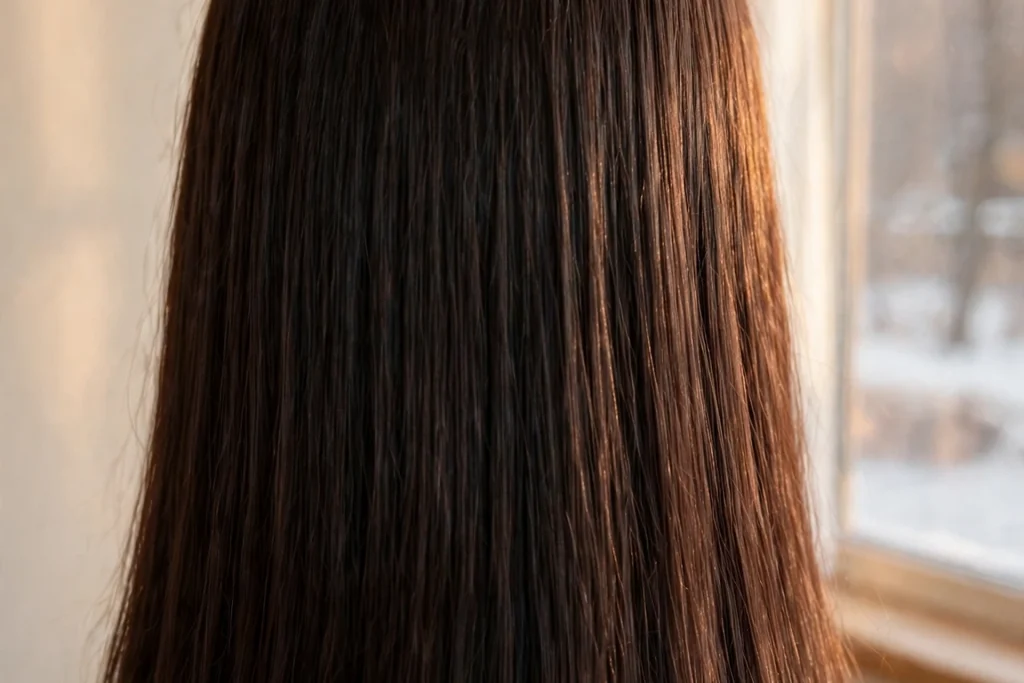
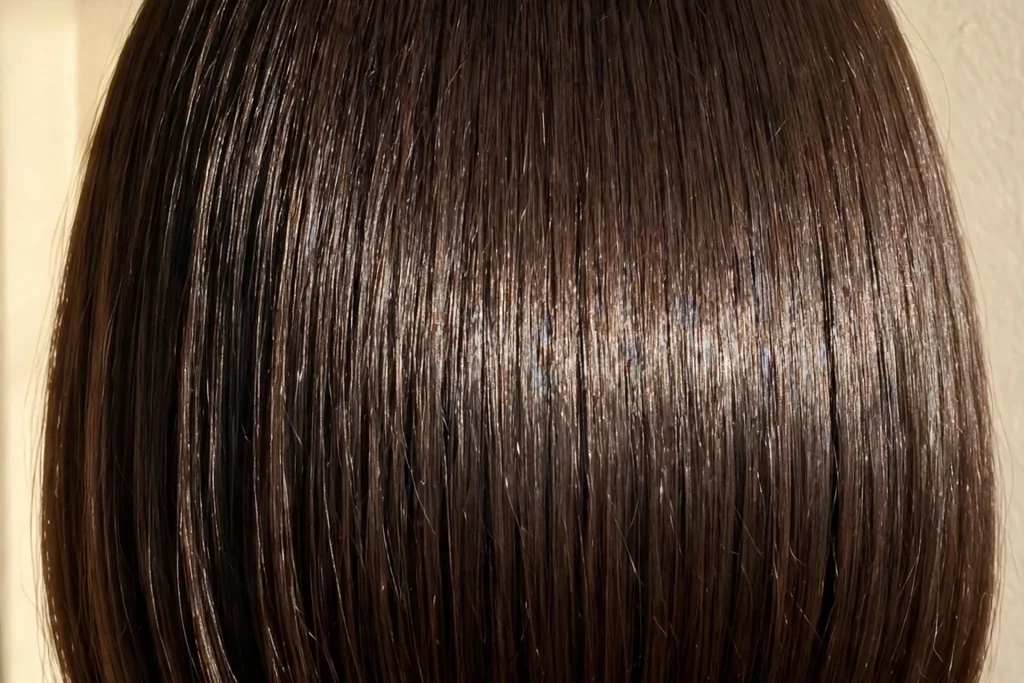
This is the sharpest cut on this list, and the simplest. The hair sits at the chin, cut dead straight all the way around, with a blunt edge so clean it looks like it was cut with a ruler. Then the whole thing is smoothed until it shines like glass. No layers on the surface, no texture chopped in, just one clean line and a mirror finish. It suits straight hair best, and it looks best on oval and heart-shaped faces, because the chin-length line frames the jaw without hiding it.
Ask your stylist for a one-length bob at the chin with a blunt perimeter and no surface layers. The sharpness comes from the cut, not from the styling, so the line has to be exact. It works on fine hair, which looks thicker with a blunt edge, and on thick hair, as long as the stylist takes a little weight out of the inside so the bob does not flare outward at the bottom.
Styling tip: Blow dry smooth with a paddle brush, then run a flat iron through in slow, single passes, one section at a time. Finish with a pea-sized drop of shine serum on the ends only. The glass look comes from smooth, sealed ends, not from piling on product.
You may also like: 22 Winter Hair Colors That Make Winter Feel So Beautiful, if you want a deeper color to go with the sharp line.
2. The Shortest Winter Bob
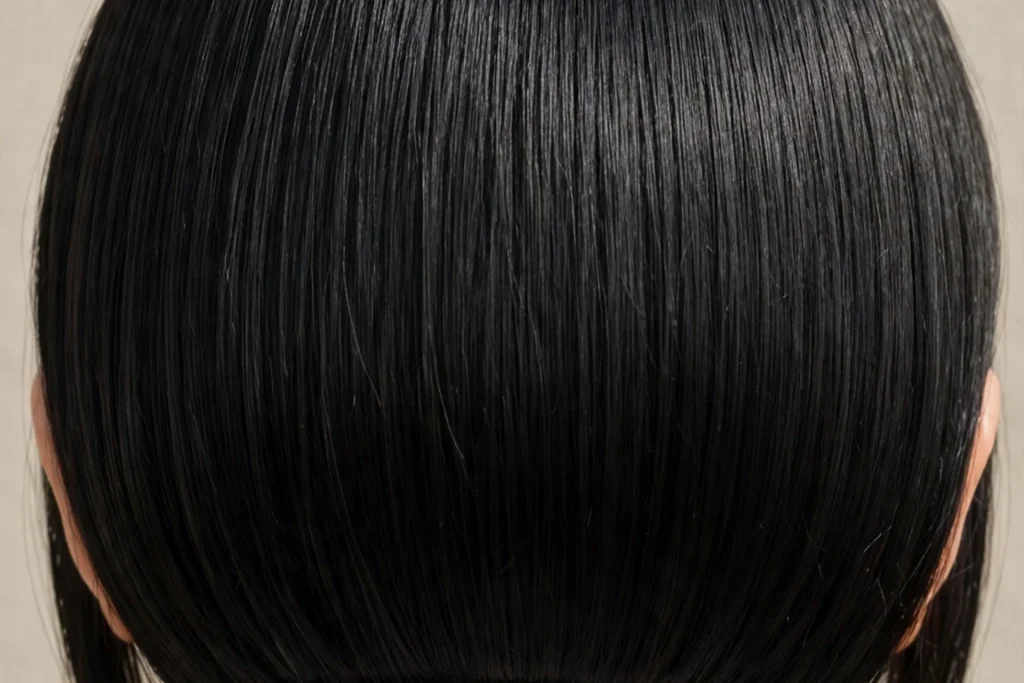
This one is the boldest short cut of the winter. The hair sits just below the ears, cut short and sharp, with a clean line around the back and slightly longer pieces at the front. It is a bob, but shorter and braver than the usual one, and it shows off the neck and the jaw in a way longer cuts never do. It suits oval and square faces best, and it looks great on straight and slightly wavy hair. It is also one of the easiest winter haircuts to live with, because there is so little hair that a hat barely dents it.
Ask your stylist for a bob that ends just below the ear, with a sharp line at the back and the front pieces left a finger longer than the back. Keep the ends blunt. The shape comes from the line, so ask for no thinning on the surface, or the sharpness disappears.
Styling tip: Rough dry with your fingers, then tuck the front pieces behind the ears or leave them loose, depending on the day. A dab of light pomade on the ends keeps the line crisp without making it stiff. The whole style takes about five minutes.
You may also like: 22 Medium Length Hairstyles for Thick Hair That Work So Well, if you want a longer option after the short cut grows out.
3. The Sharp Pixie With a Long Top
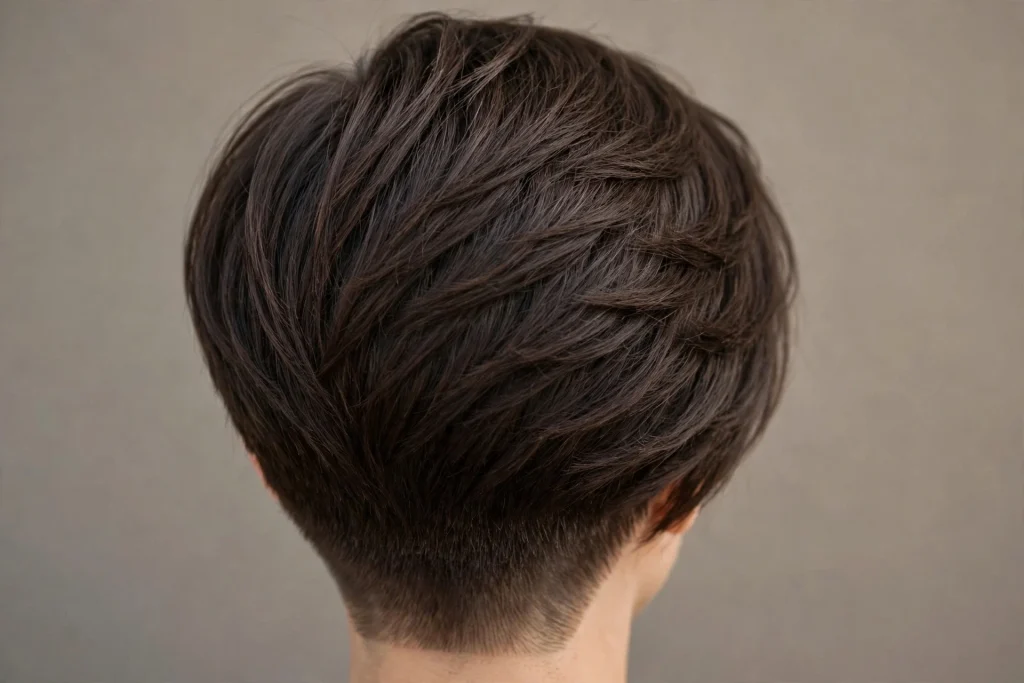
This is the short cut for people who want drama without losing styling options. The sides and back are cut short and neat, close to the head, while the top stays long enough to sweep, spike, or smooth back. The contrast is the whole point: short at the sides, long on top, and a sharp line where the two meet. It suits oval, heart-shaped, and round faces, because the height on top lengthens the face. It works on straight and wavy hair, and it is one of the best winter hair styles for fine hair, because the short sides make the top look thicker.
Ask your stylist for short, tapered sides and back with the top left long, at least three to four inches, so you can style it more than one way. Ask for a clean line at the temples and the nape. The top should be point cut, not blunt, so it moves instead of sitting like a cap.
Styling tip: Work a small amount of matte paste through the top while it is still slightly damp, then push it in the direction you want and let it dry. For a night out, sweep it all to one side with a little shine cream. For a cold morning under a hat, flatten it down and let it dry that way, then shake it back up when you get inside.
You may also like: 22 Winter Outfits for Women That Beat the Freezing Cold, if you want a coat and scarf look that matches a short cut.
4. The French Bob With a Short Fringe
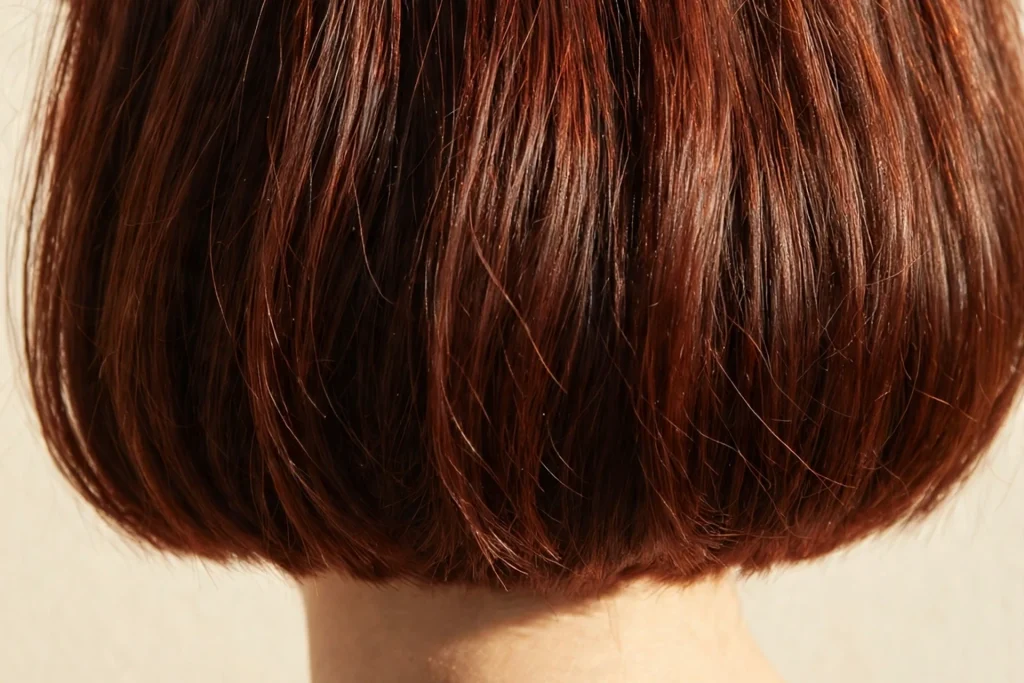
This is the chic one. The hair sits at the chin with a blunt edge, like the glass-hair bob, but it has a short, straight fringe that ends just above the eyebrows, and a little more softness through the ends. It is the classic Paris bob, and it looks effortless because the shape does all the work. It suits oval and long faces best, and it looks great on straight and lightly wavy hair. The fringe is the key detail: it has to be short and straight, not wispy, or the whole look goes soft and loses its edge.
Ask your stylist for a chin-length bob with a blunt perimeter and a straight fringe cut just above the eyebrows. The fringe should be cut dry, so the stylist can see exactly where it falls. Keep the ends blunt but ask for a tiny bit of softness at the very tips, just enough that the bob does not look like a helmet.
Styling tip: Let the bob air dry with a little leave-in cream, then smooth the fringe with a small round brush and a quick pass of the flat iron. Tuck one side behind the ear for a casual look, or leave both sides loose for the full French effect. A silk scarf tied at the neck finishes it without flattening the fringe.
You may also like: 22 Winter Hair Colors That Make Winter Feel So Beautiful, if you want the deep auburn color that suits this cut.
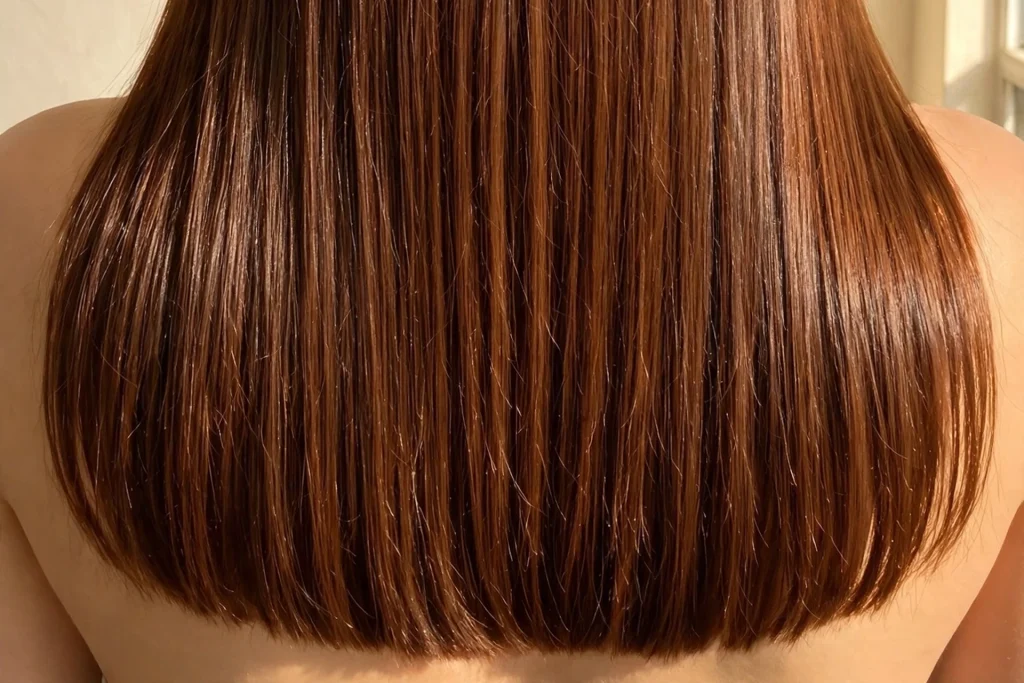
5. The Long One-Length Cut With Blunt Ends
This is the sharp cut for people who do not want to go short. The hair is long, past the shoulders and down toward the chest, cut all one length with a blunt, straight edge at the bottom. No layers on the surface, no thinning, no steps. Just one clean line. It looks expensive because it is simple, and it makes the hair look thicker than it is, because the blunt ends hold together instead of tapering away. It suits straight and slightly wavy hair best, and it works on almost every face shape, because the length frames the face without hiding it.
Ask your stylist for a one-length cut with a blunt perimeter and no surface layers. The ends have to be cut dead straight, so ask for the cut to be done with the hair dry or nearly dry, so the stylist can see the true line. If your hair is very thick, ask for a little weight taken out of the inside only, so the outside still looks like one clean line.
Styling tip: Blow dry smooth with a round brush, turning the ends under just slightly at the bottom. A drop of oil on the ends keeps them from splitting in the dry winter air. If you wear a hat, pull the hair out from under the collar when you get inside and give it one shake. The blunt line falls back into place on its own.
You may also like: 22 Sweater Dress Outfits That Stay Warm Without the Bulk, if you want an outfit that sits well with long hair.
Group 2: The Deeper Colors
These five are not about picking a shade off a chart. They are about color techniques, the way the color is put on, grown out, and finished, so it looks deeper and richer in winter light. Winter hair color trends lean deep this year, and these five techniques are how you get that depth without a flat, dull result. A flat, single-process color can look dull by January. These techniques give the color depth, so it catches the low winter light instead of disappearing in it.
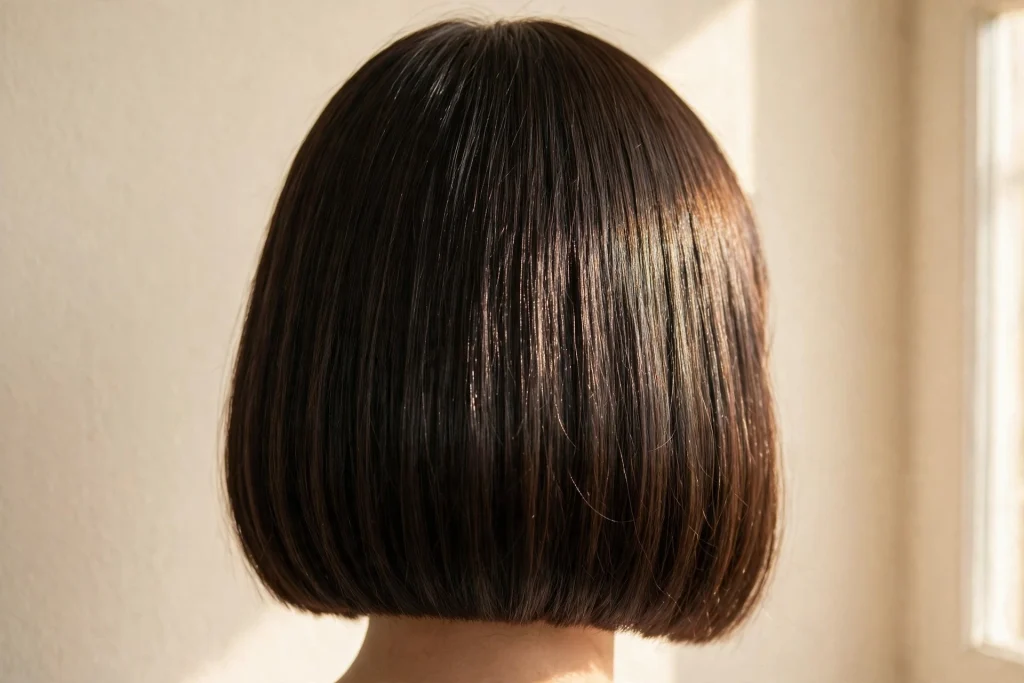
6. The Glossed Dark Bob
This one is a cut and a finish together. The hair is a bob, any length from chin to collarbone, colored a deep brown or near-black, and then finished with a clear gloss treatment that seals the surface and makes the color shine. The gloss is the whole trick. It adds depth without changing the color, and it makes dark hair look like it has light inside it, even on a grey winter afternoon. It suits straight and wavy hair, and it works on every face shape, because the bob does the shaping and the gloss does the shining.
Ask your stylist for a deep, single-process color, then a clear gloss on top, and a trim to keep the ends blunt. The gloss lasts about four to six weeks, and it fades gently, so there is no harsh line as it grows out. It is also a good way to try a deeper color without committing to a permanent change, because a gloss washes out slowly on its own.
Styling tip: Wash with lukewarm water, not hot, because hot water strips gloss faster. Use a sulfate-free shampoo, and skip the clarifying shampoo until the gloss has faded. A drop of shine oil on the ends after drying keeps the gloss looking fresh for an extra week or two.
You may also like: 22 Winter Hair Colors That Make Winter Feel So Beautiful, if you want more deep shades to pair with a gloss.
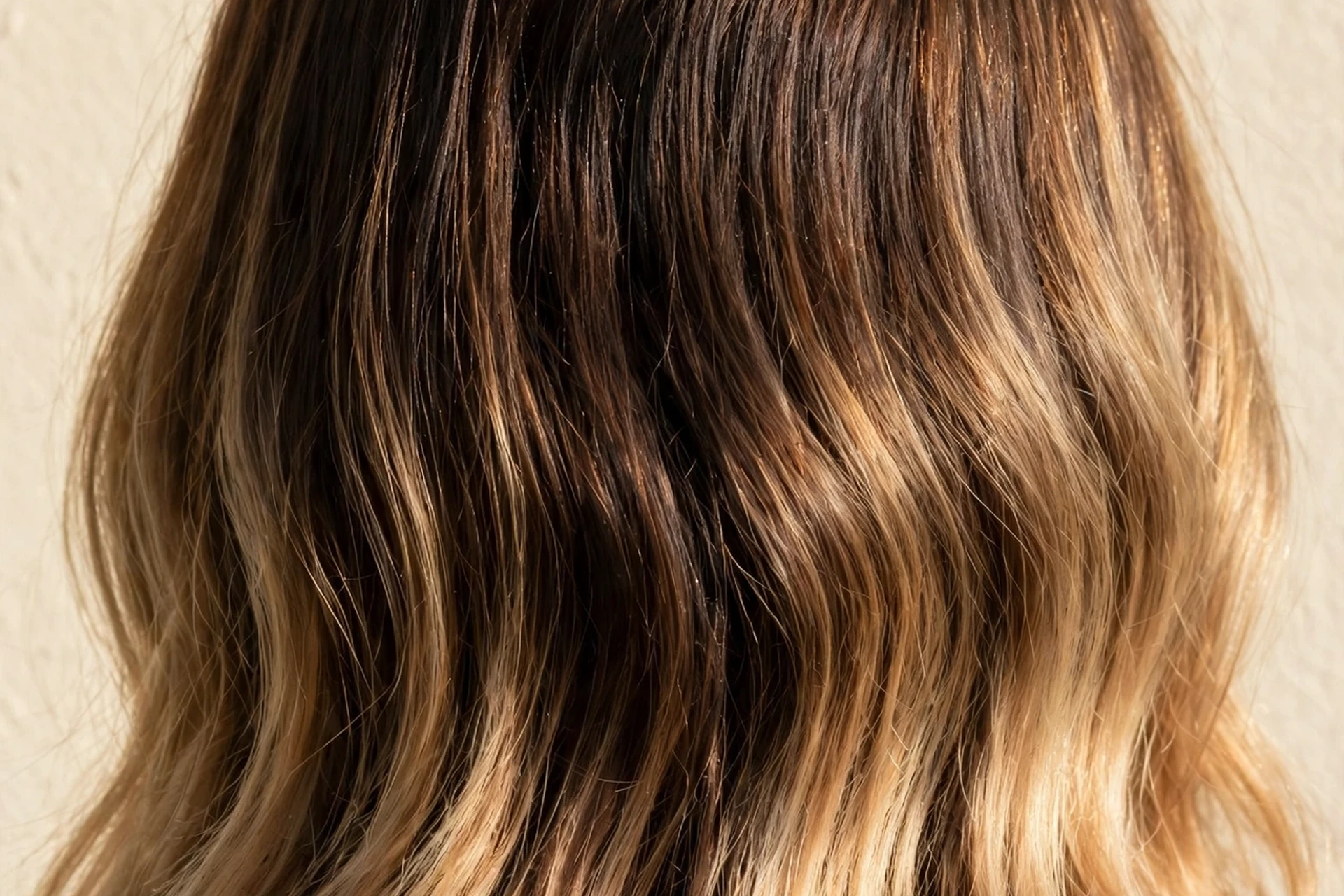
7. The Shadow Root Grow-Out
This is the low-maintenance color that actually looks better as it grows out. The stylist colors the roots a shade or two darker than the lengths, blending the dark root down into the lighter ends with a soft, smudged line instead of a hard one. As the hair grows, the dark root just extends, and there is no stripe to fix. It suits every hair length and almost every face shape, and it is the best winter hair color technique for anyone who does not want to sit in the salon every four weeks.
Ask your stylist for a shadow root, with the root color two shades darker than your ends, blended down about two inches with a soft, diffused line. The blend is everything. If the line is hard, it looks like grown-out roots. If it is soft, it looks deliberate. Bring a photo of the blend you want, not just the color, so the stylist can see the softness you mean.
Styling tip: Use a color-safe shampoo and wash less often, two or three times a week in winter, so the root blend lasts longer. When the roots grow out, the shadow just gets longer, which still looks fine. You can go eight to ten weeks between salon visits with this one, which is a gift in the cold months.
You may also like: 22 Medium Length Hairstyles for Thick Hair That Work So Well, if you want a medium cut that shows off a shadow root.
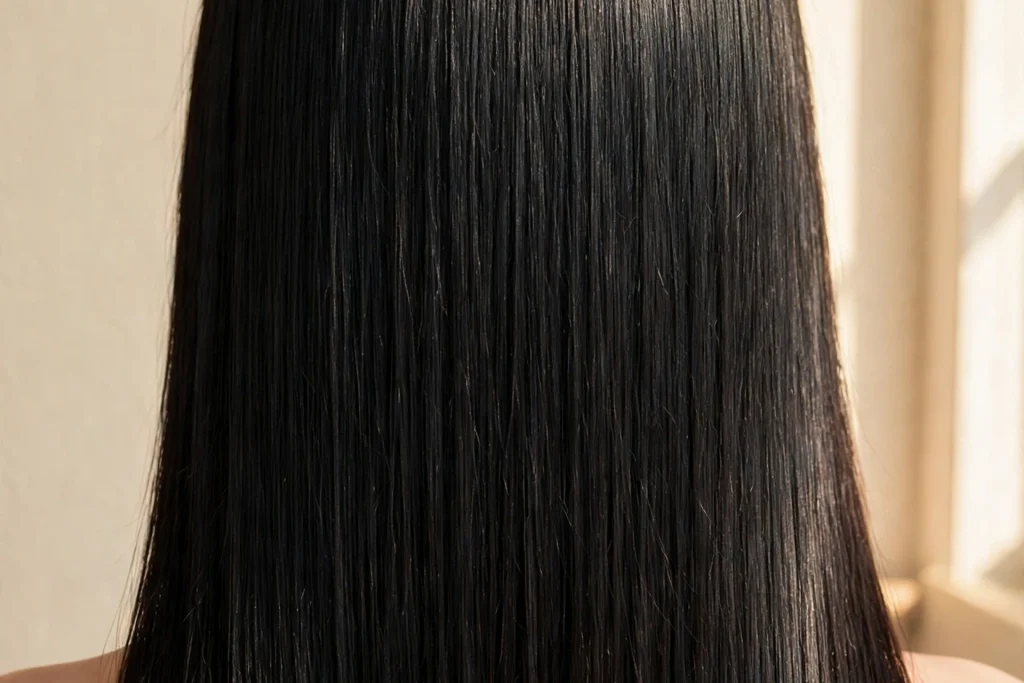
8. The Single-Process Deep Color
This is the simplest color on this list, and sometimes the most striking. The whole head is colored one deep shade, all the way through, with no highlights, no lowlights, no blend. Just one rich color, done well. Deep chocolate, espresso, inky black, or a dark auburn, all one shade, all the way to the ends. It looks expensive because it is uniform, and it looks dramatic because the color is so deep. It suits straight hair best, where the uniform color reads as a single sheet of shine, and it works on every face shape.
Ask your stylist for a single-process color in a shade two levels deeper than your natural color, so the change is clear but not shocking. Ask for a gloss on top if your hair is fine, because a gloss adds the shine that makes a single color look rich instead of flat. The upkeep is simple: a root touch-up every four to six weeks, and a color-safe shampoo in between.
Styling tip: Keep the ends healthy, because a single deep color shows dry, split ends more than a highlighted one does. A weekly mask and a drop of oil on the ends will keep the color looking rich. If the color starts to look flat, a clear gloss at the salon brings it back in one visit.
You may also like: 22 Winter Nail Color Trends That Make Winter Feel Beautiful, if you want dark nails to match a deep hair color.
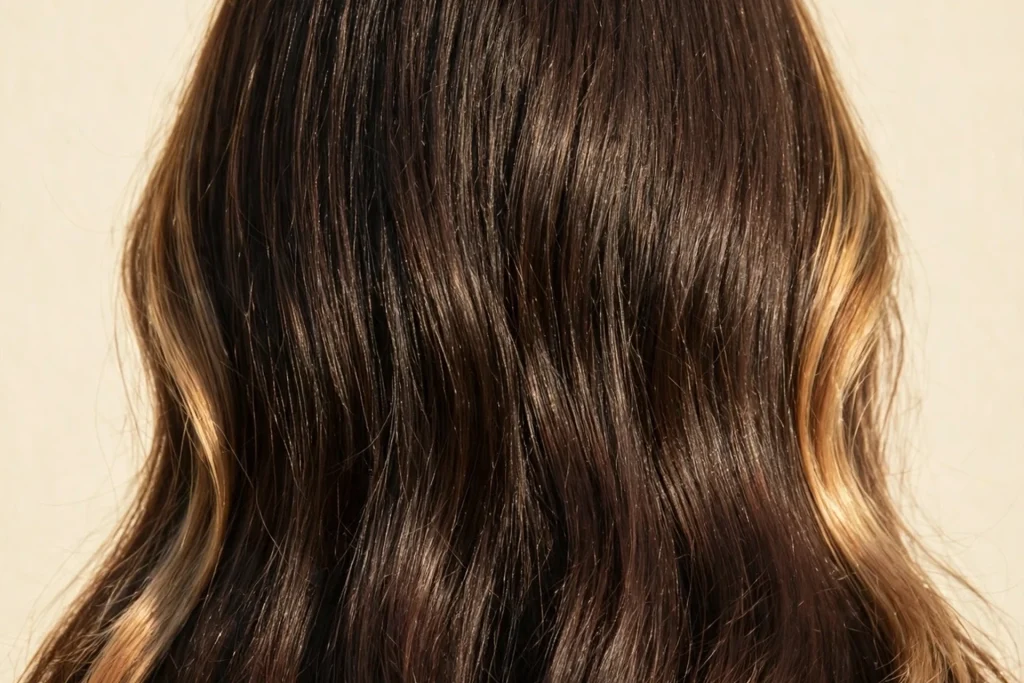
9. The Money-Piece Frame on Dark Hair
This is the one bright detail in a dark style. Two face-framing pieces at the front are lightened, just the front sections, while the rest of the hair stays dark. The light pieces catch the light around the face and make the whole style look brighter, without lightening the whole head. It suits dark brown and black hair best, and it works on every face shape, because the light pieces draw the eye to the face. It is also one of the cheapest color techniques to maintain, because only two small sections need touching up.
Ask your stylist for money-piece highlights, two face-framing sections lightened two to three shades lighter than the rest, with a soft blend where they meet the dark hair. The pieces should start at the part and run down past the chin, so they frame the face from the front and from the side. Keep the rest of the hair dark and glossy, so the contrast does the work.
Styling tip: Style the front pieces with a round brush, curving them slightly away from the face, so the light catches them. A drop of shine serum on the front pieces makes them glow. The rest of the hair can be left straight or wavy, it does not matter, because the money pieces are doing the talking.
You may also like: 22 December Nails That Feel Festive and Look So Beautiful, if you want a festive look to go with the bright frame.
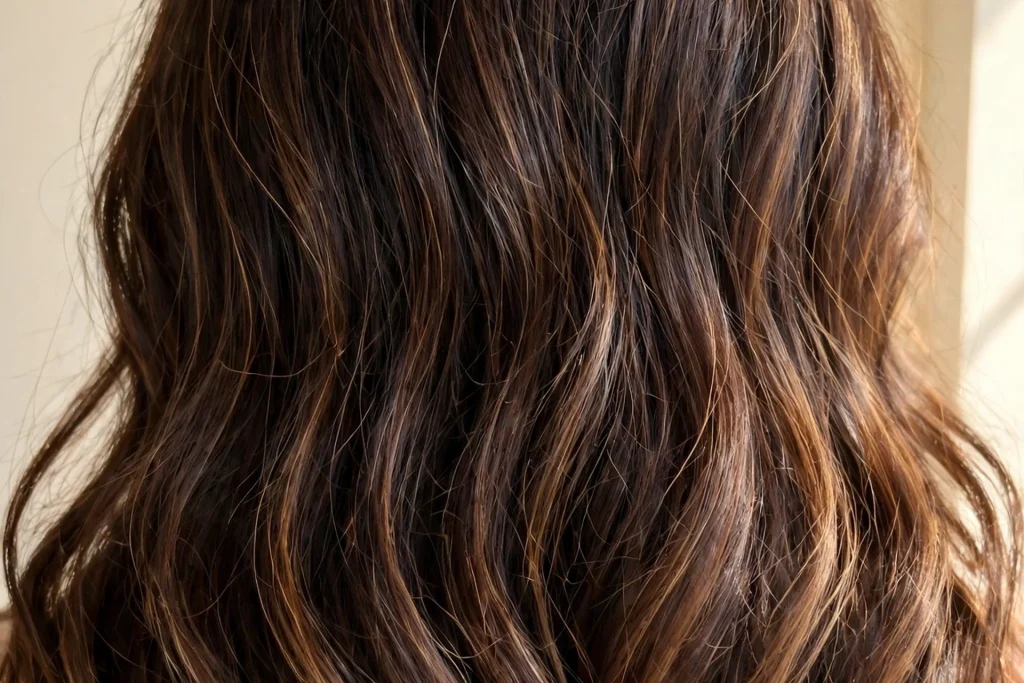
10. The Dimensional Dark Blend
This is the dark color that looks like it has light inside it. The stylist paints fine, hand-painted highlights through dark hair, not in stripes, but in soft, scattered pieces that catch the light when the hair moves. The base stays dark, but the blend gives it depth, so the color looks different from every angle. It suits wavy and curly hair best, because the movement shows off the dimension, and it works on every face shape. It is also the most forgiving dark color to grow out, because there is no hard line anywhere.
Ask your stylist for a hand-painted dimensional blend on a dark base, with the lightest pieces two shades lighter than the base and placed mostly through the mid-lengths and ends. Ask for the pieces to be fine and scattered, not chunky, so the blend looks like natural light on dark hair instead of stripes. Bring a photo of the dimension you want, because “dimensional” means different things to different stylists.
Styling tip: Scrunch a little curl cream into damp hair and let it air dry, or diffuse it on low heat, so the waves show off the dimension. Straightening it flat hides the blend, so save the flat iron for days when you want a sleek look instead. A weekly mask keeps the lightened pieces from going dry in winter.
You may also like: 22 January Nail Colors That Make Winter Feel So Beautiful, if you want soft winter nails to go with a dimensional dark color.
Group 3: The Drama
These four are the showpieces. They are the styles you wear to a party, a dinner, or a night out, when you want your hair to be part of the outfit. They take a little more effort than the everyday cuts, but they pay it back in the room.
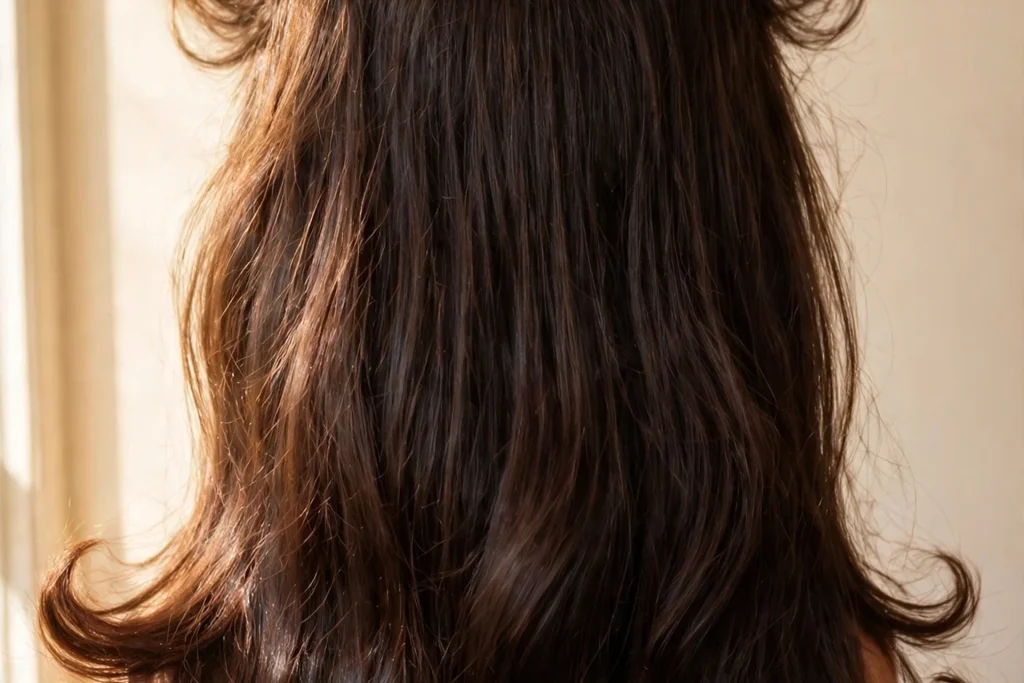
11. The Big Bouncy Blowout
This is the big one. The hair is blown out with a round brush until it is full, bouncy, and curved under at the ends, with volume at the roots and movement through the lengths. It is the 90s supermodel look, and it works in winter because the volume survives a coat and a scarf better than a flat style does. It suits medium to long hair best, and it works on every face shape, because the volume frames the face softly. It is also the style that gets the most compliments, because it looks like you spent an hour on it, even when you did not.
Ask your stylist for long layers that start below the chin, so the blowout has something to bounce with, and ask for the ends to be cut so they curve under naturally. At home, the trick is the round brush: lift the roots up and away from the head as you dry, and roll the ends under at the bottom. A large round brush, the biggest you can handle, gives the most volume.
Styling tip: Blow dry in sections, starting at the bottom and working up, and roll each section around the brush and hold it for five seconds before letting it drop. A light hairspray on the roots, sprayed from underneath, holds the volume without making the hair stiff. Do not brush it out after, or the volume collapses. Let it fall on its own.
You may also like: 22 Winter Outfits That Look Good Even When It Is Freezing, if you want an outfit that matches a big blowout.
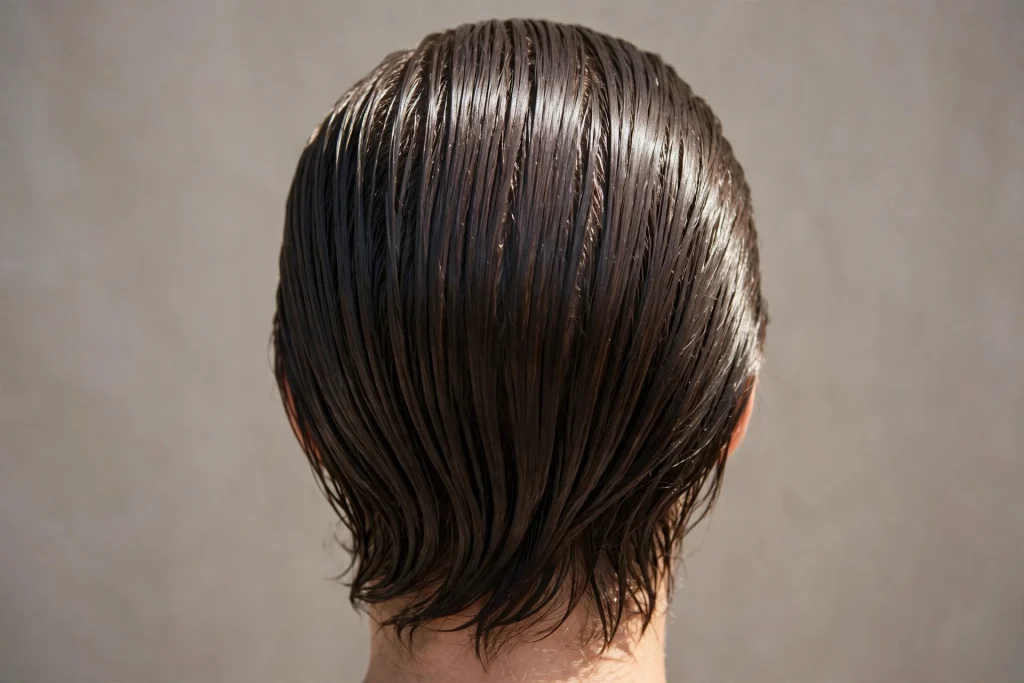
12. The Wet-Look Slick Back
This is the most dramatic style on this list, and the simplest to do. The hair is combed straight back from the face, smoothed flat against the head, and finished with a product that gives it a wet, glossy shine. It looks like you just stepped out of the rain, on purpose. It suits straight and wavy hair, and it works best on oval and heart-shaped faces, because the slicked-back shape shows the whole face. It is also the best winter hair style for a night out, because it does not move, it does not frizz, and a scarf cannot dent it.
Ask your stylist for a cut with enough length on top to slick back, at least four to five inches, and short enough at the sides that the slicked shape holds. At home, the product matters more than the cut. Work a strong-hold gel or a wet-look cream through damp hair, comb it straight back with a fine-tooth comb, and let it dry without touching it. The shine is the whole point, so do not use a matte product.
Styling tip: Apply the product to damp hair, not dry, or it goes white and flaky. Comb it back in one smooth motion, and then leave it alone. If it starts to dry and lose its shine, smooth a tiny bit more product over the surface with your palms. A pair of statement earrings finishes the look, because the whole face is on show.
You may also like: Minimal Jewelry Ideas That Make You Look Put Together Without Trying, if you want jewelry that suits a slicked-back style.
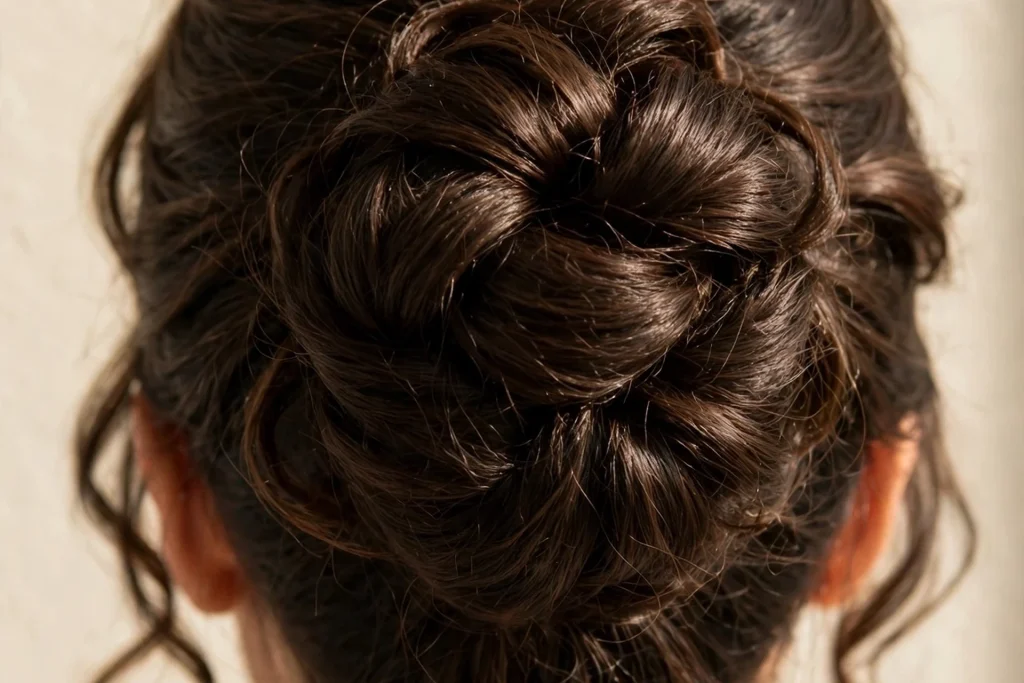
13. The Sculpted Updo for Winter Nights
This is the updo for a winter evening, when the hair needs to be up, out of the way, and beautiful. The hair is swept up and pinned into a soft, sculpted shape, with a few loose pieces left out around the face. It is not a tight, severe bun. It is soft, full, and shaped, like a sculpture that happens to be hair. It suits medium to long hair, and it works on every face shape, because the loose pieces soften it. It is also the best style for a coat with a high collar, because the hair is up and clear of the collar.
Ask your stylist to show you a soft updo with volume at the crown and loose pieces at the front, pinned loosely so it does not look stiff. At home, the trick is to start with day-old hair, which holds a pin better than clean hair, and to backcomb the crown lightly before you pin it up. The volume at the crown is what makes it look sculpted instead of flat.
Styling tip: Gather the hair loosely at the back, twist it up, and pin it in place with bobby pins that match your hair color. Leave two thin pieces out at the front and curl them lightly with a curling iron. A light hairspray holds it without making it crunchy. If a piece falls out during the evening, leave it out. It looks better that way.
You may also like: Medium Gold Hoops with Casual Outfits That Always Look Effortless, if you want earrings that suit an updo.
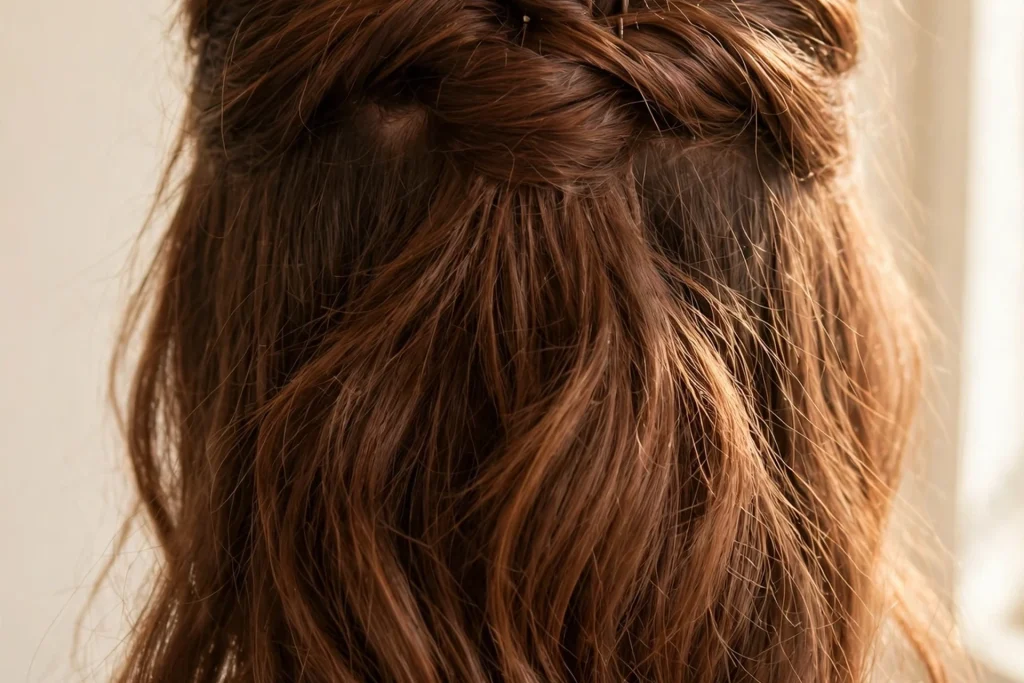
14. The Half-Up Twist With Volume
This is the drama you can wear every day. The top half of the hair is pulled back and twisted, then pinned at the crown, while the bottom half stays down and loose. The twist gives the crown volume and lift, and the loose lengths keep it soft. It suits medium to long hair, and it works on every face shape, because the lift at the crown lengthens the face. It is also one of the best winter hairstyles for women who want their hair out of their face without putting it all up.
Ask your stylist for long layers that start below the chin, so the loose half has movement, and ask for a little texture at the crown, so the twist has something to grip. At home, the trick is the twist itself: take two sections from the front, twist them back toward the crown, cross them over each other, and pin them. The volume comes from pulling the twist up slightly after you pin it, so it lifts off the head.
Styling tip: Tease the crown lightly with a comb before you twist, just three or four strokes, and the twist will sit higher. Use two bobby pins crossed over each other to hold it, because one pin slips. Leave the bottom half loose and wavy, or straight, either works. A velvet scrunchie at the twist, instead of pins, turns it into a going-out style.
You may also like: 22 Winter Nails Trends for 2027 From Quiet to Full Sparkle, if you want nails that match a half-up style for a night out.
Group 4: The Winter Care
These four are the styles that protect your hair while the weather is rough. They are not about looking dramatic. They are about keeping your hair healthy through the cold months, so it is still in good shape when spring comes.
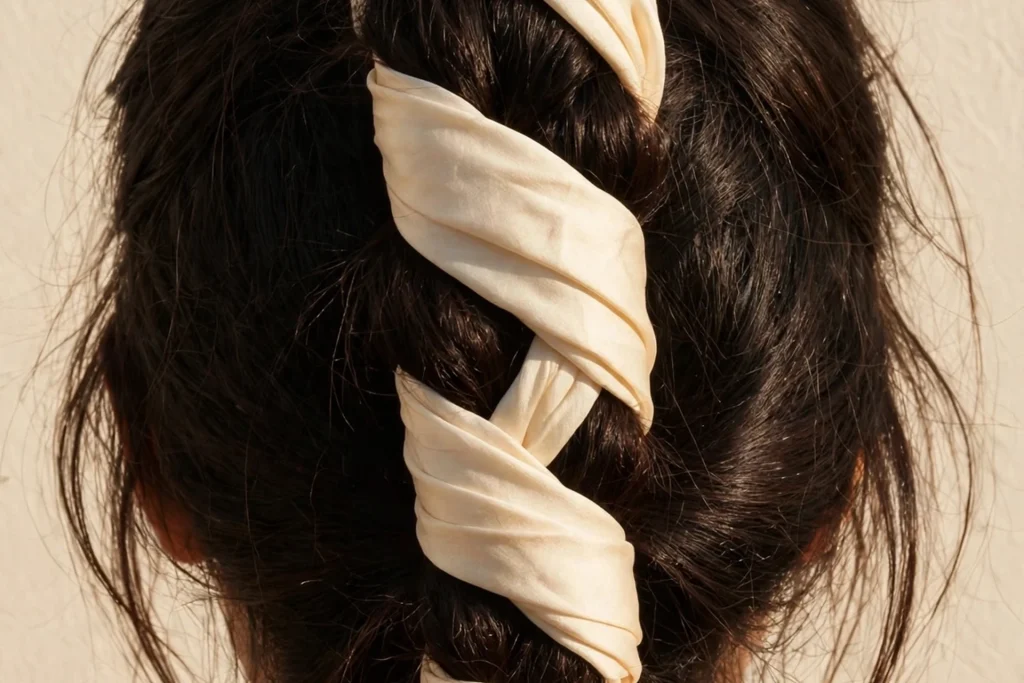
15. The Silk-Scarf Wrap Style
This is the protective style that looks like a fashion choice. The hair is gathered low at the nape, loosely braided or twisted, and then wrapped in a silk scarf, tied under the chin or at the back of the neck. The silk protects the hair from the wool scarf and the coat collar, which are the two things that rub winter hair the most. It suits every hair length past the chin, and it works on every face shape, because the scarf frames the face softly. It is also the best winter hair style for a windy day, because nothing moves.
Ask your stylist for a cut that gathers easily at the nape, which means no short layers at the back that stick out when you tie it. At home, the trick is the scarf itself: silk or satin, not cotton, because silk lets the hair slide instead of catching on it. Tie it loosely, so it does not press a dent into the hair, and tuck the ends in so they do not flap in the wind.
Styling tip: Braid the hair loosely before you wrap it, and the braid holds the shape under the scarf without needing pins. When you take the scarf off inside, undo the braid and shake the hair out. The loose waves from the braid look like you styled it on purpose, which, in a way, you did.
You may also like: 22 Sweater Dress Outfits That Stay Warm Without the Bulk, if you want a winter outfit that pairs with a scarf wrap.
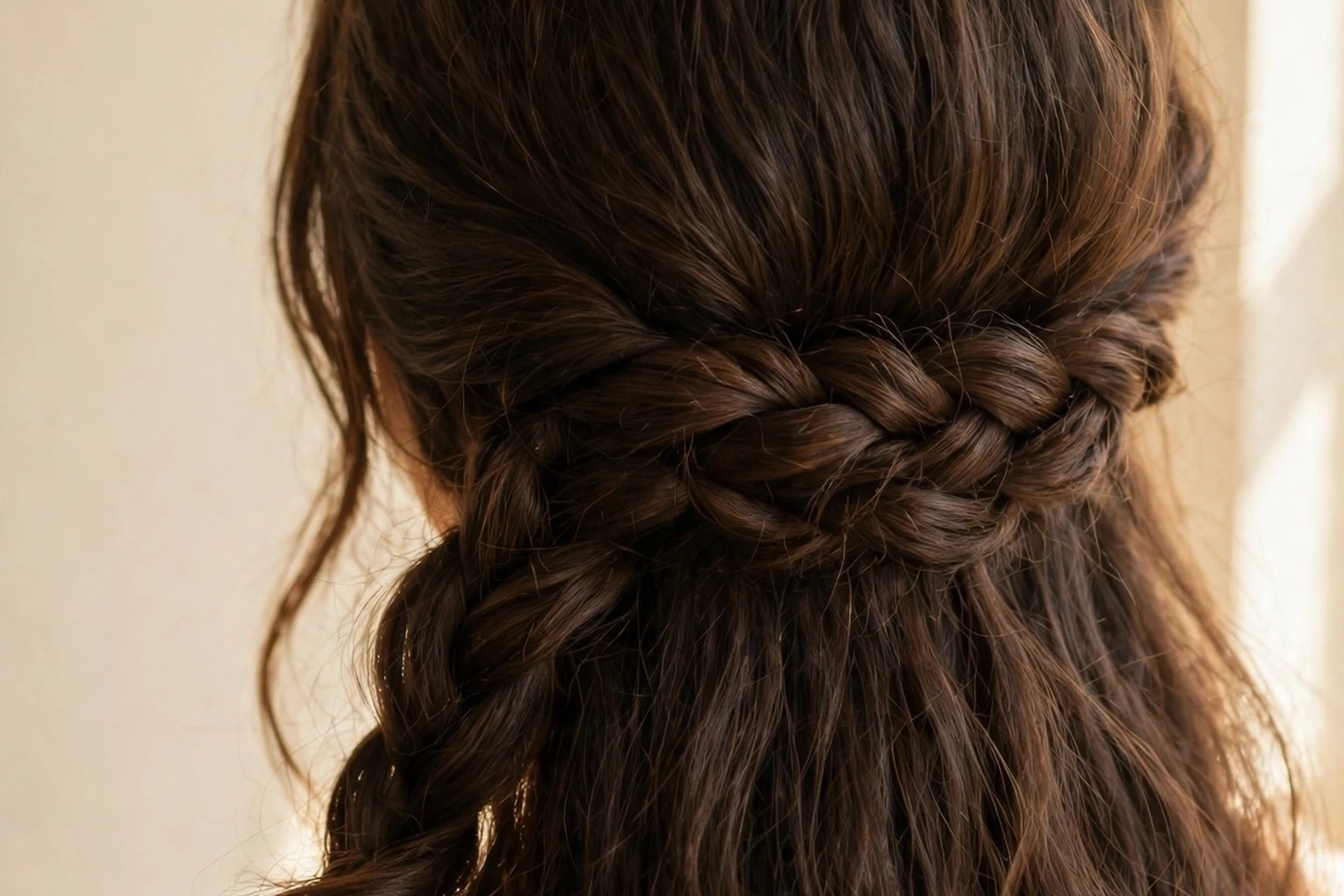
16. The Low Braided Crown
This is the protective style that keeps the hair completely out of the way. The hair is braided low, in a single loose braid that sits over one shoulder or down the back, with the braid starting at the nape so it does not pull at the roots. It suits medium to long hair, and it works on every face shape, because the braid is low and soft. It is also the best style for a day when you are wearing a heavy coat and a thick scarf, because the braid sits flat under the collar and does not tangle.
Ask your stylist for long layers that start below the chin, so the braid has enough length to look full, and ask for no short layers at the front that fall out of the braid. At home, the trick is to braid loosely, not tightly. A tight braid pulls at the roots and leaves a dent. A loose braid protects the hair and looks softer. Tie it with a fabric-covered elastic, not a rubber band, because rubber bands snap winter-dry hair.
Styling tip: Braid the hair when it is slightly damp, and it will hold the braid without needing product. When you take the braid out at night, the hair will have soft waves from the braid, which is a free style for the next day. A drop of oil on the ends before you braid keeps them from drying out under the coat.
You may also like: 22 Winter Outfits for Women That Beat the Freezing Cold, if you want a coat that works with a low braid.
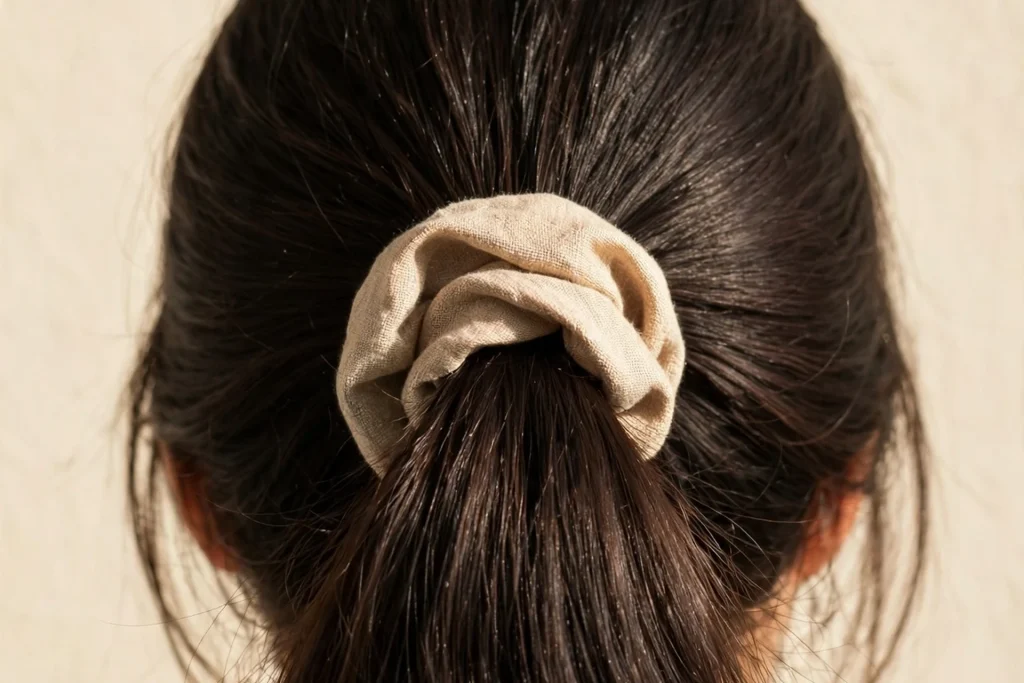
17. The Hat-Friendly Low Ponytail
This is the style for hat season. The hair is gathered into a low ponytail at the nape, tied loosely, and left to fall down the back. The low position means the hat sits on top of the head without pressing on the ponytail, and when the hat comes off, the hair falls back into place with one shake. It suits every hair length past the shoulders, and it works on every face shape. It is also the fastest winter hair style on this list, which is why it is the one you will actually wear on a cold morning.
Ask your stylist for a cut with no short layers at the crown that stick up when the hair is pulled back. At home, the trick is the tie: a fabric-covered elastic or a silk scrunchie, tied loosely, so it does not leave a dent or snap dry hair. Gather the hair with your fingers, not a brush, so it stays soft and a little loose at the front.
Styling tip: Before you put the hat on, smooth a drop of leave-in cream over the surface of the hair, so the hat slides instead of catching. When you take the hat off, bend forward, shake the hair out, and flip it back. The low ponytail falls back into place, and the front pieces soften around the face. If the crown is flat, lift it with your fingers and a quick spray of dry shampoo at the roots.
You may also like: 24 Fall Winter Nails That Make Autumn Feel So Beautiful, if you want autumn-to-winter nails to go with a low ponytail.
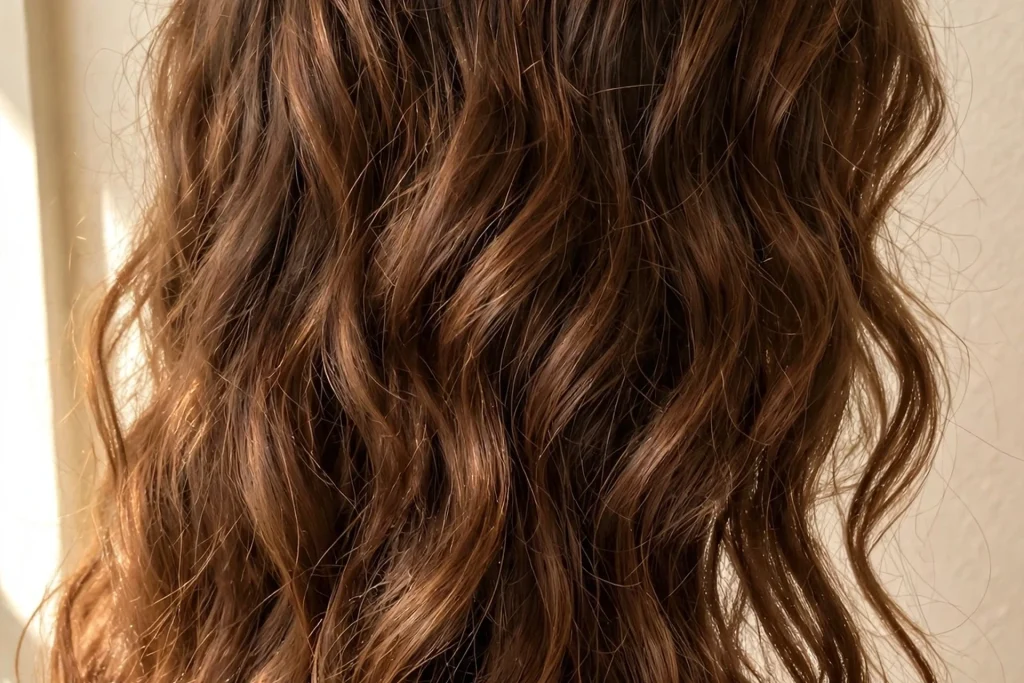
18. The Overnight Heatless Waves
This is the style that asks nothing of you in the morning. Before bed, the hair is twisted into two or three loose braids or twists, and left overnight. In the morning, you undo them, and the hair has soft waves, with no heat, no styling, and no damage. It suits medium to long hair, and it works on every face shape, because the waves are soft and loose. It is also the best winter hair style for hair that is already dry, because it adds texture without adding heat.
Ask your stylist for long layers that start below the chin, so the waves have something to move with, and ask for the ends to be cut blunt, so the waves look full instead of wispy. At home, the trick is the dampness: the hair should be slightly damp, not wet, when you twist it, or it will still be damp in the morning. A little leave-in cream on the lengths before you twist keeps the waves soft.
Styling tip: Twist the hair into two loose braids, one on each side, and tie them with fabric-covered elastics. Sleep on a silk pillowcase, and the waves will be smoother in the morning. Undo the braids, shake the hair out with your fingers, and do not brush it, or the waves turn to frizz. A drop of oil on the ends finishes it.
You may also like: 22 Winter Hair Colors That Make Winter Feel So Beautiful, if you want a deep color that shows off heatless waves.
Group 5: The Finishing Touches
These four are the small things that make a winter style feel finished. An accessory, a twist, a clip, a knot. They take two minutes and they change the whole look. They are the difference between hair that is just done and hair that looks considered.
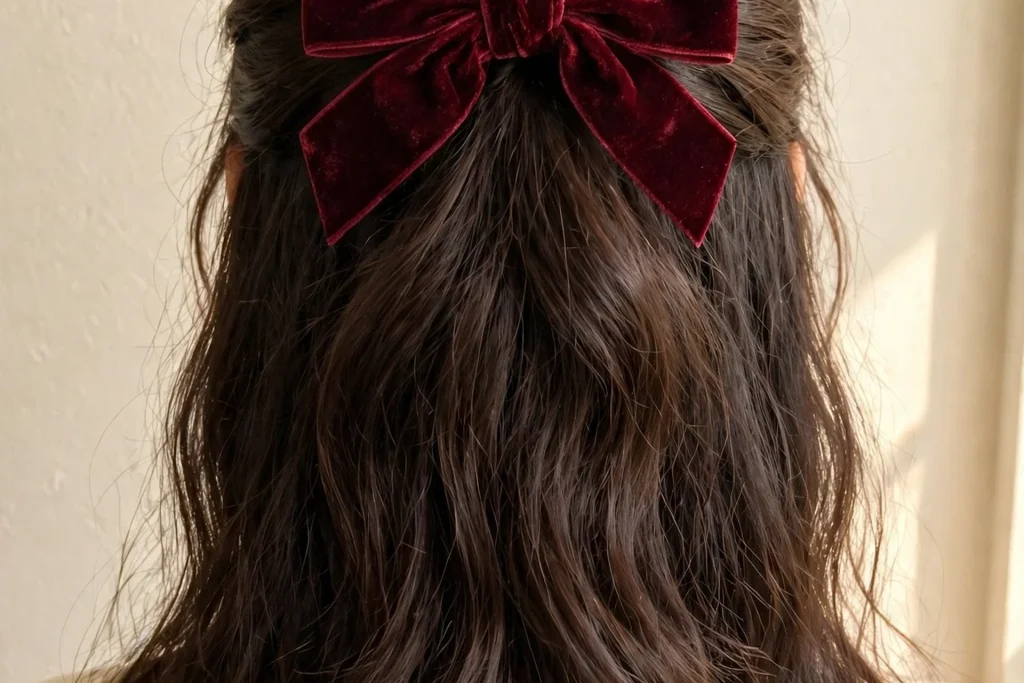
19. The Velvet Bow Half-Up
This is the prettiest finishing touch on this list. The top half of the hair is pulled back and tied with a velvet bow, in a deep winter color like burgundy, forest green, or black, while the bottom half stays down and loose. The bow is the whole point. It is soft, it is festive, and it turns an everyday half-up style into something that looks like it belongs at a holiday dinner. It suits medium to long hair, and it works on every face shape.
Ask your stylist for long layers that start below the chin, so the loose half has movement, and ask for a little texture at the crown, so the bow has something to sit on. At home, the trick is the bow itself: velvet, not satin, because velvet grips the hair and stays put, while satin slides. Tie the bow over a small elastic, so the elastic holds the hair and the bow just sits on top of it.
Styling tip: Pull the top half back loosely, tie it with a small elastic, then tie the velvet bow over the elastic and fluff the loops until they look full. Leave the bottom half wavy or straight, either works. If the bow slides, pin it with two bobby pins crossed underneath it, and it will stay all evening.
You may also like: 22 December Nails That Feel Festive and Look So Beautiful, if you want festive nails to match a velvet bow.
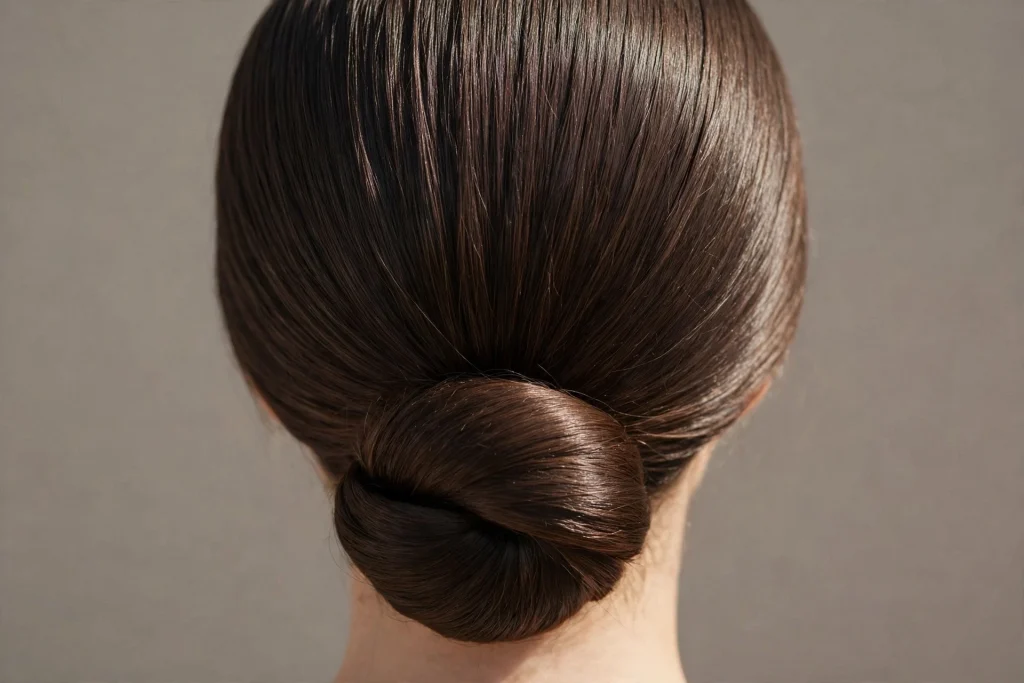
20. The Smooth Nape Bun
This is the cleanest finishing touch. The hair is gathered low at the nape and twisted into a smooth, sleek bun, with no bumps, no flyaways, and a clean part. It looks polished and expensive, and it takes five minutes. It suits every hair length past the shoulders, and it works on every face shape, because the low position is soft and flattering. It is also the best style for a high-collared coat, because the hair is up and clear of the collar, and for a night when you do not want to think about your hair at all.
Ask your stylist for a cut with no short layers at the crown that stick up when the hair is pulled back. At home, the trick is the smoothing: brush the hair back with a boar bristle brush, which smooths the surface without creating static, and use a light gel on the surface to hold down flyaways. Twist the hair at the nape, wrap it around itself, and pin it with bobby pins that match your hair color.
Styling tip: Do the bun on second-day hair, which holds better than clean hair, and smooth a drop of shine serum over the surface after you pin it. If a few flyaways pop up during the day, smooth them down with a tiny bit of hand cream, rubbed between your palms first. A pair of small gold hoops finishes the look without competing with the clean line of the bun.
You may also like: Medium Gold Hoops with Casual Outfits That Always Look Effortless, if you want earrings that suit a sleek low bun.
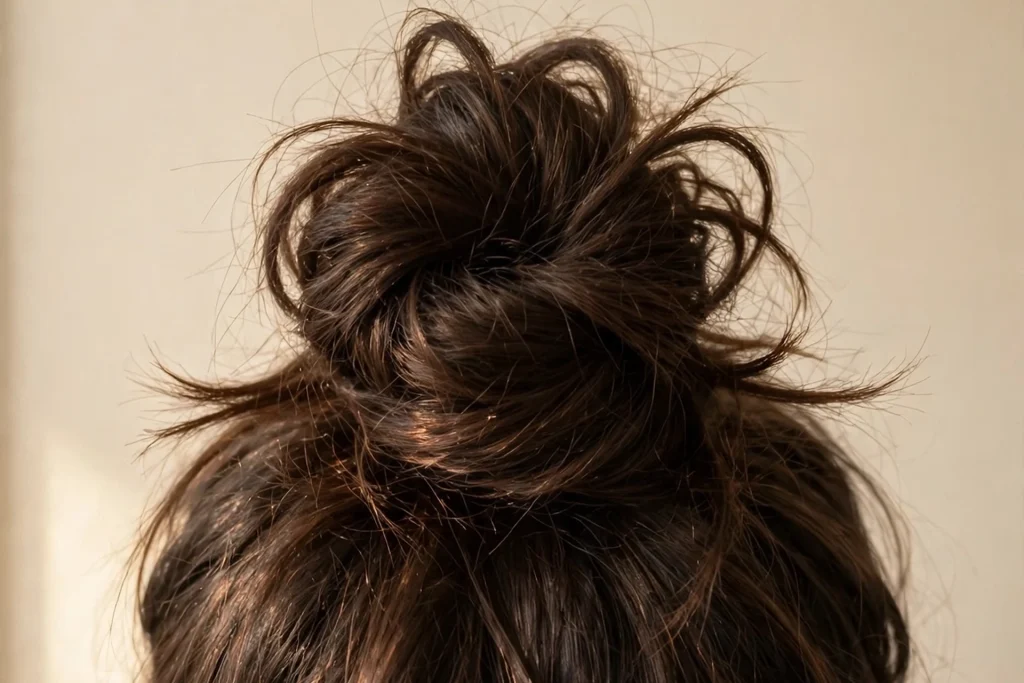
21. The Textured Top Knot
This is the messy one, done on purpose. The hair is gathered high on top of the head and twisted into a loose, textured knot, with a few pieces pulled out around the face and at the nape. It looks effortless because it is, mostly, but the texture is deliberate: the knot is full and soft, not tight and small. It suits medium to long hair, and it works on every face shape, because the height on top lengthens the face. It is also the best style for a day when your hair is not cooperating, because a top knot turns a bad hair day into a style.
Ask your stylist for long layers that start below the chin, so the knot has texture to work with, and ask for no short layers at the front that fall out of the knot. At home, the trick is the texture: work a little texturizing spray or dry shampoo through the hair before you gather it, so the knot has grip and fullness. Gather the hair high, twist it loosely, wrap it around itself, and pin it. Then pull a few pieces out around the face and at the nape, and pull the knot itself a little wider, so it looks full instead of tight.
Styling tip: Do the knot on hair that is a day or two old, because clean hair slips out of a top knot. If the knot feels too small, pull it apart gently with your fingers, section by section, until it looks full. A few bobby pins crossed underneath hold it all day. If the front pieces fall flat, curl them lightly with a curling iron and leave them loose.
You may also like: 22 Winter Outfits for Women That Beat the Freezing Cold, if you want a winter outfit that works with a top knot.
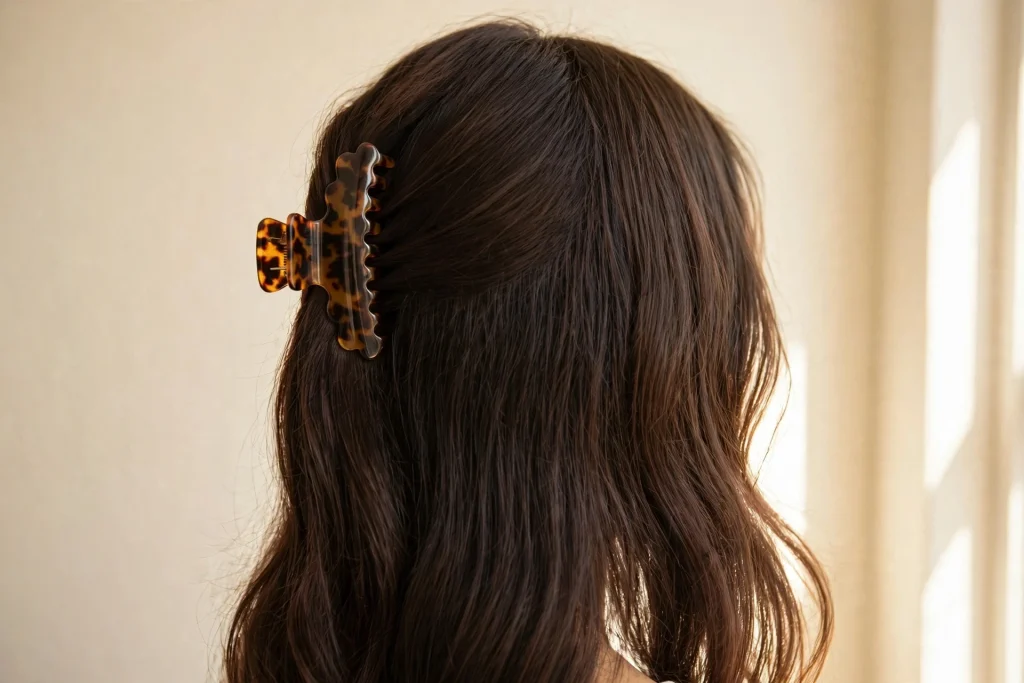
22. The Statement Clip Sweep
This is the easiest finishing touch of all. One side of the hair is swept back from the face and held with a single statement clip, a large tortoiseshell clip, a gold barrette, or a pearl clip, while the rest of the hair stays down and loose. The clip is the whole style. It holds the hair back, it catches the light, and it makes a simple down style look deliberate. It suits every hair length past the chin, and it works on every face shape.
Ask your stylist for a cut with enough length at the front to sweep back, at least to the chin, and ask for a little layering at the front, so the swept section blends into the rest of the hair instead of looking like a separate piece. At home, the trick is the placement: sweep the hair back from one side, just above the ear, and clip it there, so the clip sits at the temple and the hair falls behind it. The other side stays loose, so the style looks asymmetric and interesting.
Styling tip: Smooth a drop of shine serum over the swept section before you clip it, so it lies flat and glossy. Choose a clip that is heavy enough to hold the hair, because a light clip slides out by lunchtime. A tortoiseshell clip works with everything, a gold barrette looks dressy, and a pearl clip is the festive choice. One clip is enough. Two clips look like you are trying too hard.
You may also like: Minimal Jewelry Ideas That Make You Look Put Together Without Trying, if you want simple jewelry that pairs with a statement clip.
The 1-2-3 Winter Hair Method
If you take one framework from this guide, take this one. It works for every style above, and it takes less time than you think.
1. One shape that survives winter. Pick a cut with a clean line and weight in the right places, so a hat, a scarf, and a coat collar do not wreck it. A sharp bob, a blunt long cut, or a pixie with a long top all do this. A fussy cut with short pieces chopped into the surface does not. Before you book anything, ask yourself: will this shape still look good when I take my hat off? If the answer is no, pick a different shape.
2. Two products, not ten. Winter hair needs moisture and hold, and two products do both. A leave-in conditioner on damp hair, and a light oil or serum on the ends. That is it. The leave-in keeps the hair hydrated through the dry indoor heat. The oil seals the ends and smooths static. Everything else is optional. If you buy ten products, nine of them will sit in the cupboard. Buy two good ones and use them every time.
3. Three minutes of care a day. Smooth a drop of oil on the ends in the morning. Brush the hair with a wooden comb or a boar bristle brush, not plastic, so you do not build up static. And once a week, leave a mask in for ten minutes while you do something else. Three minutes a day and ten minutes a week is enough to keep winter hair healthy until spring.
Before and after: Before this method, winter hair meant flat roots, static sides, dry ends, and a hat dent that never came out. After it, the cut holds its shape, the color looks deep, and the ends stay smooth. The difference is not a miracle product. It is a shape that works with winter, two products used every time, and three minutes of care a day.
At a Glance
| Style | Effort | Upkeep | Best For |
|---|---|---|---|
| 1. The Pin-Straight Glass Bob | Medium | Trim every 4 to 6 weeks | Straight hair, oval and heart faces |
| 2. The Shortest Winter Bob | Low | Trim every 4 to 6 weeks | Bold short looks, hat season |
| 3. The Sharp Pixie With a Long Top | Low | Trim every 4 to 6 weeks | Fine hair, oval, heart and round faces |
| 4. The French Bob With a Short Fringe | Medium | Trim every 4 to 6 weeks | Straight hair, oval and long faces |
| 5. The Long One-Length Cut With Blunt Ends | Low | Trim every 6 to 8 weeks | Long hair, every face shape |
| 6. The Glossed Dark Bob | Low | Gloss every 4 to 6 weeks | Deep color, low winter light |
| 7. The Shadow Root Grow-Out | Low | Visit every 8 to 10 weeks | Low maintenance, every length |
| 8. The Single-Process Deep Color | Low | Root touch-up every 4 to 6 weeks | Straight hair, uniform shine |
| 9. The Money-Piece Frame on Dark Hair | Low | Touch up two sections only | Dark hair, brightening the face |
| 10. The Dimensional Dark Blend | Low | Visit every 8 to 10 weeks | Wavy and curly hair, soft depth |
| 11. The Big Bouncy Blowout | High | Blow dry each time | Parties, medium to long hair |
| 12. The Wet-Look Slick Back | Low | Restyle each time | Nights out, oval and heart faces |
| 13. The Sculpted Updo for Winter Nights | Medium | Restyle each time | Evening events, high collars |
| 14. The Half-Up Twist With Volume | Low | Restyle each time | Everyday drama, medium to long hair |
| 15. The Silk-Scarf Wrap Style | Low | None | Windy days, every length past chin |
| 16. The Low Braided Crown | Low | None | Heavy coats, medium to long hair |
| 17. The Hat-Friendly Low Ponytail | Low | None | Hat season, every length past shoulders |
| 18. The Overnight Heatless Waves | Low | None, overnight | Dry hair, medium to long hair |
| 19. The Velvet Bow Half-Up | Low | None | Holiday dinners, medium to long hair |
| 20. The Smooth Nape Bun | Low | None | High collars, every length past shoulders |
| 21. The Textured Top Knot | Low | None | Bad hair days, medium to long hair |
| 22. The Statement Clip Sweep | Low | None | Everyday polish, every length past chin |
Do This Not That
| Do This | Not That |
|---|---|
| Pick a shape with a clean line that survives a hat | Pick a fussy cut with short pieces chopped into the surface |
| Ask for weight taken out of the inside, not the surface | Ask for thinning shears on the top layer, which causes frizz and spiky regrowth |
| Use a leave-in on damp hair and oil on the ends only | Pile heavy products on the roots, which makes hair greasy by lunch |
| Wash two or three times a week in winter | Wash every day, which strips the natural oils winter hair needs |
| Use a wooden comb or boar bristle brush | Use a plastic brush on dry hair, which builds static |
| Line a wool hat with silk or wear a silk scarf under it | Let wool and acrylic touch your hair all day |
| Trim every 6 to 8 weeks, or 4 to 6 for short cuts | Skip trims all winter, so split ends travel up the strand |
| Do a weekly mask for ten minutes | Rely on daily conditioner alone, which only smooths the surface |
| Choose a deeper color with dimension for winter light | Choose a flat, pale color that washes out in weak winter light |
| Let a gloss or a shadow root grow out gently | Book a full color every four weeks when a root touch-up would do |
Your Winter Hair Styles Weekend Plan
Saturday morning: the salon. Book the cut first, before anything else, because December weekends fill fast. Bring photos of the shape you want and photos of the color blend you want, not just the color, so the stylist can see the softness and the depth you mean. Ask for the cut to be done with the hair dry or nearly dry, so the line is exact. If you are getting color, ask for a gloss on top, and ask how long it will last, so you know when to come back.
Saturday afternoon: the products. Buy two things and only two things, if you do not have them already. A leave-in conditioner and a light oil or serum. While you are there, pick up a fabric-covered elastic or two, and a silk pillowcase if you do not own one. Skip the rest. The cupboard is already full enough.
Sunday morning: the practice. Try the style you picked, at home, with no pressure. Blow dry the bob smooth, or twist the half-up, or pin the low bun. Time yourself. If it takes more than fifteen minutes, simplify it. A winter style you cannot do in fifteen minutes is a style you will not do on a cold morning. Practice once, so Monday is not the first time.
Sunday evening: the mask. Wash the hair, squeeze out the water, and put a mask on from the mid-lengths to the ends, never on the scalp. Leave it in for ten to fifteen minutes while you do something else. Rinse with lukewarm water, not hot. This is the one weekly habit that keeps winter hair soft until spring.
Monday morning: the test. Wear the style out, with a hat and a scarf, the way you actually live. When you get inside, take the hat off and shake the hair out. If the shape comes back with one shake, the cut is right. If it does not, tell your stylist next time, and ask for more weight in the right places and less fuss on the surface.
Take It Further
If you liked this guide, these articles from Supliice pair with it nicely. A fresh cut deserves a color that shows it off, an outfit that matches it, and nails that finish the look.
- 22 Medium Length Hairstyles for Thick Hair That Work So Well
- 22 Winter Hair Colors That Make Winter Feel So Beautiful
- 22 Sweater Dress Outfits That Stay Warm Without the Bulk
- 22 Winter Outfits for Women That Beat the Freezing Cold
- 22 Winter Outfits That Look Good Even When It Is Freezing
- 22 December Nails That Feel Festive and Look So Beautiful
- 22 Winter Nail Color Trends That Make Winter Feel Beautiful
- 22 January Nail Colors That Make Winter Feel So Beautiful
Stylist’s Cheat Sheet
- The shape matters more than the styling. A clean line holds itself together. A fussy cut falls apart by lunch.
- Winter light rewards depth. Deeper colors, glosses, shadow roots, and dimensional blends all look better in low winter light than flat, pale color.
- Two products are enough. A leave-in on damp hair and a light oil on the ends. Everything else is optional.
- Wash less, mask more. Two or three washes a week in winter, and a mask once a week for ten to fifteen minutes.
- Static is a dryness problem, not a hair problem. Hydrated hair holds far less charge. If the hair is static, it is dry. Fix the dryness first.
- Hats need silk between them and your hair. Line a wool hat with silk, or wear a silk scarf under a wool one, so wool never touches your hair.
- Trims are not optional in winter. Every 6 to 8 weeks for most cuts, every 4 to 6 weeks for short ones. Split ends travel up the strand faster when the hair is dry.
- A note on the numbers, said plainly. The phrase “winter 2027 hair trends” has no measurable search volume right now, no data on Pinterest and 0 on Google in the most recent week, with its 100 peak being a single-week spike in February 2024. The same goes for “winter hair trends 2027”, “haircuts winter 2027”, and “hair trends 2027”, all of which sit at 0 on Google in the most recent week. Winter hair styles are strongly seasonal, peaking from November to February and sitting near 0 from March to September. This guide is for the current winter season, at its best in the November to February peak, and the 2027-dated wording is a title phrase only, not a claim that “2027 trends” are trending right now.
- The working keyword for this guide is “winter hair styles”. It passes on both platforms, Pinterest 40 and Google 51, with a peak of 100 on both. The two-word spelling matters: one-word “winter hairstyles” sits at 30 on Pinterest, which is not a pass, and only 33 on Google. Use “winter 2027 hair” and “winter hair trends 2026” as supporting terms, and treat “hair trends winter 2027” as a title phrase only.
Questions People Ask
The best winter haircut is one with a clean, strong line that survives a hat and a scarf. A sharp bob, a blunt long cut, or a pixie with a long top all work, because the shape holds itself together even when you do nothing to it. Ask for weight taken out of the inside, not chopped into the surface, so the hat dent falls out with one shake.
Static is a dryness and friction problem, not a hair problem on its own. Dry hair picks up a charge when it rubs against wool, acrylic, and synthetic fabrics, and strands with the same charge push away from each other, which is what makes flyaways. Hydrate first, with a leave-in and a weekly mask, then swap plastic brushes for wood or boar bristle, smooth a drop of oil over the surface, and line wool hats with silk so wool never touches your hair.
Deeper colors with dimension look best in winter light. Rich browns, dark coppers, inky blacks, and cool blondes with a dark root all catch the low winter light better than a single flat shade. A gloss, a shadow root, or a few darker lowlights give the color something to catch the light with, so it looks richer the darker the days get. Flat, pale color washes out fast in weak winter light.
Most hair does well with a trim every 6 to 8 weeks in winter, because dry air makes split ends travel up the strand faster. Short cuts, like bobs and pixies, need one every 4 to 6 weeks to hold their shape, because a precision cut loses its line as it grows. Book the trim before the shape goes, not after, and a small dusting trim costs far less length than waiting until the splits have travelled.
A Last Word
Winter hair does not need to be a fight. It needs a shape that works with the cold, a color that works with the light, and a little care that you can actually keep up. Pick one style from this guide, book the cut, buy the two products, and give it a week. If the hat dent falls out with one shake and the ends still feel smooth on Friday, you picked right.
Neuman