The Anchor
The pavement still held the dull, baked-in heat of the afternoon sun, radiating a faint warmth through the thin rubber soles of my sneakers.
I took my dog out three times a day. It was a rigid, unbreakable routine. The morning walk was for energy, the afternoon walk was for fresh air, but the final walk of the day—the late-night walk—was something else entirely. It had become a habit I couldn’t break, a quiet, solitary ritual of isolation. I liked the emptiness of the world at that hour. I liked the way the neighborhood folded in on itself, abandoning the streets to the shadows and the stray cats.
The leash pulled taut, the heavy nylon digging a familiar, comforting groove into the calluses of my palm. My dog, a solid, broad-chested mix, kept his nose to the asphalt, aggressively cataloging the invisible scents left behind by the day’s foot traffic. The rhythmic click of his claws against the concrete was a steady, grounding metronome.
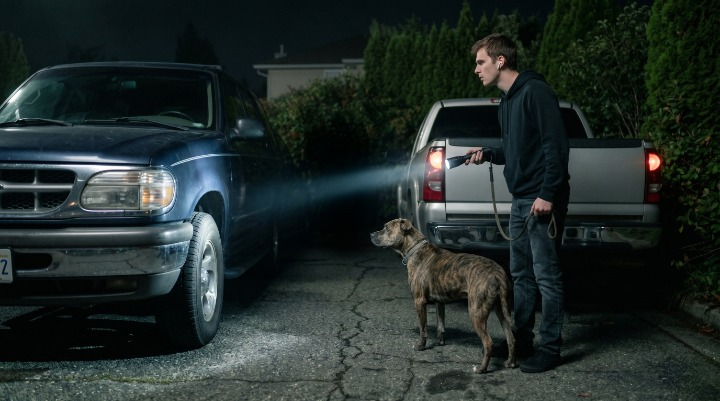
I kept a heavy, black aluminum flashlight in my left hand. My thumb rested lightly over the rubberized power button. In my right ear, a single white AirPod played a low, droning synth track. I never wore both. It was a hard rule of walking at night. You needed an anchor to the physical world. You needed one ear left entirely open to the wind, the rustle of the dry leaves, the sudden approach of tires, or the snap of a twig in the brush.
The music in my right ear was a barrier. The open air in my left was a security camera.
Our route never changed. We would start at the front door of my complex, follow the winding concrete pathway down the gentle slope of the hill, and exit through the main driveway. From there, the road bled into a massive, sprawling cul-de-sac that served as an overflow parking lot for the neighboring condominium buildings.
It was a dead zone. The city planners hadn’t bothered to install a single streetlamp in the cul-de-sac. It was a vast, circular expanse of cracked asphalt bordered by a high, impenetrable wall of dense evergreen bushes.
At midnight, it was a black hole.
The Dead Zone
We cleared the driveway exit. The ambient orange glow of the residential streetlights simply stopped at the edge of the cul-de-sac, unable to penetrate the thick canopy of the surrounding trees.
I pressed my thumb down on the flashlight. A brilliant, cutting beam of LED white ignited, slicing through the absolute dark. The beam swept across the asphalt, illuminating the reflective license plates of the cars parked along the outer edge.
There were a dozen vehicles out here tonight. Mostly large, hulking shapes. A heavy-duty pickup truck with an extended cab. A dark, boxy SUV with deeply tinted windows. A utility van. They sat shoulder-to-shoulder along the curved perimeter, their massive frames casting long, distorted, overlapping shadows across the asphalt.
The flashlight beam caught the chrome of a bumper, bounced off a side mirror, and lost itself in the deep, black chasms of space between the parked vehicles. The cars created a labyrinth of blind spots. If someone were crouching between the tires, or standing perfectly still behind the tailgate of the utility van, the flashlight wouldn’t catch them.
My dog pulled forward, his nose dropping back to the ground, entirely unfazed by the sudden drop in visibility. He led the way into the cul-de-sac. I followed, letting the music in my right ear dictate the slow, lethargic pace of my steps.
The air was perfectly still. Not a single leaf moved in the evergreens.
I was completely zoned out, my mind adrift in the heavy, synthesized bass of the track playing in my ear, letting muscle memory guide my feet along the edge of the parked cars.
Then, the frequency of the night shifted.
Bleed Through
It wasn’t a loud noise. It didn’t startle me. It was just a sound that didn’t belong in the auditory landscape.
It bled through the open air of my left ear, slipping beneath the music playing in my right. It was faint. Distant. A low, soft distortion that snagged on the edge of my consciousness.
I didn’t stop walking. My brain immediately tried to categorize it and file it away as harmless. A television playing through an open window in the condos. A stray cat crying in the bushes. The squeak of an old fan belt on a distant highway.
But as I took another step, the sound repeated.
It was a voice.
It was coming from somewhere up ahead, lost in the heavy shadows of the parked trucks.
My thumb twitched on the flashlight handle. The heavy nylon leash suddenly felt incredibly thin in my right hand.
I stopped.
My dog took two more steps before the leash pulled tight, snapping his head back slightly. He huffed in annoyance, shaking his head. The metal tags on his collar jingled sharply against the heavy silence of the cul-de-sac.
I raised my right hand, my fingers trembling ever so slightly, and tapped the stem of the AirPod.
The music cut out.
The sudden influx of absolute, dead silence was deafening. The ringing in my ears amplified, stretching out to fill the void left by the heavy bass. I held my breath, opening my mouth slightly to ensure the sound of my own respiration wouldn’t mask anything in the dark.
I stood perfectly still in the middle of the asphalt.
I waited. One second. Three seconds. Five seconds.
Nothing. Only the soft, rhythmic panting of my dog at the end of the leash.
I let out a slow, jagged exhale through my nose. My shoulders dropped a fraction of an inch. My mind rushed to rebuild the wall of denial. You’re tired. You’re hearing the echo of the music. You’re scaring yourself for no reason.
I did the stupidest, most profoundly human thing possible. I forced my foot forward. I kept walking.
The Blind Spot
I moved slower now. The casual, lethargic stroll was gone. My knees were slightly bent, my weight shifting carefully from heel to toe to minimize the crunch of gravel beneath my sneakers.
The cul-de-sac curved to the left. The wall of vehicles grew thicker here. The SUV sat next to the pickup truck, leaving a gap of perhaps three feet of absolute darkness between their steel bodies.
My flashlight beam trembled. It was a subtle, microscopic shake, born from the sudden, involuntary tension coiling in my forearms. The circle of white light swept over the rear tire of the truck, climbed the tailgate, and dipped into the empty space behind it.
Nothing.
I closed the distance. Twenty feet away from the rear bumper of the SUV. Fifteen feet.
The hair on my forearms began to stand on end. It was a deep, biological warning system firing off, thousands of years of evolutionary survival instinct screaming at me to turn around. The air suddenly felt too heavy. The space between the vehicles felt charged, electric, as if I were walking directly toward the edge of a sheer cliff in the dark.
I stopped again.
I planted my feet on the asphalt, my body angling slightly toward the dark gap between the truck and the SUV. I raised the flashlight, leveling the beam directly into the void.
The light caught the dust particles hovering in the stagnant air. It illuminated the faded yellow lines painted on the asphalt. It hit the thick, tangled roots of the evergreen bushes pressing against the concrete curb.
There was no one there.
I lowered the flashlight an inch, the tension beginning to bleed out of my jaw.
Then, the voice spoke again.
The Bait
“Help.”
The word hit me with the physical force of a sledgehammer.
My heart did not speed up. It simply dropped, plummeting into the bottom of my stomach like a stone. A violent, icy shockwave exploded outward from the center of my chest, instantly paralyzing my limbs. My lungs seized, trapping a half-drawn breath in the back of my throat.
The word had come directly from the left.
Directly from the heavy, impenetrable darkness pooling behind the tinted windows of the SUV and the bed of the pickup truck. Not more than fifteen feet away.
I couldn’t move my legs. The thick rubber grip of the flashlight slipped against the sudden, cold slickness of my palm. I frantically jerked my wrist, whipping the beam of light back and forth across the vehicles.
The light violently splashed against the chrome. It glinted off the red plastic of the taillights. It swept under the chassis, illuminating the oily pavement and the heavy treads of the tires.
Nothing. No shoes. No legs. No crouched figure.
My eyes darted wildly, searching for a face pressed against the tinted glass of the SUV, searching for the outline of a child huddled in the bed of the truck.
The space was empty.
I looked down at my dog. He was the anchor. He was the animal instinct.
He was entirely oblivious.
He had his nose buried in a tuft of weeds growing out of a crack in the pavement. His tail gave a slow, lazy wag. He hadn’t flinched. He hadn’t growled. He hadn’t even looked up toward the cars.
A new, infinitely worse kind of terror spiked through my veins. I am hallucinating. My brain is breaking.
I stood frozen in the beam of my own flashlight, staring into the empty space between the vehicles, waiting for the world to make sense.
Uncanny Valley
The silence stretched out, taut and fragile.
Then, the voice returned.
“Help.”
A pause. Two seconds of dead air.
“Help.”
Another pause.
“Help.”
Three times. Spaced with mechanical, terrifying precision.
It was coming from the cars. It was definitely coming from the cluster of vehicles on my left. But the realization that slammed into me was worse than the sound itself.
As the word repeated, my brain finally stripped away the shock and processed the actual auditory data of the voice.
It was muffled. Muted. It didn’t have the sharp, desperate projection of someone screaming into the open air. It sounded like it was buried. Like it was speaking from inside a closed trunk, or beneath heavy blankets, or playing through a cheap, distorted speaker buried in the bushes.
But it was the texture of the voice that made my stomach heave.
It was supposed to be a kid. It had the high, reedy pitch of a young child. But the timber, the underlying vibration of the vocal cords, was entirely wrong. It was too thick. Too heavy. It sounded like a grown adult violently forcing their voice into the register of a toddler. It was an impossible, grotesque hybrid—an adult wearing a child’s voice like an ill-fitting mask.
And there was absolutely no emotion in it.
When a child is lost, or hurt, or scared, their voice cracks. It rises in pitch. It breaks with panic, or tears, or desperation.
This voice was entirely flat.
“Help.”
It was a generic statement. A pre-recorded declaration. There was zero change in the tone, zero inflection, zero shift in volume. Every single syllable was a perfect, carbon copy of the last. It wasn’t a cry for salvation.
It was bait.
My dog stopped sniffing the weeds.
The leash suddenly went entirely slack.
I looked down. His body had gone completely rigid. His broad chest was lowered, his front paws planted wide on the asphalt. The hair along the ridge of his spine was standing straight up, a jagged line of pure aggression.
His ears were perked, swiveled sharply forward like radar dishes.
He wasn’t looking at the bushes. He wasn’t looking at the open asphalt.
He was staring directly into the dark, empty void between the SUV and the pickup truck. The exact spot where the flashlight beam had revealed absolutely nothing.
A low, vibrating rumble started deep in his chest. It wasn’t a bark. It was the primal, guttural sound a predator makes when it recognizes something deeply, inherently dangerous.
The hallucination theory shattered. The dog heard it. The dog saw exactly where it was coming from.
Whatever was hiding in the blind spot of those oversized vehicles—whether it was crouched behind an axle, curled inside a trunk, or waiting in the deepest shadow of the tree line—it was watching us. And it wanted me to step closer. It was waiting for my empathy to override my survival instinct. It wanted me to cross the yellow line, step off the open pavement, and lean into the darkness to find the source of the trapped, muffled child.
My flashlight beam was shaking so violently now that the circle of light danced erratically across the side of the truck.
The voice did not speak again.
The trap had been set. The bait was in the water. The silence that followed was heavy, expectant, and utterly suffocating.
The Snap
The paralysis broke.
The survival instinct finally burned through the shock, flooding my nervous system with a massive, blinding surge of adrenaline.
I didn’t back away slowly. I didn’t try to keep the flashlight trained on the vehicles. I didn’t care about making noise.
I yanked the heavy nylon leash with terrifying force.
My dog didn’t need a second command. The moment the tension hit his collar, his own fight-or-flight response snapped. We both spun on our heels, our rubber soles tearing against the rough asphalt.
I sprinted.
I ran faster than I had in years. I ran with a wild, uncoordinated panic, my arms pumping, the heavy flashlight swinging wildly in my left hand, sending erratic slashes of white light bouncing across the pavement, the trees, and the sky.
I didn’t look back. The thought of turning my head, the thought of the flashlight beam catching a tall, misshapen figure stepping out from behind the SUV and silently sprinting after me, was too horrifying to process. If I looked back, my legs would give out.
The air burned in my lungs. The night wind roared in my empty left ear. The single AirPod dislodged from my right ear and bounced away into the grass. I didn’t even slow down.
My dog was a blurred shape running at my side, his claws frantically scraping for traction on the concrete.
We crested the gentle slope of the driveway, bursting out of the oppressive darkness of the cul-de-sac and into the pale, orange glow of the residential streetlights. The sudden illumination felt like breaking the surface of the water after nearly drowning.
I kept running. Past the manicured lawns, past the locked front doors of the complex, up the concrete steps to my building.
I hit the heavy glass door of the lobby, fumbling blindly with my keys. The metal scraped against the lock. My hands were shaking so badly I dropped the ring twice. The entire time, my back was exposed to the open night. Every shadow shifting in the wind looked like a silhouette stepping onto the sidewalk.
The key finally caught. I shoved the door open, dragged the dog inside, and slammed the heavy glass shut behind us.
I leaned my full body weight against the door, my chest heaving, sucking in massive, ragged gulps of air. The lobby was painfully bright, silent, and empty.
My dog sat on the tile floor, panting heavily, his tongue lolling out the side of his mouth. He looked up at me, the ridge of hair on his spine slowly beginning to flatten back down.
Safe Harbor
I locked three separate deadbolts on the front door of our apartment.
I checked every window. I drew every blind. I turned on every single light in the living room, the kitchen, and the hallway.
My mom was awake on the couch, watching a late-night talk show with the volume turned down low. She looked up, her brow furrowing at the sight of my pale, sweat-slicked face and my shaking hands.
I tried to explain it to her. I tried to force the words out between my ragged breaths. I told her about the cars, the blind spot, the repetition, and the grotesque, unnatural texture of the voice. I begged her to let me call the police. I told her that on the impossible, microscopic chance that there was an actual child trapped in the trunk of one of those cars, we had to send someone.
She listened, her expression slowly shifting from concern to polite, dismissive skepticism.
She shook her head. She told me I was tired. She told me the dark plays tricks on the mind. She suggested it was probably just a weird echo from a late-night television set in one of the ground-floor condos, or teenagers playing a cruel prank in the bushes.
She told me it wasn’t necessary to bother the police over a noise.
She went back to her show.
I didn’t sleep that night. I sat on the floor of my bedroom, my back pressed firmly against the locked door, my dog curled into a tight, anxious ball at my feet.
The questions began to multiply, breeding in the silence of the bright, locked room.
Why was the voice muffled? Was it playing through a speaker, or was someone holding a hand over their own mouth to distort the sound? Was there someone crouched down in the backseat of the SUV, entirely hidden by the dark tint, watching me through the glass?
Or was it something darker? Someone standing perfectly still in the narrow gap between the bumpers, waiting with endless, predatory patience for me to walk just three feet closer, into the space where the flashlight beam couldn’t reach?
I never found out. I never walked my dog down to that cul-de-sac again.
I don’t like to think too much about the mechanics of what happened that night. The logical brain tries to assemble the pieces into a prank, or an acoustic anomaly, or a misunderstanding.
But my body remembers the truth. My body remembers the violent plunge of my heart, the sudden paralysis of my limbs, and the deep, guttural growl vibrating in my dog’s chest.
Whatever was waiting in the heavy shadows of those parked cars wasn’t a child in need of saving. It was something that had learned exactly how to sound like one.