Dead Air
The ceiling fan chewed lazily at the humid air, its wooden blades clicking faintly with every rotation. It did nothing to break the midnight heat.
I had the sunroom windows cranked open as far as their rusted aluminum tracks would allow, praying for a stray breeze off the massive, ink-black pond that swallowed the back half of our property. None came. The summer air was entirely dead, hanging over the house like a damp woolen blanket. There was only the heavy, suffocating smell of stagnant water, decaying algae, and wet earth baking under the July humidity.
I sat curled into the far corner of the leather sectional, my bare knees pulled tight to my chest, bathed in the pale, flickering blue light of a late-night infomercial. The volume was set to a barely audible hum—just a murmur of synthesized voices and canned applause designed to fill the void.
The rest of the house sat directly behind me in pitch-black silence.
It was a sprawling, three-story monument to my parents’ bank accounts, a place of vaulted ceilings, excessive, unused space, and long, echoing hardwood hallways. With them out of town for the week on a business trip, the sheer size of the house didn’t feel like a luxury. It felt like a mausoleum. During the day, the tall windows let in the sun, making the marble countertops and pristine white walls feel open and airy. But at night, without the hum of my mother’s voice or the quiet, reassuring thud of my father’s footsteps upstairs, the architecture seemed to expand, stretching into deep, impenetrable shadows that swallowed the ambient light.
Outside, the cicadas had been screaming a steady, deafening chorus for hours. It was the white noise of summer in the deep suburbs.
Then, abruptly, they stopped.
Not a gradual fade. A sudden, synchronized cessation of noise, as if a switch had been flipped in the woods. The silence that rushed in to replace the hum was absolute. It pressed against the window screens, heavy and unnatural, making my ears ring.
A moment later, the surface of the water broke.
Displacement
It wasn’t a sharp, sudden sound. It wasn’t the frantic, shallow thrashing of a Canada goose taking flight, or a mallard violently defending its territory in the reeds, or a snapping turtle slipping off a sun-baked rock into the shallows.
It was a heavy, rhythmic drag.
Gadoosh.
A long, agonizing pause. The sound of water settling back into itself, lapping softly against the muddy bank.
Gadoosh.
My thumb clamped down rigidly on the television remote. The screen flashed to black. The synthesized voices vanished in an instant.
The sudden quiet of the empty house swelled to fill the void, pressing hard against my eardrums. I sat perfectly still, my muscles locking into place, holding my breath to keep my own chest from making a sound.
My mind scrambled, cycling blindly through rationalizations to keep the panic at bay. A deer swimming across. A stray dog that slipped in. A dead branch falling from the weeping willow.
But the acoustics were entirely wrong. The rhythm was too consistent, too deliberate. This was the undeniable sound of something massive displacing dozens of gallons of water with every movement. It sounded like a slow, exhausted breaststroke.
I lowered my legs from the couch. The leather peeled away from the sweat on my bare skin with a quiet, sticky sound that seemed deafening in the silence. I crept toward the open window, stepping carefully to avoid the floorboards I knew would creak. I leaned forward until the tip of my nose was inches from the wire mesh.
Beyond the edge of the wooden deck, the tree line was a solid wall of absolute black. There were no streetlights out here. No neighbors for a quarter of a mile in any direction. Just the dark water and the dense, suffocating woods.
Then, woven beneath the slow churn of the water, a vibration rattled against the window screen.
A hum.
It was low, guttural, and completely tuneless. It was a man’s voice, dragging a steady, broken melody across the flat, dark surface of the pond. He wasn’t humming a song I recognized. It was just a discordant string of low notes, vibrating with a wet, gravelly timber.
It didn’t sound like someone calling out for help. It didn’t sound lost or drowning. It sounded entirely careless, entirely at home in the black water at one in the morning.
Someone was out there. Swimming in the dead of night.
The Perimeter
A cold bead of sweat formed at the base of my neck, tracing a slow, icy path down the line of my spine. The heat of the sunroom suddenly felt suffocating, as if all the oxygen had been burned out of the air.
The prickle of deep, primal intrusion washed over my skin, raising the hairs on my arms. This was private property. Whoever was out there had bypassed the locked gates of the subdivision, walked through acres of dense, unlit woods, and bypassed the security signs just to reach the water in our backyard.
I swallowed hard. My throat felt like sandpaper. My hands were shaking as I reached for the heavy brass handle of the sliding glass door. I twisted the lock, slid the heavy pane open, and stepped out onto the wooden deck.
The humidity hit me like a physical blow, instantly pasting my thin cotton shirt to my shoulder blades. The wood under my bare feet was still warm from the afternoon sun, retaining a deep, baked-in heat.
I walked to the edge of the railing, peering out into the darkness, straining my eyes against the black. I scanned the flat expanse of the pond, looking for a silhouette, a reflection, anything.
Nothing. The water was a void.
But I could hear the parting of the surface, the slow push of water against flesh, and that rhythmic, mindless humming. It was louder out here. Much louder. The acoustics of the water were playing tricks on me, or the swimmer was much closer to the bank than I had originally thought.
I reached blindly inside the doorway, running my hand along the textured drywall until my fingers found the plastic panel of the light switches. I slammed my palm against the far right switch—the backyard floodlights.
Twin cones of harsh, halogen yellow violently carved out a fifty-foot perimeter of the pond. The light illuminated the muddy bank, the tall stalks of the cattails, and a wide semicircle of green, stagnant water.
Instantly, the water stilled.
The humming snapped off.
It didn’t fade out into the distance, tapering off as the swimmer realized they were caught. It was choked off in the back of a throat, cut so abruptly it felt as if the air itself had been violently vacuumed from the yard.
Gentle, concentric ripples pushed outward toward the reeds, catching the harsh yellow glare of the halogens. The water lapped softly against the mud.
But whoever had been out there was gone.
There was no splashing retreat toward the opposite shore. No panicked thrashing. No sound of footsteps dragging up onto the muddy bank and retreating into the woods.
They had simply sunk. Dropped silently below the dark, oily surface.
Waiting just beyond the edge of the light.
Blind
My lungs seized. The instinct to run hit me so hard my vision briefly blurred at the edges, a rush of blood pounding in my ears. I took a stumbling step backward, my heel catching slightly on a raised nail in the deck. I threw my weight backward, grabbed the handle of the glass door, and pulled it shut with far more force than necessary.
I threw the deadbolt. It locked with a loud, metallic clack that echoed down the empty hallways of the house.
My hand hovered over the light switch. If I left the halogens on, I could see the yard. I could see the perimeter. But the glass door turned into a mirror from the outside when the lights were on. Anyone standing in the dark out there could see exactly where I was, perfectly illuminated in the sunroom, while I would be staring blindly at my own reflection.
I hit the switch. I killed the floodlights.
The room plunged into a blinding, suffocating darkness.
I stood frozen with my back pressed against the drywall, gripping my phone in my pocket until the rigid plastic edges dug painfully into my palm. I squeezed my eyes shut, then opened them wide, waiting for my pupils to dilate, staring blindly into the blackness of the sunroom.
I listened to the frantic, panicked thud of my own pulse beating against the sides of my neck. The silence of the house felt heavier now, oppressive, as if the walls were leaning inward.
Hhhccch.
The sound was wet. A loose, rattling inhale that caught on a buildup of phlegm.
It wasn’t coming from the pond.
It wasn’t coming from the woods.
It was coming from the open window screen. Less than two feet from my right shoulder.
The Intrusion
My knees simply gave out. I didn’t crouch; my legs turned to water, and I dropped straight to the hardwood floor. The impact bit sharply into my joints, but I didn’t make a sound as I flattened my body against the baseboards.
I pressed both hands tightly over my mouth, biting down hard on my own knuckles to stifle the gasp clawing its way up my throat. I tasted copper. I made myself as small as physically possible in the dark, curling my spine, terrified that the fabric of my shorts would rustle against the floorboards.
The breathing continued on the other side of the thin wire mesh.
Slow. Deep. Deliberate.
Hhhhccch. A pause. A long, slow exhale that fluttered against the screen.
The smell hit me a second later. It wasn’t just the scent of the pond. It was the heavy, nauseating stench of wet, rotting soil, dead fish, and unwashed, feverish skin. It seeped through the screen, heavy and warm, clinging to the inside of my nose, coating the back of my throat like an oily film. I could feel the slight, terrifying displacement of warm air brushing against my exposed shoulder with every exhalation.
Then, the rasp of vocal cords tearing through the absolute silence.
“I see you.”
The voice was a low, scraping whisper, dripping with thick, wet malice. It didn’t sound like a question. It didn’t sound angry or aggressive. It sounded deeply, horrifyingly amused.
My chest caved in. I couldn’t draw oxygen. My mind scrambled, grasping blindly at any rational anchor, terrified that if I didn’t speak, if I didn’t prove I wasn’t entirely alone, the glass door would simply shatter inward.
“Paul?” I choked out. The neighbor’s name scraped my dry throat, weak and pathetic. My voice trembled violently. “Paul, is that you?”
Silence.
A heavy, dripping drop of water fell onto the deck outside.
Then, a wet, heavy slap against the deck boards.
And another.
Bare feet. Peeling away from the window screen, making a slow, dragging cadence across the wood. Slap. Slap. Slap. Moving away from the glass, heading slowly toward the wooden stairs that led down to the yard.
The Crawl
I laid there against the baseboards until my joints locked, terrified that any scrape of my clothing against the floor would bring the dragging footsteps back to the window. I didn’t blink. My eyes burned in the dark. I didn’t breathe until my lungs burned. I just listened to the oppressive silence of the house pressing down on me from the empty floors above.
When the adrenaline finally burned through the paralysis, leaving my limbs shaking and hollow, I moved.
I didn’t stand up. I couldn’t trust my legs to hold my weight. I crawled.
I stayed on my hands and knees, keeping my head far beneath the sightline of the windows, dragging myself out of the sunroom and into the long, echoing hallway. The hardwood gave way to the cold marble of the kitchen. The sudden drop in temperature against my palms was a shock.
The sheer size of the open-concept kitchen felt terrifyingly exposed. I was a target in the center of an empty room. I reached blindly up onto the granite island, my fingers frantically tracing the smooth surface until they found the heavy wooden block near the sink.
I pulled out an eight-inch butcher knife.
The cold, heavy steel grounded me. The weight of the black handle in my palm was the first real, tangible thing I had felt in what seemed like hours. I held it in a white-knuckle grip, the blade trembling slightly in the dark.
My phone vibrated violently in my pocket, buzzing against my thigh.
I flinched, nearly dropping the blade, biting back a whimper. I pulled the phone out, shielding the screen against my stomach to hide the glow from the windows. The harsh white glare illuminated a small, stark patch of the marble floor.
It was a text from my dad. I had texted him twenty minutes ago, back when the splashing first started, back when I thought it was just a strange animal.
Turn the lights on. Secure the perimeter. Make sure all the doors are locked. Call the police if you see anyone.
I stared at the glowing words. Secure the perimeter. It was the clinical, composed advice of a man three states away, a man sitting in a hotel room who didn’t know about the smell of the swamp water, or the wet, rattling inhale pressed against the window screen.
I stood up. My legs felt like lead, heavy and unresponsive. The knife trembled in my grip, the broad steel blade catching the ambient silver light of the moon bleeding through the kitchen skylight.
What Remains
I crept back down the hallway, staying pressed flat against the wall, sliding my shoulders along the expensive wallpaper until I reached the threshold of the sunroom. The glass door was still intact. The deadbolt was still turned. The darkness outside was an impenetrable wall.
I reached around the doorframe, my fingers finding the plastic panel, and slammed my hand against the floodlight switch.
The yellow halogens roared back to life, instantly flooding the deck and the pond with harsh, unforgiving light.
The deck was empty.
There was no one standing on the wood. No silhouette pressed against the glass.
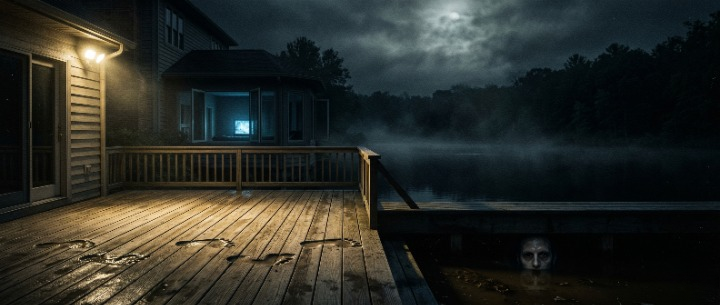
But stamped directly into the dry, gray planks were massive, soaking wet footprints.
They were impossibly large, pooling with dark, muddy water. They led up from the top of the stairs. They walked directly to the window where I had been hiding. A large, dark puddle had formed exactly where the man had stood, right where his breath had passed through the screen.
From there, the wet prints trailed off, dragging across the center of the deck, turning sharply toward the far railing that overlooked the muddy embankment.
I swallowed the bitter taste of bile rising in my throat. I wiped my sweaty palm against my shorts and shifted my grip on the heavy knife handle. I stepped forward, unlocking the deadbolt with a loud click, and slid the glass door open. The humid air immediately wrapped around my throat, choking me.
I followed the footprints.
I kept the knife raised in front of me, my bare feet sticking to the damp, muddy spots left behind on the wood. The moisture was freezing cold against my soles.
The footprints stopped right at the edge of the railing.
They didn’t lead toward the far stairs. They didn’t show signs of a struggle, or someone vaulting over the edge to jump down into the yard. They just ended, the dirty water pooling against the bottom rail and dripping slowly onto the ground below.
I stepped up to the edge. The halogens cast long, distorted shadows across the lawn, but the area directly beneath the deck was swallowed by an overhang, completely obscured by the thick wooden lattice and the sharp angle of the light above.
I leaned over the wood, gripping the railing so tightly my knuckles turned white with my left hand, the knife trembling violently in my right.
I looked down into the narrow, shadowed strip of mud beneath the floorboards.
He hadn’t left.
He was crouched in the absolute, pitch-black darkness below the deck.
I couldn’t see a torso. I couldn’t see arms, or legs, or the color of his clothes. I could only see the top half of a waterlogged, impossibly pale face protruding from the blackness, hovering inches above the wet soil.
Deep-set, unblinking eyes stared straight up at me.
The skin of his wide forehead was slick with green pond scum, catching a faint, sickly sliver of the yellow halogen light filtering through the floorboards.
He wasn’t breathing heavily. He wasn’t tensed, preparing to spring forward and grab my ankles. He wasn’t hiding.
He didn’t scramble away when my shadow crossed his face. He didn’t flinch or blink against the sudden glare of the lights above.
He simply remained perfectly, horrifyingly still, half-buried in the wet earth and the deep shadows. He didn’t make a single sound. He just watched me. A silent, terrifying promise anchored in the mud, waiting with endless, inhuman patience for me to finally turn my back.