Too Long; Didn’t Read
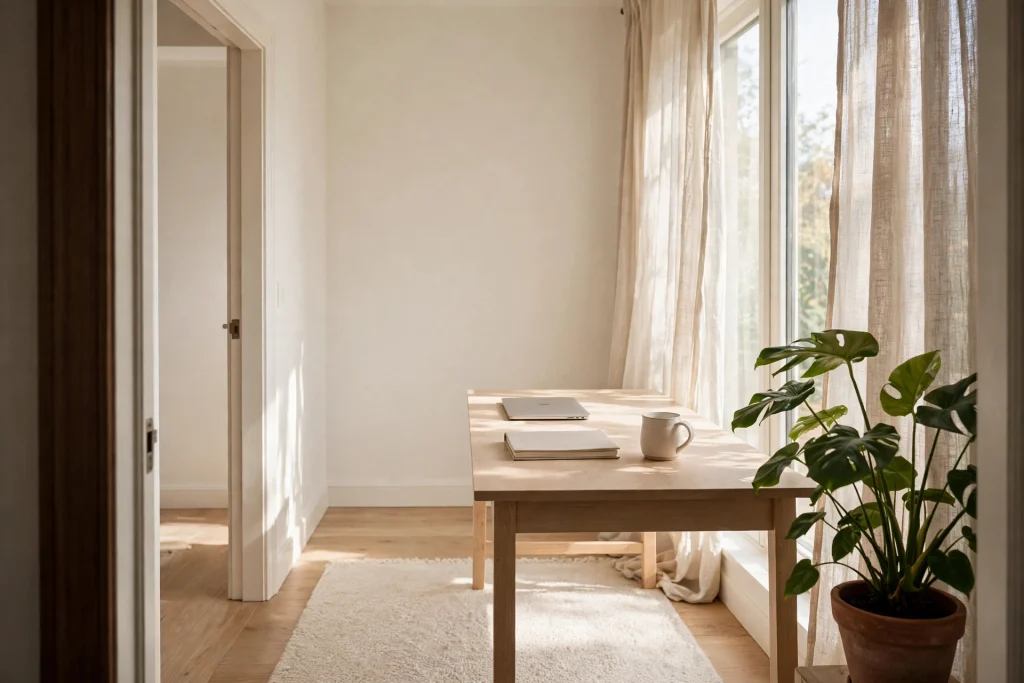
A calm home office is not about buying a new desk or filling the room with gadgets. It is about light, soft surfaces, one clear desk, and a room that tells your brain work starts here and ends here. Put the desk beside a window so daylight falls across it from the side, soften the glare with sheer linen curtains, and add a warm lamp for evenings. Warm up the hard surfaces with a wool rug, wood, and linen, give every cable and paper a home off the desk, and keep one plant and one picture in your line of sight. The 21 home office decor ideas below work in a spare room, a bedroom corner, or one end of a living room, and most of them cost less than a takeaway dinner for two. Start with the light this weekend, and the rest gets easier from there.
What's Inside This Guide
ToggleThe Afternoon I Worked From the Couch
For the first year I worked from home, my office was wherever the laptop landed. Most days that was the couch, with the laptop balanced on a cushion, the charger trailing across the floor, and a pile of notebooks slowly taking over the coffee table. By three in the afternoon the light in the room had gone flat, my shoulders hurt, and the only thing I wanted was to stop working, even though I had barely started.
The fix was not a renovation. It was a small desk beside the window in the spare corner of the bedroom, a rug under it, a lamp that gave off warm light, and a rule that nothing lived on the desk except what the day needed. The first morning I sat down there, the room felt different. Daylight fell across the desk from the side, the screen had no glare, and there was a plant in the corner of my eye instead of a pile of laundry. I worked better, and when I pushed the chair in at six, work stayed in that corner instead of following me to the couch.
That is what these 21 home office decor ideas are for. Not a showroom, and not a room you need a spare bedroom for. A calm workspace you actually want to walk into in the morning, built one small, cheap change at a time, in whatever corner you already have.
One honest note before you start. Home office decor is an evergreen topic, not a trend spiking right now. Search interest in home office ideas stays steady all year, with home office desk ideas and work from home office searches the strongest of the set at the moment. That is good news. It means the room you build this week will still feel right next spring, and the small changes below are worth doing properly instead of rushing them.
What’s Inside This Guide
- The 3 Things That Make a Home Office Feel Calm
- Group 1: Light First (Ideas 1 to 4)
- Group 2: Soft Surfaces and Sound (Ideas 5 to 8)
- Group 3: Plants and Natural Texture (Ideas 9 to 12)
- Group 4: A Desk That Stays Clear (Ideas 13 to 16)
- Group 5: Small Spaces and the Daily Ritual (Ideas 17 to 21)
- The 1-2-3 Calm Office Method
- At a Glance
- Do This Not That
- Your Calm Office Weekend Plan
- Take It Further
- Calm Office Cheat Sheet
- Questions People Ask
The 3 Things That Make a Home Office Feel Calm
Before you buy anything, these three things decide whether your room feels calm or feels like a storage cupboard with a laptop in it.
1. Light decides everything else. No amount of decor fixes a dark room. Daylight from the side is the kindest light for a screen and for your eyes, and a warm lamp beats a bright ceiling light every evening. Sort the light first, and every other idea in this guide looks better.
2. Soft beats hard. A home office fills up fast with hard surfaces: a laminate desk, a plastic chair, bare floors, a metal shelf. Sound bounces off all of it, and the room feels like a waiting area. A rug, linen curtains, a wood desk mat, and one soft chair take the echo out and warm the whole room up.
3. The desk holds today only. A clear desk is the quickest change you can make, and the hardest one to keep. The trick is giving everything else a home off the desk: a shelf, a drawer, a basket, a tray. The desk keeps the computer, a notebook, one pen cup, and a drink. Everything else goes back on the shelf before you log off, which takes about two minutes and makes the next morning feel very different.
Keep those three in mind and every idea below will make sense.
One more thing worth saying plainly. Calm does not mean empty, and it does not mean expensive. It means every object in the room has a job, and nothing in your line of sight is shouting for attention while you work. Three to five personal touches are plenty. More than that, and the room starts competing with the work again.
Group 1: Light First
Light comes first, because no amount of decor fixes a dark room. These four ideas sort daylight, glare, evening light, and wall colour, and they cost the least of anything in this guide.
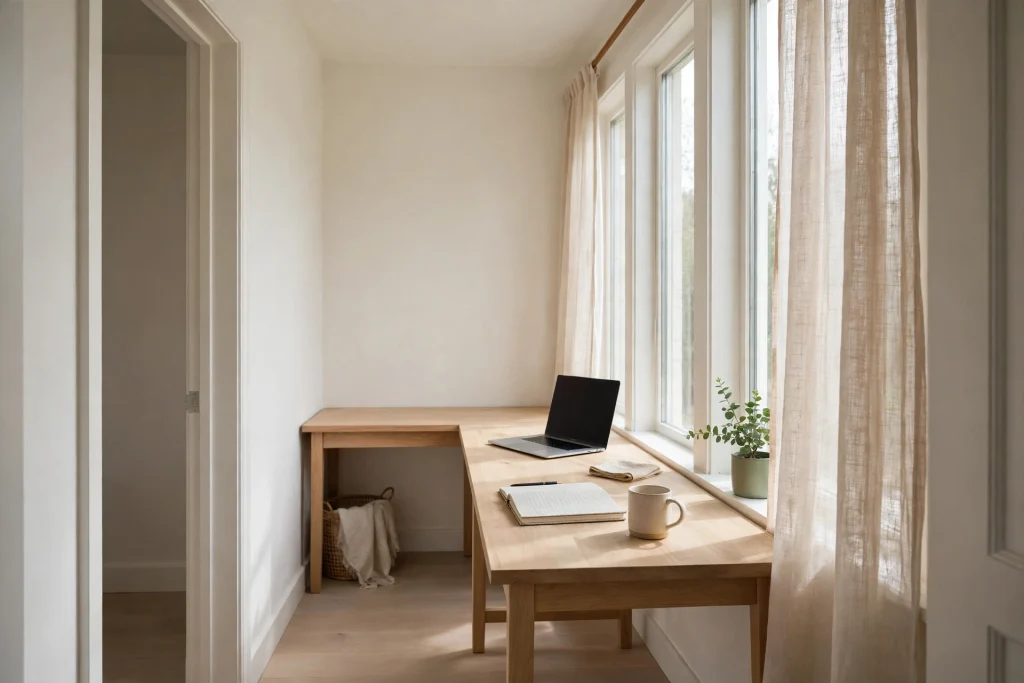
1. Put the Desk Beside the Window, Not Facing It
Put the desk beside a window or at a right angle to it, so daylight falls across the desk from the side or front. With your back to the window, the screen catches every reflection and your face sits in shadow on video calls. Facing the window directly can be bright at certain times of day, so a desk at a right angle to the glass is often the most comfortable spot of all, with light on your work and no glare on your screen.
Measure first. You need about 90 cm of width for a small desk and chair, and room to push the chair back without hitting the wall behind you. If the window is on your left and you are right handed, the light falls across your writing hand without your own shadow getting in the way, which is a small detail you notice by lunchtime.
Best for: Any room with a window, and anyone whose screen glares by mid-afternoon. Cost: Free if you only move the desk. Time: About 30 minutes.
2. Hang Sheer Linen Curtains to Soften the Glare
Sheer curtains or light filtering blinds take the glare off the screen without making the room dark. Linen or cotton Roman shades do the same job and look softer than plastic blinds. If the sun hits the desk directly for a few hours each day, choose blinds you can tilt, so you can keep the light and lose the glare. Hang the curtains high and wide, a few inches above the window frame and past the edges, so the window looks bigger and the fabric hangs in soft folds instead of covering the glass. A warm white or pale natural linen suits almost every wall colour, and it keeps the home office aesthetic calm on grey days too. Best for: South and west facing windows, and anyone who squints at the screen after lunch. Cost: 20 to 60 dollars for a pair of sheer linen panels. Time: About 30 minutes to hang.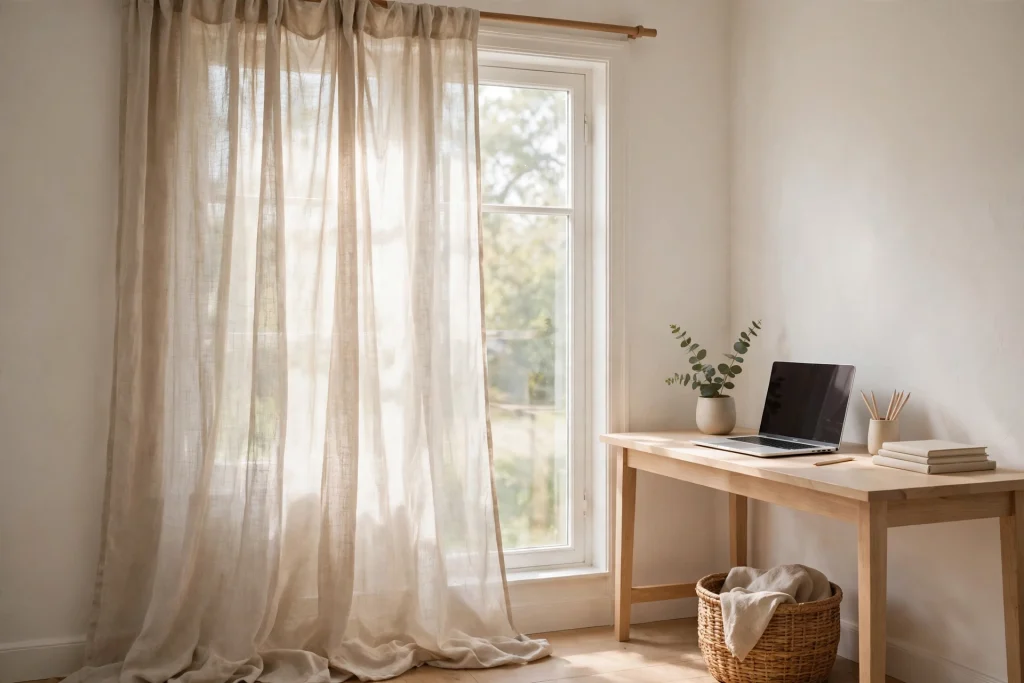
3. Add a Warm Desk Lamp for Evenings
For evenings and dark winter afternoons, add a warm lamp. A bulb around 2700K gives the yellowish light of a table lamp at home, not the cool white of an office ceiling. Put it on the desk or on a shelf beside it, so the light falls on the wall and not straight into your eyes. Two small lamps at different heights make a room feel calmer than one bright overhead light. Pick a lamp with an adjustable arm if you can, so you can angle it across your work in the morning and dim it for video calls later. A ceramic or wood base warms the desk up, and a linen shade softens the light further. Turn the ceiling light off once the lamp is on, and notice how much smaller and calmer the room feels. Best for: Evening workers, winter afternoons, and rooms with one harsh ceiling light. Cost: 25 to 70 dollars for a good adjustable desk lamp. Time: About 10 minutes.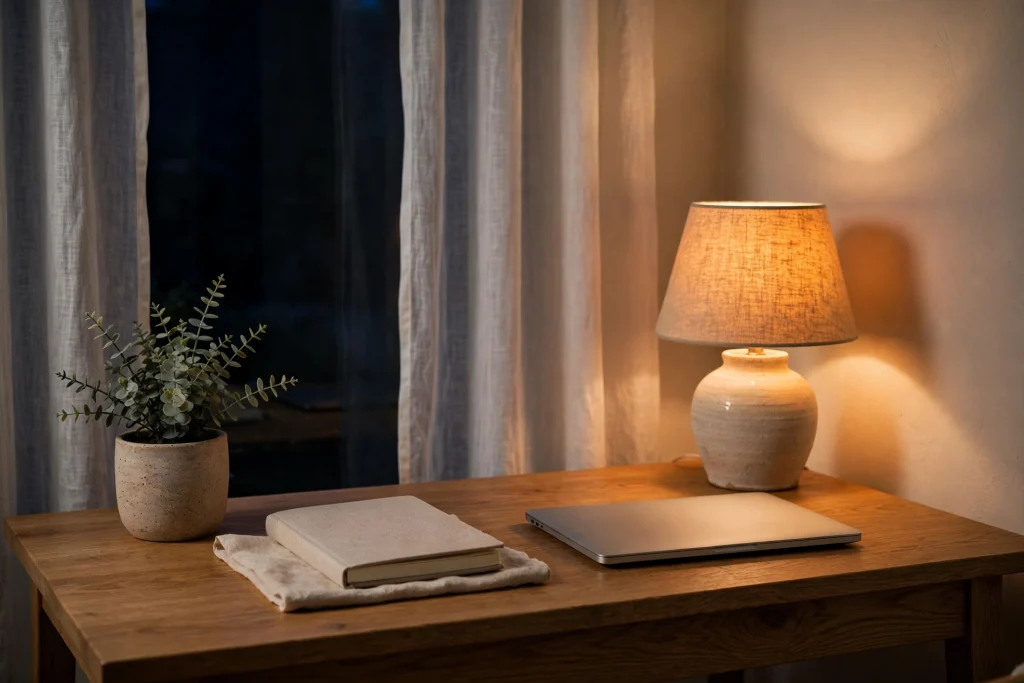
4. Paint the Wall Behind the Screen Warm White or Soft Greige
Wall colour plays a part too. Warm white, soft greige, or a pale clay tone bounces daylight around the room without the chilly look of bright white, and it keeps the room calm on grey days. Muted blue green and soft sage are the other safe picks for a home office, because they support focus without strain, and they look steady and professional on video calls. If painting is not an option, a large light coloured print or a mirror across from the window does some of the same work, bouncing light back into the room. Renters can get most of the effect from the print alone. If you do paint, paint the wall behind your monitor or in your direct line of sight the muted colour, and keep the other three walls a quiet neutral, so you get a calming focal point without the room feeling small or dark. Best for: Grey rooms, rented rooms where only one wall can change, and anyone on video calls all day. Cost: 30 to 60 dollars for a tin of paint and a roller, or 40 to 90 dollars for a large print. Time: About 3 hours to paint one wall.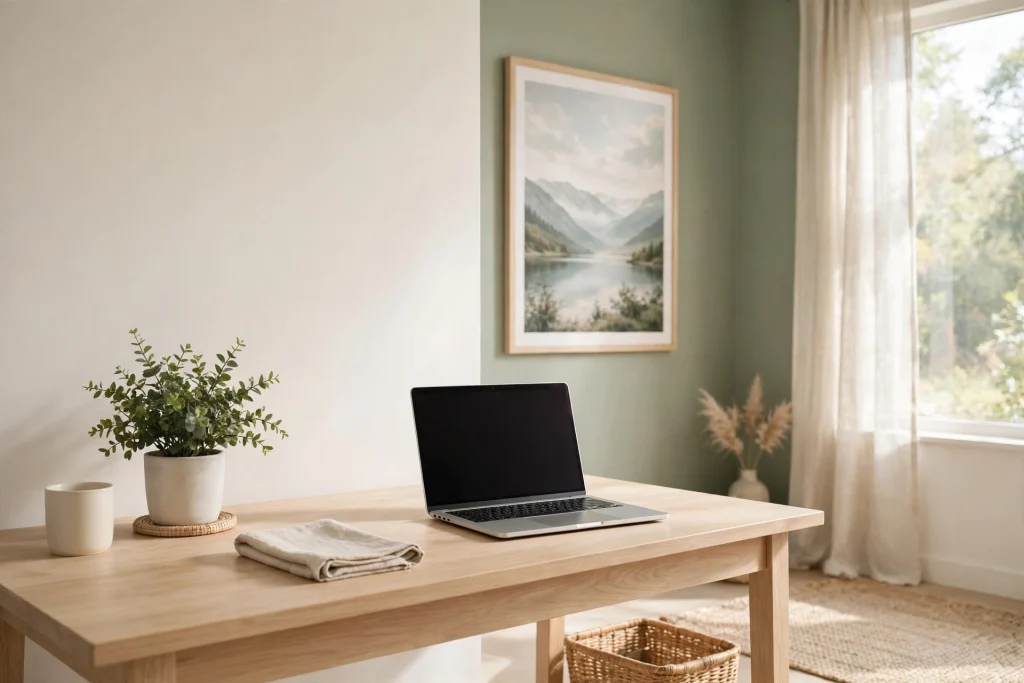
Group 2: Soft Surfaces and Sound
A home office tends to fill up with hard surfaces, and sound bounces off all of it. These four ideas add softness underfoot, on the desk, on the walls, and in a second seat, and they change how the room sounds as much as how it looks.5. Lay a Low Pile Wool Rug Under the Desk and Chair
Start with the floor. A jute or wool rug under the desk and chair takes the echo out of the room and gives your feet something warmer than tile or bare wood. Jute is rough and hard wearing; wool is softer and stays warm in winter. If you use a rolling chair, get a rug with a low, tight weave, because chair wheels sink into thick pile and wear it down in one spot. Size it so the chair stays on the rug when you push back from the desk. A rug also marks the work zone, which matters most when the office shares a room with a living room or a bedroom. Pick a calm pattern or a plain weave in a warm neutral, and let the rug do the zoning instead of a screen or a wall of furniture. Best for: Bare floors, echoey rooms, and shared rooms that need a visible work zone. Cost: 60 to 150 dollars for a good wool rug in desk size. Time: About 15 minutes to lay.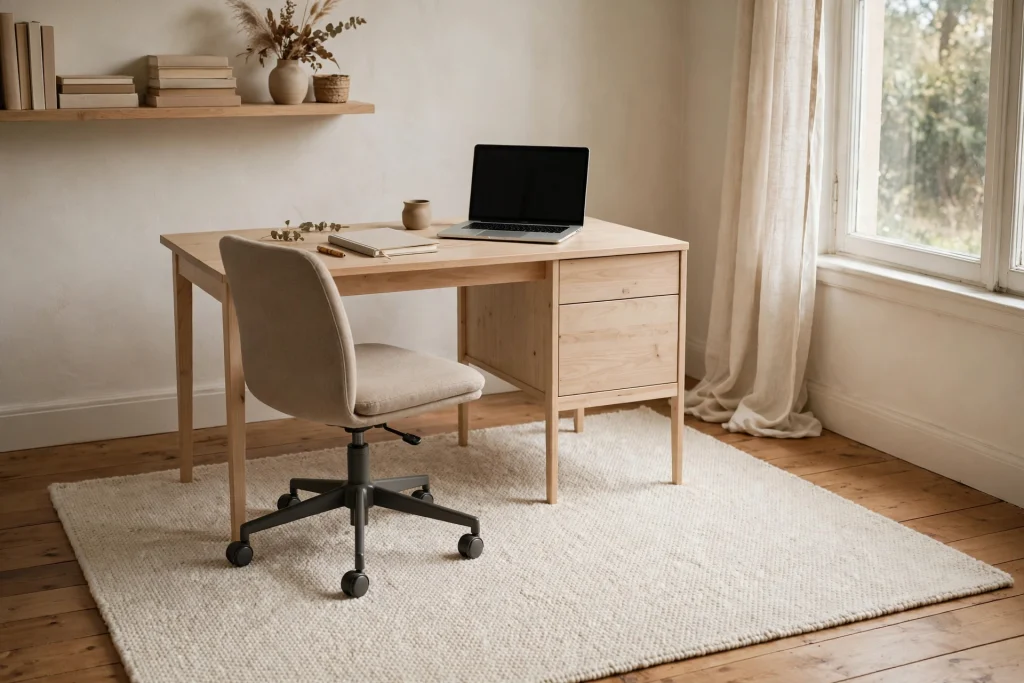
6. Add a Wood Desk Mat and a Wooden Monitor Stand
Wood is the next easy layer: a wood desk, a wood shelf, a wooden frame. Even one wooden surface warms up a room full of white and grey. If your desk stays as it is, a wood desk mat or a wooden monitor stand brings the same effect for less, and the stand has a practical bonus, because it lifts the screen to eye level and leaves space underneath for the keyboard when you finish. Choose a warm, pale wood like oak or ash, and keep the grain visible. A desk mat in leather or felt works too, but wood is the one that changes both the look and the feel of the desk under your hands. Wipe it down once a week and it will outlast the laptop sitting on it. Best for: Laminate and white desks that feel cold, and anyone whose screen sits too low. Cost: 20 to 50 dollars for a mat and a stand. Time: About 10 minutes.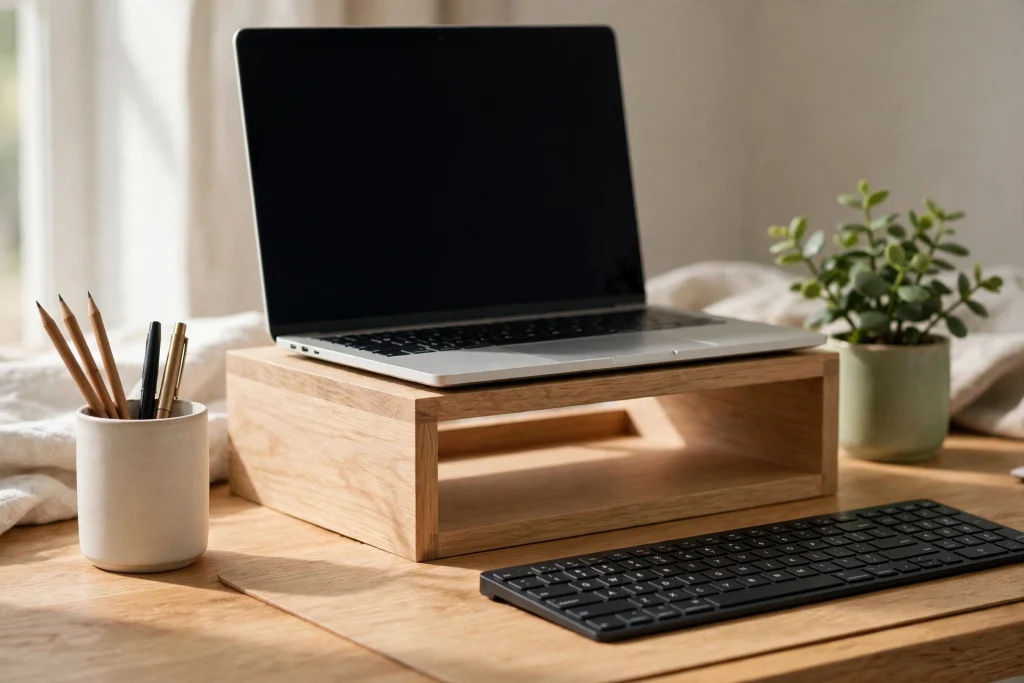
7. Hang Full Length Linen Panels to Soften the Echo
Curtains count as soundproofing as well as decoration. A pair of full length linen panels absorbs more sound than any blind, even if you leave them open all day. The fabric breaks up the hard wall, softens the corners, and makes the room feel finished in a way a bare window never does. Let the panels fall to the floor, and choose a colour close to the wall, so the room reads as one calm block of colour instead of a set of stripes. If the room still echoes after the curtains, a rug and a soft chair are the next two layers, and together the three of them will change the sound of the room completely. Best for: Echoey rooms, video calls, and anyone who works near a hard tiled floor. Cost: 40 to 100 dollars for a pair of full length linen panels. Time: About 30 minutes to hang.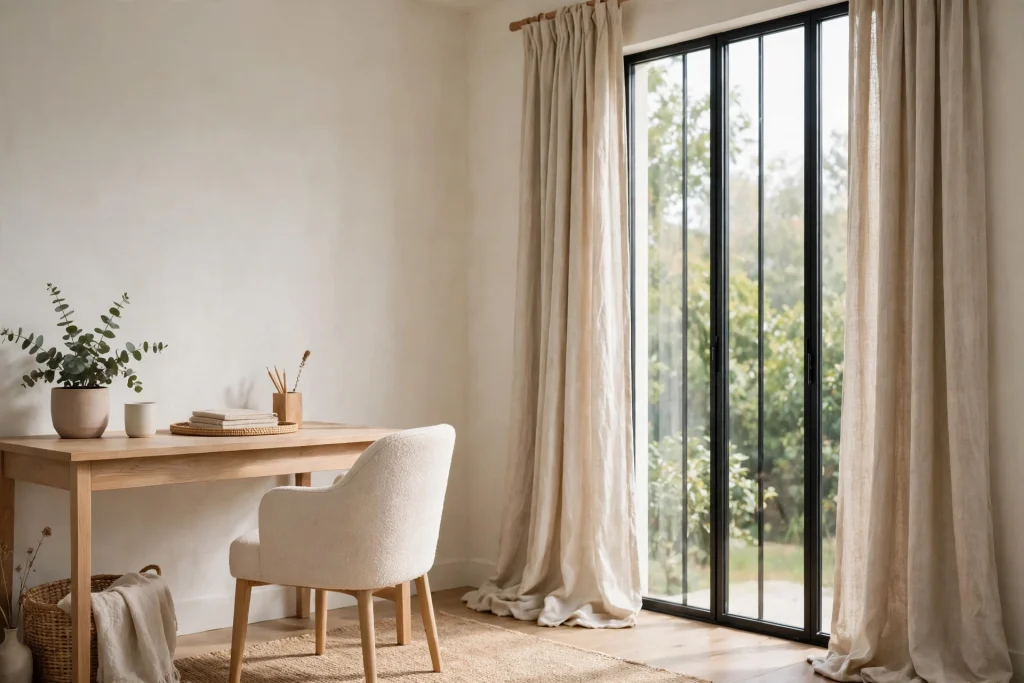
8. Add a Second Soft Seat by the Window
The chair matters more than any other piece in the room, because you sit in it for hours, so a good desk chair comes first. The upgrade that turns a work corner into a home office you want to stay in is a second, softer seat: a lounge chair or an armchair by the window for reading, phone calls, and coffee breaks away from the screen. Put a small side table beside it and a throw over one arm, and you have a reading nook inside your office, which sounds like a luxury until you try taking a ten minute break somewhere that is not your desk chair. You come back to the desk fresher, and the room stops feeling like a place you are stuck in. Best for: Spare rooms with a spare corner, and anyone who takes calls or reads for work. Cost: 80 to 250 dollars for a comfortable second hand armchair. Time: About 20 minutes to place.
Group 3: Plants and Natural Texture
Plants and natural textures pull the eye away from the screens and cables, and they do it better than any other decor. These four ideas cover the one big plant, the trailing plant, the basket that hides the mess, and the cables themselves.9. Choose One Large Plant Instead of Ten Small Pots
Pick plants for the light you have, not for the photo you saved. A pothos or a snake plant copes with a darker corner; a monstera or a fiddle leaf fig wants bright, indirect light near a window. A trailing plant on a high shelf softens a wall of screens better than a row of small pots on the desk, which only adds to the clutter. One large plant usually makes a home office look calmer than ten small ones. Put the big plant where you can see it from the chair, in a plain ceramic or terracotta pot, and water it on a schedule you will keep, not the one on the label. If you only remember on Mondays, choose plants that do not mind drying out between drinks. If you have pets, check whether a plant is safe for them before it comes home, since several common office plants are not. Best for: Bright corners near a window, and anyone who has killed a row of small pots. Cost: 25 to 60 dollars for a large plant and pot. Time: About 20 minutes.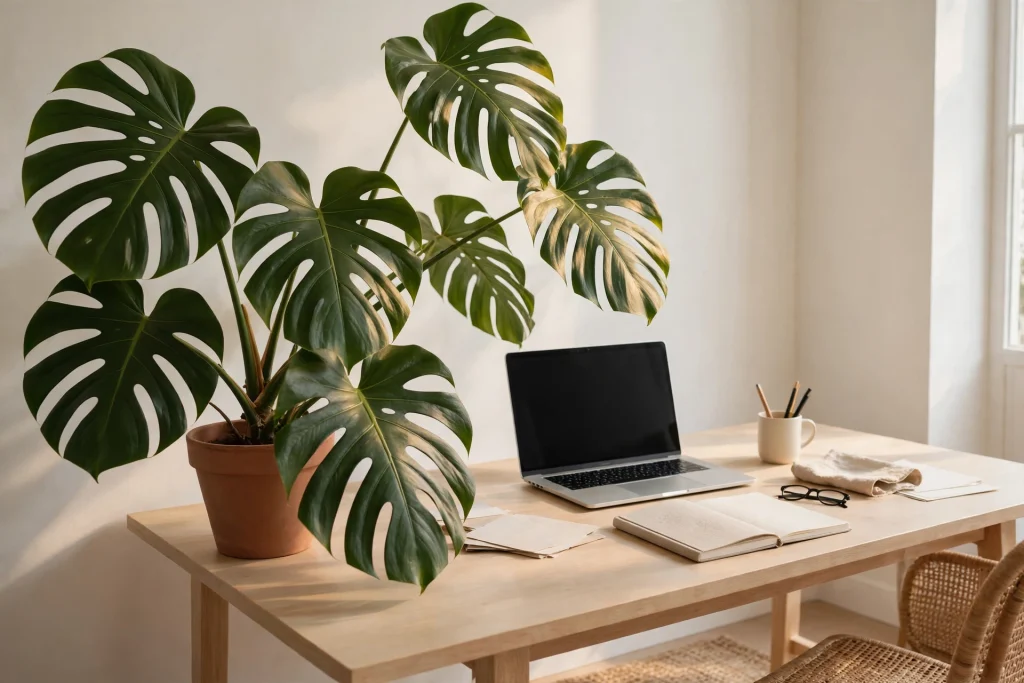
10. Trail a Pothos From a High Shelf
A trailing plant on a high shelf softens a wall of screens and shelves in a way nothing else does. A pothos is the easiest choice, because it copes with low light, forgives missed watering, and grows long trailing stems that fall down the wall in soft green lines. Hang it in a plain pot on the top shelf, and let two or three stems trail down past the books. Keep it off the desk itself. The desk already has enough on it, and a plant up high gives you the green in your eyeline without taking a single centimetre of work space. Trim the stems when they reach the desk, and pop the cuttings in water on the windowsill, where they will root in a week or two. Best for: Wall shelves above the desk, and low light rooms where a floor plant would struggle. Cost: 10 to 25 dollars for a pothos and a pot. Time: About 15 minutes.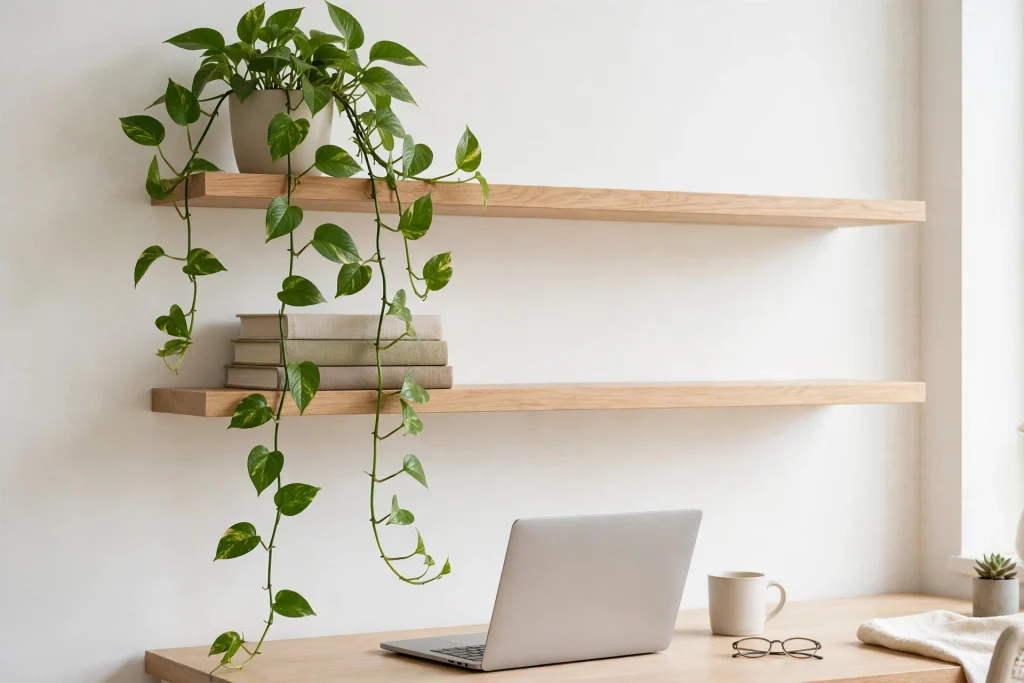
11. Hide Chargers in a Rattan Basket
Natural textures help in the same way plants do: a rattan basket for chargers, a linen lampshade, a ceramic cup for pens, a woven rug. A basket is the fastest way to hide the mess that makes a desk look busy, because chargers, cables, and spare notebooks all go in it and the lid, or the weave, does the rest. Keep one basket on the floor beside the desk for chargers and one small one on the shelf for stationery. Label nothing, because you will remember what lives where after two days, and the basket looks better without a tag on it. Choose rattan, seagrass, or woven cotton, and keep the colour close to the wood in the room. Best for: Desks buried under chargers, and anyone who hates plastic storage boxes. Cost: 15 to 40 dollars for two woven baskets. Time: About 10 minutes.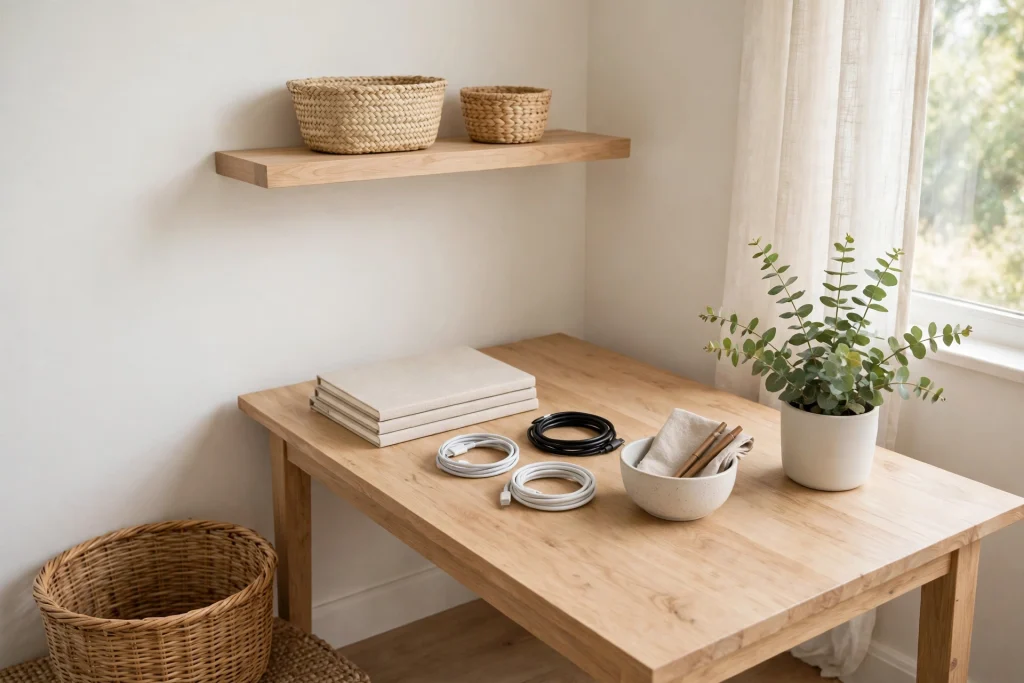
12. Tidy Cables With a Tray and Clips
A monitor, a laptop, a charger, a lamp cord, and a phone cable add up to a desk that looks like an electronics aisle. For cables, a tray clipped under the desk and a few adhesive cable clips do most of the work. Route every cable down one desk leg so cords travel together instead of spreading across the floor, and clip the phone charger to the side of the desk where your hand reaches it without looking. Anything more involved, like new outlets or moving wiring into the wall, is a job for an electrician, and it is not needed for a calm room. A tray, five clips, and ten minutes will take a desk from tangled to tidy, and it is the cheapest idea in this whole guide. Best for: Every desk with more than two cables, which is nearly every desk. Cost: 10 to 25 dollars for a tray and a pack of clips. Time: About 20 minutes.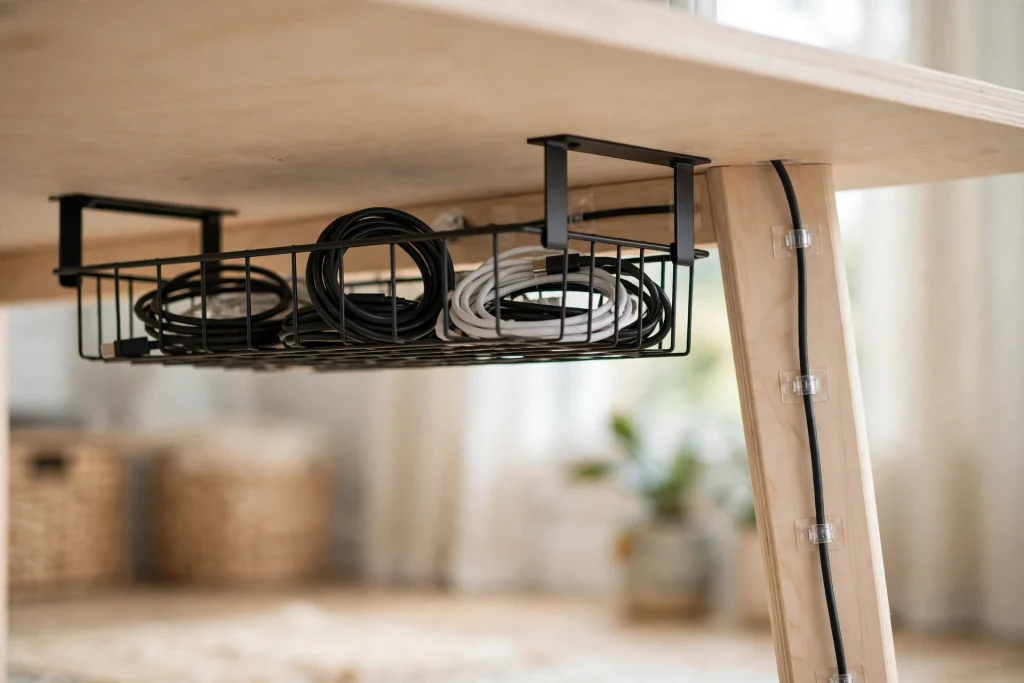
Group 4: A Desk That Stays Clear
A clear desk is the quickest home office setup change you can make in a room of any size, and the hardest one to keep. These four ideas give everything else a place off the desk, so the desk itself stays clear for the work in front of you.13. Give the Wall in Front of You One Thing Worth Looking At
Think about the view from the chair as well. You spend hours looking at one wall, so give it one thing worth looking at: a framed print, a small shelf with a plant and two books, a mirror that catches the window. Most home office inspiration photos are shot from the doorway, but you will see the room from the desk, so decorate for that angle first. One large, calm print beats a gallery wall behind a monitor, because a gallery wall competes with the screen for your eyes. Pick a landscape, a soft abstract, or a simple botanical print in muted tones, frame it in light wood, and hang it at eye level from the chair, not from standing height. Sit down, check it, and move it until it feels right. Best for: Desks facing a blank wall, and anyone who stares at paint all day. Cost: 30 to 80 dollars for a large framed print. Time: About 20 minutes to hang.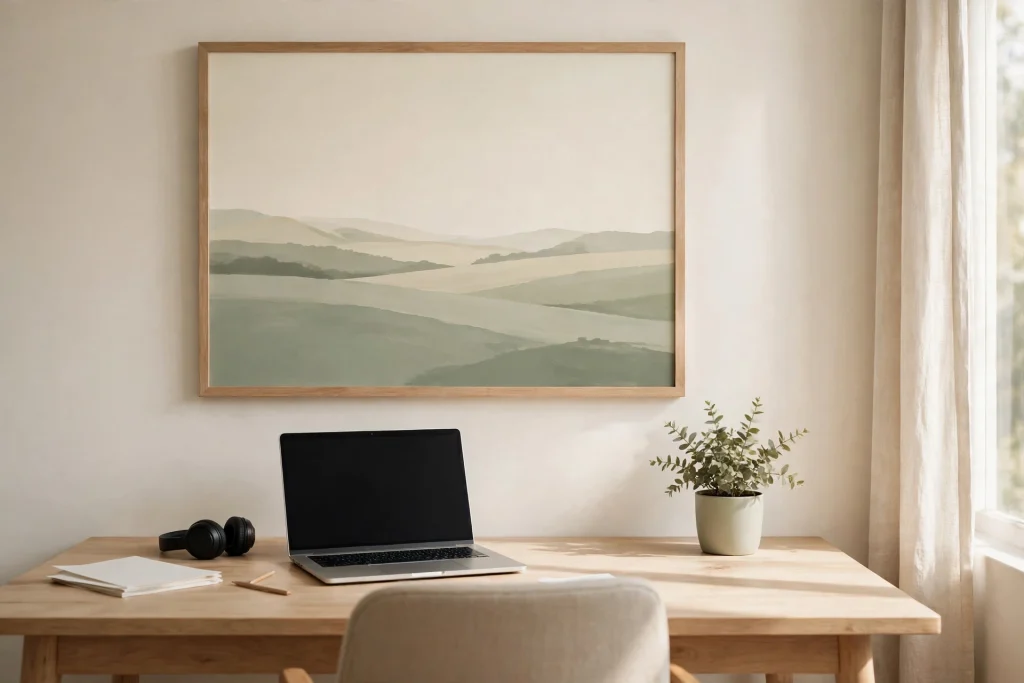
14. Put Wall Shelves Above the Desk for Daily Books
Wall shelves above or beside the desk hold books, folders, and the things you reach for once a day. Open storage, like a low shelf with baskets or cubbies, takes everything you need weekly. The desk itself keeps only what the current day’s work needs: the computer, a notebook, one pen cup, a drink. Everything else goes back on the shelf before you log off. Keep the shelves shallow, about 20 to 25 cm deep, so they hold books without crowding the desk below. Put the daily books at arm height, the weekly things higher up, and leave one shelf half empty on purpose, because a shelf with breathing room looks calm and a shelf packed edge to edge looks like storage, not decor. Best for: Small desks, renters who cannot add furniture, and anyone whose desk disappears under books. Cost: 30 to 80 dollars for two wood shelves and brackets. Time: About 1 hour to fit.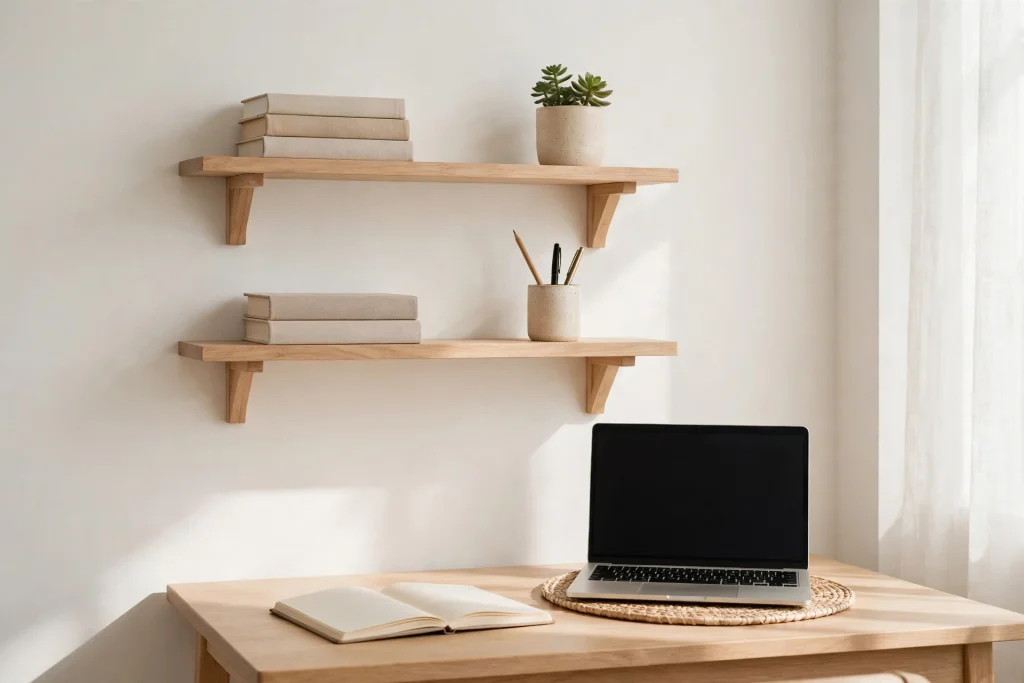
15. Use a Monitor Stand With Space for the Keyboard Underneath
A few small things help the desk stay clear: a monitor stand with space underneath for the keyboard, a single tray for loose items, and books stood upright at one end with a heavy object as a bookend. The stand is the best of the three, because it lifts the screen to eye level, which is kinder to your neck, and it frees the whole footprint of the keyboard when you push it underneath at the end of the day. If you use a laptop, a laptop stand does the same job, and a separate keyboard and mouse make it comfortable. Measure the stand against your screen width before you buy, and leave a centimetre or two of space on each side so the stand does not look wedged in. Best for: Small desks, laptop workers, and anyone with a sore neck by lunch. Cost: 25 to 60 dollars for a wood monitor or laptop stand. Time: About 10 minutes.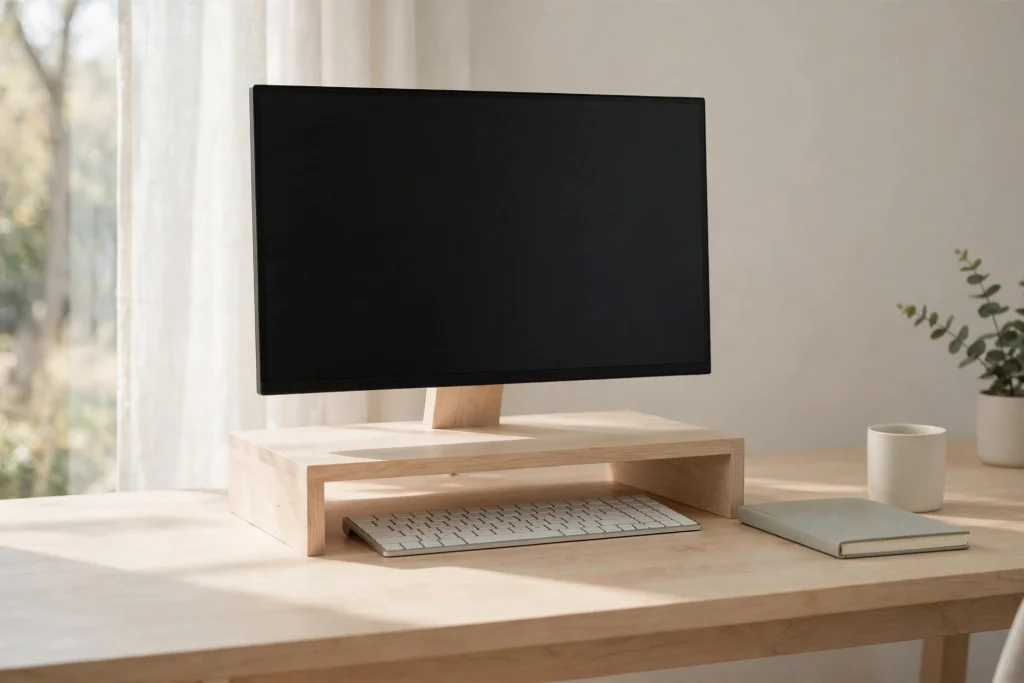
16. Keep One Tray for Loose Items and One Heavy Bookend
A single tray for loose items is the rule that holds a clear desk together. Paperclips, a spare pen, a charging cable, and the notebook you are not using today all live in the tray, and the tray lives at one end of the desk. When the tray is full, that is your signal to put things away, not to buy a bigger tray. Stand books upright at the other end with a heavy object as a bookend, a stone, a brass weight, or a small potted plant in a heavy pot. The books stay tidy, the desk keeps its two ends, and the middle stays clear for the work in front of you. It sounds too simple to matter, and it is the idea most people notice first when they sit down. Best for: Desks that collect small things, and anyone who loses pens daily. Cost: 15 to 35 dollars for a tray and a bookend. Time: About 10 minutes.
Group 5: Small Spaces and the Daily Ritual
Most small office ideas for home start with a corner that already exists. These last five ideas cover the bedroom corner, the window nook, the living room, two people sharing one room, and the small ritual that switches work on and off.17. Choose a Desk With Drawers and a Closed Cabinet
Home office furniture with storage solves most of the clutter before it starts: a desk with drawers, a closed cabinet for the printer and paper, and one shelf above eye level for the things you rarely need. Closed storage matters, because a printer and a stack of paper behind a door look calm, and the same things on an open shelf look busy. If you are buying a desk, choose drawers on one side and open leg room on the other, so your knees are free and your supplies are within reach. If your desk has no drawers, a slim rolling cart with drawers tucked beside it does the same job, and you can wheel it away when guests come. Best for: Paper heavy work, printers, and anyone whose desk has no storage at all. Cost: 120 to 300 dollars for a desk with drawers, or 40 to 80 dollars for a rolling cart. Time: About 1 hour to build or place.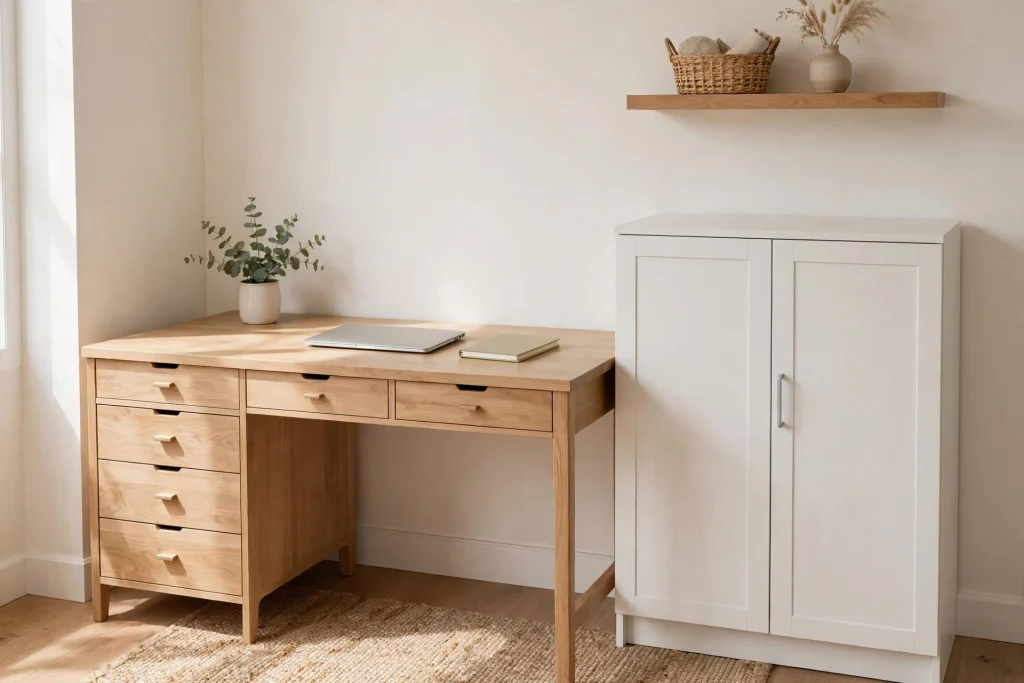
18. Claim a Bedroom Corner With Its Own Lamp
A bedroom corner works well: a narrow desk against the wall on the far side of the bed, with its own lamp. Keep the work things on the desk and out of the rest of the room. A desk about 100 by 50 cm holds a laptop, a notebook, and a mug with room to breathe, and slim legs keep the floor visible so the corner reads light instead of stuffed. In a bedroom, the hard part is switching off at night when the desk is in view. A folding screen, a curtain on a ceiling track, or simply turning the chair to face the wall when you finish helps. Small office decor works best when it repeats the room around it: the same wood, the same colour of lamp, the same rug texture. Then the desk looks like part of the room instead of a temporary arrival. Best for: Bedrooms, renters, and anyone without a spare room. Cost: 80 to 200 dollars for a narrow desk and lamp. Time: About 1 hour.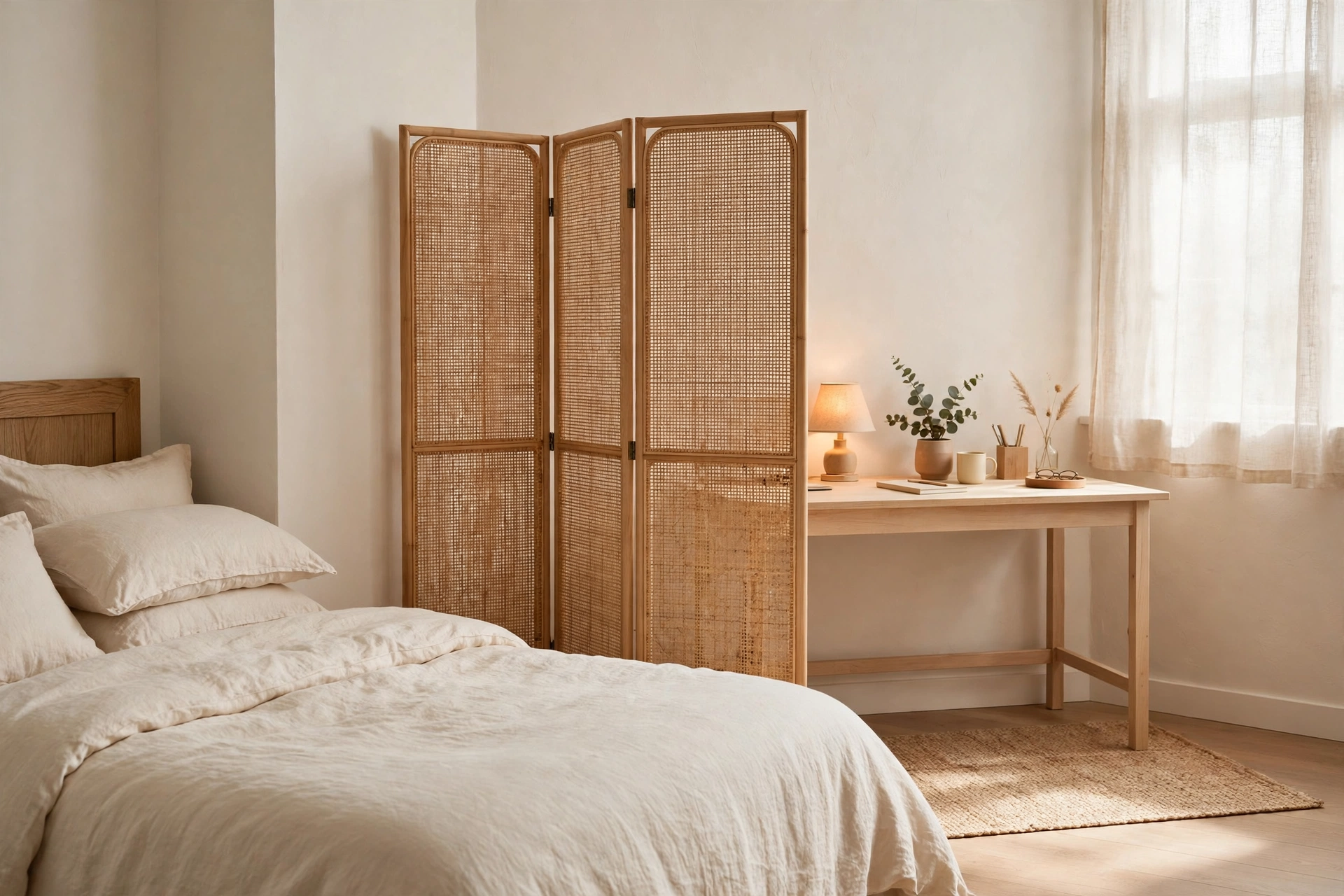
19. Build the Desk Into a Window Nook
A window nook is one of the prettiest small office ideas for home: a desk built into a window bay or between two cupboards. The window takes care of light, and the nook frames the space, so the desk feels built in even when it is only a board on brackets and two cupboards holding it up. Add a cushion on the window seat if there is one, a small shelf on each side for books, and a Roman shade in linen or cotton to soften the glass. The nook is naturally small, so keep the desk clear with the same rule as everywhere else: today only on the desk, the rest on the shelves. A nook desk suits one person and one laptop best, and it is the calmest seat in the house on a bright morning. Best for: Bay windows, alcoves, and homes with a cupboard gap going spare. Cost: 60 to 180 dollars for a board, brackets, and a shade. Time: About 2 hours.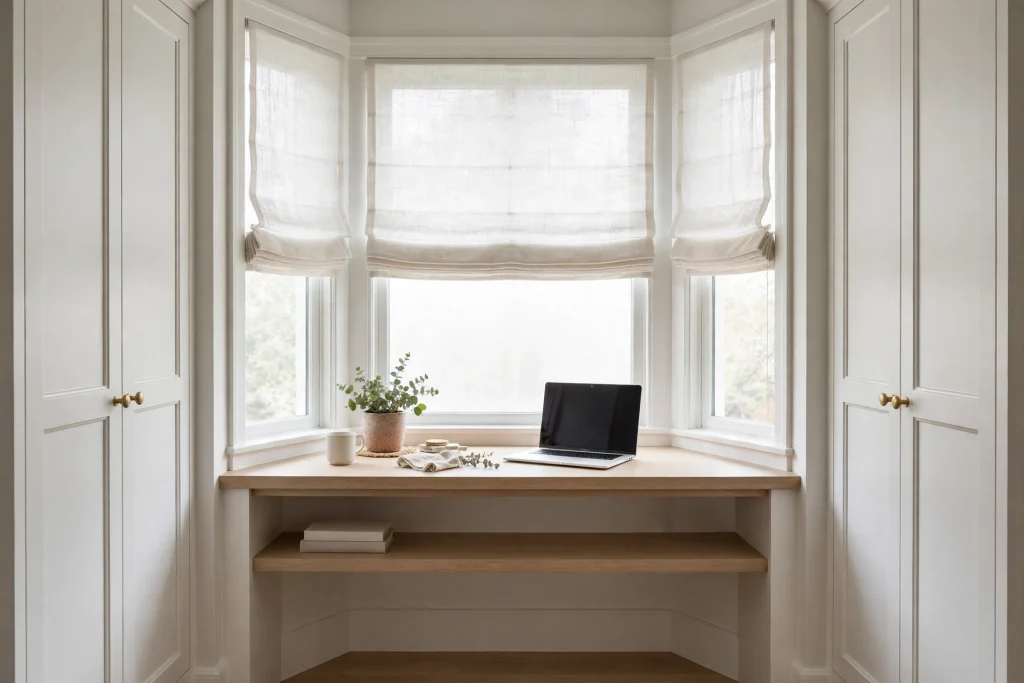
20. Put the Desk Behind the Sofa and Mark the Zone With a Rug
One end of the living room works too. A desk behind the sofa or along a short wall, with a rug that marks the work zone, turns a shared room into a room with an office in it instead of an office that ate the living room. The rug is the boundary, and it does the job better than a screen, because you can see across it and the room still feels like one room. Repeat the living room around the desk: the same wood as the coffee table, the same colour of lamp, the same rug texture. If two people work from home, a home office with 2 desks works best when the desks sit side by side along one wall or back to back, so neither screen faces the other person’s video calls. In a guest room, a daybed instead of a full bed leaves enough floor for a proper desk. Best for: Living rooms, shared homes, and two people working from home. Cost: 80 to 250 dollars for a narrow desk, plus the rug from Idea 5 if you do not have one. Time: About 1 hour.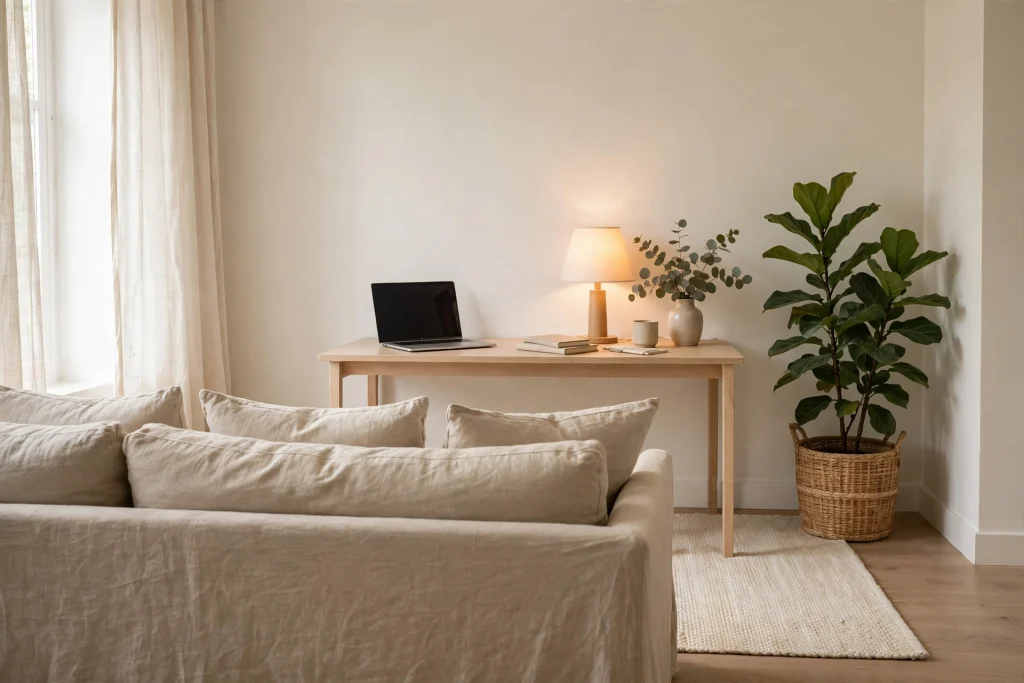
21. Start and End the Day With the Same Small Ritual
With a work from home set up, the commute is ten steps, and your brain does not always notice you have arrived. A small ritual helps mark the start: lighting a candle, turning on a diffuser, opening the blinds, or starting the same playlist every morning. The ritual itself matters less than repeating it at the same point every day, so it becomes the signal that work has started. The playlist version works even if you share the space with someone: headphones on, the same few songs, and you are at work, whether the desk is in a spare room or at the kitchen table. Ending the day the same way helps too. Blow out the candle, turn off the lamp, push the chair in. If you use a candle, keep it on a stable, heat safe surface away from papers and curtains, and never leave it burning when you step out of the room. In my opinion, this is the most underrated part of any home office decor plan, and the cheapest. A room can look great in photos and still feel like a place you avoid; the ritual is what makes walking in feel normal. Best for: Everyone working from home, and especially anyone whose desk is in a bedroom or living room. Cost: 5 to 20 dollars for a candle or a diffuser. Time: About 2 minutes a day.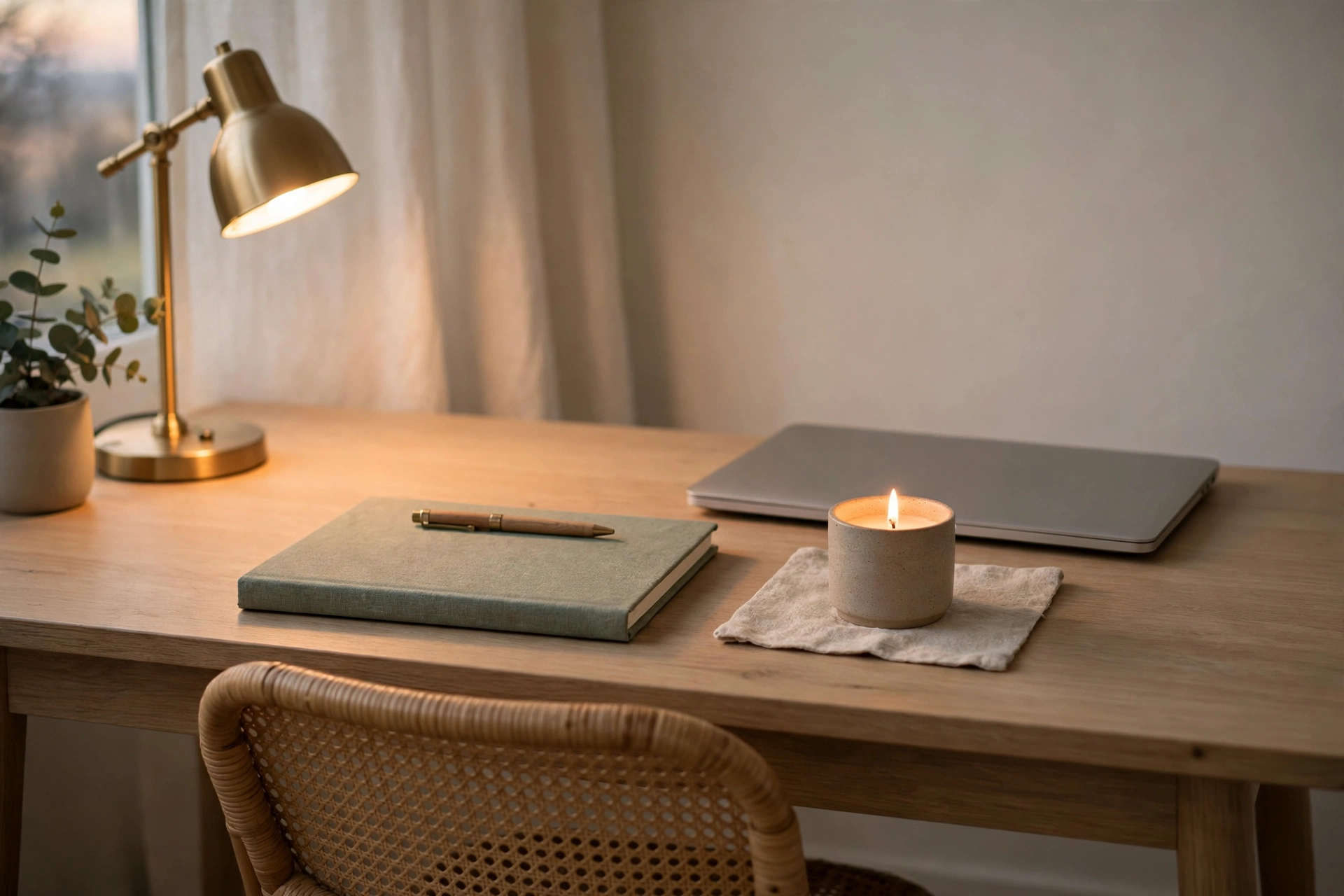
The 1-2-3 Calm Office Method
If you only change one thing this weekend, make it the light. A room that stops feeling dim at 9 a.m. makes every other fix easier to enjoy. Here is the whole guide in three steps.
1. One spot, chosen for light. Pick the spot with the best side daylight, even if it is only a corner. Move the desk there, at a right angle to the window, and hang sheer curtains if the sun is too strong at midday.
2. Two soft layers. Add a rug under the desk and chair, and one soft layer on the desk itself, a wood mat, a linen lampshade, or a full length curtain. The room will sound softer the same day.
3. Three homes off the desk. Give everything a home that is not the desk: a shelf above it, a drawer beside it, and a basket below it. Clear the desk to today only, and put everything back before you log off.
Do those three, and the room is calm. The plants, the print, and the second seat are the finishing touches, and they can wait until next weekend.
At a Glance
| Idea | What it is | Cost | Time |
|---|---|---|---|
| 1 | Desk beside the window | Free | 30 min |
| 2 | Sheer linen curtains | 20 to 60 dollars | 30 min |
| 3 | Warm desk lamp | 25 to 70 dollars | 10 min |
| 4 | Warm white or greige wall | 30 to 90 dollars | 3 hours |
| 5 | Low pile wool rug | 60 to 150 dollars | 15 min |
| 6 | Wood desk mat and monitor stand | 20 to 50 dollars | 10 min |
| 7 | Full length linen panels | 40 to 100 dollars | 30 min |
| 8 | Second soft seat | 80 to 250 dollars | 20 min |
| 9 | One large plant | 25 to 60 dollars | 20 min |
| 10 | Trailing pothos on a shelf | 10 to 25 dollars | 15 min |
| 11 | Rattan basket for chargers | 15 to 40 dollars | 10 min |
| 12 | Cable tray and clips | 10 to 25 dollars | 20 min |
| 13 | One framed print in sight | 30 to 80 dollars | 20 min |
| 14 | Wall shelves above the desk | 30 to 80 dollars | 1 hour |
| 15 | Monitor stand with keyboard space | 25 to 60 dollars | 10 min |
| 16 | Tray and bookend | 15 to 35 dollars | 10 min |
| 17 | Desk with drawers and cabinet | 40 to 300 dollars | 1 hour |
| 18 | Bedroom corner desk | 80 to 200 dollars | 1 hour |
| 19 | Window nook desk | 60 to 180 dollars | 2 hours |
| 20 | Desk behind the sofa | 80 to 250 dollars | 1 hour |
| 21 | Start and end ritual | 5 to 20 dollars | 2 min a day |
Do This Not That
| Do this | Not that |
|---|---|
| Put the desk at a right angle to the window | Put the desk with your back to the window, so the screen glares |
| Use a warm lamp at 2700K for evenings | Use one bright overhead light all day |
| Choose one large plant you can see from the chair | Fill the desk with ten small pots |
| Give every cable a tray and a route down one leg | Let cables trail across the floor |
| Keep the desk to today only, and clear it nightly | Pile the week on the desk and clear it never |
| Pick a rug the chair can roll on | Pick thick pile the chair sinks into |
| Hang one calm print at eye level from the chair | Hang a busy gallery wall behind the monitor |
| Repeat the room’s wood and lamp colour at the desk | Buy a desk set that fights the room it sits in |
Your Calm Office Weekend Plan
Saturday morning: light and spot. Move the desk beside the window, hang the sheer curtains, and paint the wall behind the screen if you are painting. Sit down, open the laptop, and check the glare at midday.
Saturday afternoon: soft layers. Lay the rug, hang the full length panels, and put the wood mat and monitor stand on the desk. Bring in the large plant and the basket for chargers.
Sunday morning: storage. Fit the wall shelves, the cable tray and clips, and the desk drawers or rolling cart. Put the framed print in your line of sight and the tray and bookend at the ends of the desk.
Sunday evening: the ritual. Set the candle and the lamp where the closing ritual will happen, clear the desk to today only, and push the chair in. Monday morning, light the candle, open the blinds, and start work in a room that feels like yours.
Take It Further
When the basics are done, these are the upgrades worth doing next, in order. First, a proper desk chair with lumbar support and adjustable height, because a beautiful chair that hurts your back after twenty minutes is not a good deal at any price. Sit in a chair for at least ten minutes before buying, not just a quick test, because back pain often takes longer than that to show up.
Second, a standing desk or a laptop stand that lets you change position through the day. Third, a felt desk divider or a room divider screen if you share the room and need visual separation on calls. Fourth, a second monitor on an arm, which frees desk space and stops you hunching over one small screen.
None of these are needed for a calm room. They are what you buy after the room already feels calm, when you know exactly what is still missing.
Calm Office Cheat Sheet
- Light first: desk at a right angle to the window, sheer curtains for glare, warm lamp at 2700K for evenings.
- Soft second: rug, linen, wood. Three soft layers take the echo out of any room.
- Desk rule: today only. Computer, notebook, one pen cup, one drink. The rest lives on a shelf, in a drawer, or in a basket.
- One plant, one picture: a large plant in your eyeline and one calm print in front of you.
- Colour: warm white, soft greige, muted blue green, or soft sage. Keep bright red and strong orange off the walls.
- Small spaces: a corner, a nook, or a desk behind the sofa all work, if the rug marks the zone and the desk repeats the room.
- Ritual: same start, same end, every day. Candle on, blinds open, work. Candle out, lamp off, chair in, done.
Questions People Ask
A good home office setup needs four things: a spot with decent light that is away from household noise, a desk deep enough for your screens, at least 60 cm for one monitor and 70 to 80 cm for two, an adjustable chair with lumbar support, and the ergonomic basics done right. Keep your feet flat, your elbows at roughly 90 degrees, and the top of the screen at eye level, and change position regularly through the day.
The best spot is a quiet corner with decent natural light, away from the main household traffic, the kitchen, and the television. A spot beside a window is ideal for energy and mood, with the screen side on to the window so you get daylight without glare. Separation matters too, especially in a bedroom or living room, because a dedicated zone helps your brain switch between work and rest.
Good storage keeps a small working space from feeling cramped, and vertical storage is the trick that saves the most space. Wall shelves, pegboards, and tall bookcases save desk and floor space, while a desk with drawers and a closed cabinet hide the printer and paper. Keep the desk to what the day needs, and put everything else back on the shelf before you log off, which takes about two minutes.
Muted blue green, sage green, and soft gray blue are the best picks for a home office, because they support focus without strain and look calm and professional on video calls. Warm white, soft greige, and pale clay are the safest neutrals for the other walls. Avoid bright red and strong orange on office walls, since both raise energy in a way that fights concentration, and keep them to a notebook or a small piece of art instead.
A Last Word
You do not need a spare room, a big budget, or a renovation to have a home office you like walking into. You need light from the side, something soft underfoot, a desk that holds today only, and a small ritual that tells your brain when work starts and when it ends. Do the light this weekend, add the soft layers next, and let the room teach you what it still needs. The calmest home office is rarely the most expensive one. It is the one where everything has a place, and the place you sit down in the morning feels like yours.