The Hollow Wall
The house sat at the bottom of a gentle incline, entirely choked by the surrounding woods.
There were no streetlights visible from my bedroom window. There were no neighboring driveways, no passing headlights sweeping across the ceiling, no distant sirens to anchor the property to the rest of the civilized world. There was only a dense, suffocating perimeter of old-growth oak and twisted pine pressing tightly against the glass.
My bedroom was situated in the furthest back corner of the house. Two of my four walls faced the forest directly. In the dead of summer, the branches grew so thick they scraped against the vinyl siding with a sound like dry fingernails dragging across a chalkboard.
I was ten years old. The fifth grade is a strange, purgatorial age. You are old enough to be told to grow up, but young enough that your fears are still immediately dismissed as an overactive imagination. I spent most of my time alone in that room. I didn’t have many friends, and a heavy, suffocating lethargy had already begun to take root in my chest—a quiet isolation that made the four walls of my bedroom feel like the entire universe.
But I could not sleep in the dark.
The darkness in that house wasn’t just the absence of light. It had a weight to it. It felt viscous. When the overhead fixture clicked off, the corners of the room seemed to stretch, the geometry of the walls dissolving into an endless, suffocating black void.
To keep the void at bay, I relied on a small, plastic LED nightlight plugged into the outlet directly across from the foot of my bed. It had a small dial on the side that allowed you to cycle through different colors.
I always left it on red.
Red didn’t ruin my night vision. Red cast a dull, steady, ember-like glow across the carpet, illuminating the plastic storage bins in my closet and the edges of the movie posters taped to my drywall. It was my anchor.
Until the night it changed.
The Shift
I woke up entirely without warning.
There was no nightmare fading from my consciousness, no sudden noise from the hallway, no thunder rattling the glass. My eyes simply snapped open.
The air in the bedroom felt thick, tasting faintly of ozone and old dust. I lay perfectly still beneath the weight of my comforter, waiting for my brain to process the sensory input of the room.
Something was wrong with the light.
The red ember glow that usually bathed the footboard of my bed was gone. In its place was a sickly, pale green luminescence.
It cast long, distorted shadows across the ceiling. The green hue made the plastic toys piled in the corner look like decaying bones. It made the open crack of my closet door look like a deep, underwater trench.
I didn’t move. My breathing went shallow. I stared at the small plastic square plugged into the wall.
The dial hadn’t been bumped. It required physical force to turn. It required a thumb and a forefinger, a deliberate click past the blue setting, past the purple, settling securely into the green notch.
My heart thumped a heavy, solitary beat against my ribs. I squeezed my eyes shut, pulling the comforter tightly up to my chin. I lay there, listening to the absolute silence of the house, until sheer exhaustion finally dragged me back under.
I convinced myself it was a glitch. I convinced myself I had bumped it with my toe while walking to the bathroom.
I reset it to red the next morning.
A week later, I woke up to a room bathed in blinding, surgical white.
The Disconnect
The white light was so sharp it burned my retinas.
I sat up slowly, the mattress springs groaning beneath my slight weight. The dial had been turned all the way to the opposite side. It was deliberate.
I slid my legs out from under the blankets. The carpet was freezing against the soles of my bare feet. I crossed the room, knelt beside the outlet, and pinched the small plastic dial. It clicked loudly in the silence as I forced it back to red.
The next morning, I confronted my parents in the kitchen. The bright morning sun pouring through the breakfast nook made my fears sound ridiculous, even to my own ears. I asked why they were coming into my room at night. I asked why they kept messing with the dial.
My father didn’t even look up from the coffee maker. He told me the circuitry was cheap. He told me I was getting too old for a nightlight anyway. My mother gave me a sympathetic, dismissive smile and told me I was probably just sleepwalking.
They didn’t believe me. The realization settled into my stomach like a cold stone. I was entirely on my own.
Three days later, I woke up, and the room was completely black.
The panic was instantaneous. It seized my throat, locking my vocal cords. I couldn’t see my hands in front of my face. I couldn’t see the ceiling. The void had swallowed the room.
I blindly reached out, my fingers trembling as they patted the wall beside my mattress, searching for the lamp switch. I fumbled, knocked a glass of water onto the carpet, and finally found the plastic knob.
The yellow bulb flared to life.
I looked across the room. The outlet was empty.
The nightlight was lying face-down on the carpet, nearly three feet away from the wall. It hadn’t fallen. It had been gripped, pulled from the prongs, and dropped.
When I showed my parents, the irritation in my father’s voice cracked like a whip. He accused me of playing games. He accused me of trying to get attention. He picked the plastic square off the floor and set it forcefully on my dresser, telling me to leave it unplugged.
The next afternoon, when I returned from school, the nightlight was gone entirely. It had vanished from the top of the dresser. It wasn’t under the bed. It wasn’t in the trash.
It had been confiscated. Erased.
The argument that night was deafening. My father yelled. I cried. We accused each other of hiding it, a vicious circle of gaslighting and frustration that ended with my bedroom door being slammed shut from the outside.
I was left in the absolute, suffocating dark.
The Friction
The acoustic geography of a room changes when you can’t see it.
Without the red glow, my ears became hyper-sensitive to every microscopic shift in the house. The settling of the floorboards sounded like footsteps. The wind against the siding sounded like breathing.
But the noise from the closet didn’t sound like the house settling.
It started on the third night without the light.
I was lying rigid on my back, staring blindly up into the blackness, when the sound bled through the louvered doors.
Skrrrt.
It was a slow, agonizingly deliberate friction. The sound of a heavy plastic storage bin being pushed, inch by microscopic inch, across the laminate flooring of the closet.
I stopped breathing. The blood rushed in my ears, a deafening roar that threatened to drown out the room.
Skrrrt.
Fabric shifted. The heavy winter coats hanging on the wooden rod rustled against each other, the nylon shells whispering in the dark.
Something was moving in there. Something was trying to quietly clear a path.
I didn’t scream. Fear at that age doesn’t always vocalize. Sometimes it paralyzes. I simply lay there, my fingernails digging crescents into my own palms, until the rustling stopped and the pale gray light of dawn finally began to outline the window frames.
The rustling happened the next night. And the night after that.
Every morning, I begged my parents to listen. Every morning, the dismissal grew more hostile. My father checked the closet once. He stood in the doorway, shined a flashlight over the boxes of old toys, and declared it empty. He told me it was mice in the walls. He told me to grow up.
On the fourth night, I didn’t try to sleep.
The Passenger
I sat propped up against the headboard, the comforter pulled tightly over my knees. The air conditioning had kicked off hours ago. The air was stagnant, heavy, and smelled faintly of wet earth and copper.
I stared directly at the louvered doors of the closet. In the pitch black, they were just slightly darker rectangles against a dark wall.
At 2:14 AM, the friction started.
It didn’t begin with a shifting box tonight. It began with the door itself.
A soft, wooden groan echoed in the silence. The right-side closet door began to slowly hinge outward. It moved with agonizing slowness, inching into the bedroom, revealing a narrow vertical slice of absolute blackness.
The smell hit me first.
It rolled out of the open crack, a wave of cold, subterranean air. It smelled like turned grave dirt, crushed insects, and rusted metal. It was a smell so heavy I could taste the grit of it on the back of my tongue.
Then, the fingers appeared.
They wrapped slowly around the edge of the wooden door. They were entirely the wrong color. The skin was a sickly, translucent white, like the belly of a drowned fish. But the anatomy was horrifying. The fingers were too long, boasting an extra, unnecessary joint. The knuckles were swollen, bulbous knots pushing against the thin, wet parchment of the skin. The nails were jagged, blackened with clay, and they dug silently into the painted wood.
My jaw locked so tightly my teeth ground together, the enamel squealing loudly in the base of my skull. I couldn’t look away. I couldn’t close my eyes.
The door pushed open a few more inches.
A head slid through the gap.
It emerged sideways, sliding into the room at the height of a grown man’s waist, confirming that whatever this thing was, it was crawling on all fours.
The face caught a faint sliver of moonlight filtering through the pine needles outside. There was no hair. The skull was elongated, stretching backward into the dark. It had no nose, just two vertical, pulsing slits that flared with a wet, rattling inhale.
But it was the eyes that broke my mind.
They were massive, taking up the upper half of its sunken face. They had no irises, no pupils. They were milky, convex orbs of pure white, weeping a thick, dark fluid that tracked down its pale cheeks like black tears.
It exhaled. The sound was a dry, rattling hiss, like dead leaves crushing underfoot.
It began to pull its body out of the closet. A shoulder joint popped loudly, dislocating and sliding forward to allow its impossibly wide, emaciated torso to slip through the narrow opening. The skin over its ribs was pulled so tight I could see the dark organs pulsing sluggishly beneath.
It turned its massive, milky eyes toward the bed.
It saw me.
The lower half of its face suddenly split. It didn’t have a jaw. The flesh simply tore open horizontally, revealing rows of thin, needle-like translucent teeth jutting out from pale gums.
A low, vibrating clicking sound emerged from the dark cavern of its mouth.
The paralysis shattered.
The Hollow Wall
A scream ripped out of my throat. It wasn’t a child’s cry; it was a raw, primal shriek of absolute, unfiltered terror. It tore my vocal cords, loud enough to rattle the glass in the window panes.
I kicked violently backward, slamming my spine against the wall, pulling my knees to my chest, screaming until my lungs were entirely empty, gasping, and screaming again.
The creature flinched. Its milky eyes widened in genuine surprise. It hissed, a wet, angry sound, and immediately violently threw itself into reverse. Its dislocated shoulder popped back into place with a sickening wet crunch. Its long, multi-jointed fingers scrabbled frantically against the laminate flooring, dragging its emaciated torso backward into the dark of the closet.
Heavy, frantic footsteps thundered down the hallway.
The bedroom door flew open, slamming hard against the drywall.
The overhead light flicked on, blindingly bright.
My father stood in the doorway, his chest heaving, his face red with a mixture of panic and immediate rage. My mother was right behind him, clutching the collar of her robe, her eyes wide.
“What?!” my father yelled, his voice cracking. “What is it?!”
I couldn’t form words. I just raised a trembling, rigid finger, pointing at the closet door, which was still swinging gently on its hinges.
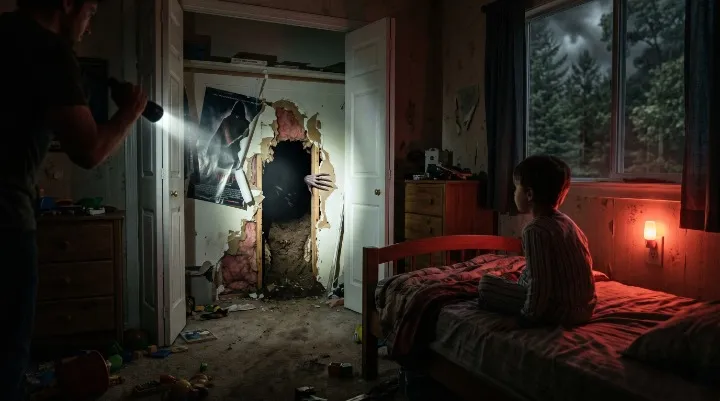
My father’s fear instantly hardened into fury. He stomped across the room, grabbing the handles of both louvered doors and ripping them completely open.
“There is nothing in here!” he roared, his voice bouncing off the acoustic ceiling.
He waded into the closet. He grabbed a heavy plastic storage bin full of Lego bricks and hurled it violently out into the bedroom. It shattered against the wall, plastic bricks exploding across the carpet like shrapnel. He grabbed a stack of winter coats, ripping the hangers off the wooden rod, throwing them onto the floor.
“I am sick of this!” he yelled, his hands tearing through the back of the closet, ripping away boxes, old board games, and a rolled-up rug. “You are too old for this! Look! Look at the wall!”
He grabbed the edge of a large, faded movie poster that had been taped to the back drywall of the closet for years.
He ripped it downward.
The thick paper tore with a loud, aggressive rip.
My father’s mouth stayed open, but the yelling stopped instantly.
The anger evaporated from his shoulders, replaced by a sudden, terrifying slackness. He stood perfectly still, holding the torn half of the poster in his hand, staring at the back of the closet.
My mother let out a short, choked gasp from the doorway, her hands flying to cover her mouth.
There was no drywall behind the poster.
There was a jagged, asymmetrical hole, nearly three feet wide. The edges of the sheetrock had been chipped and clawed away from the inside.
Beyond the drywall, the insulation had been violently ripped out. The wooden studs had been gnawed or broken, creating a massive cavity that led directly into the crawlspace beneath the foundation.
But it went further than that.
A heavy, freezing draft of subterranean air poured out of the hole, carrying the overwhelming stench of wet earth, copper, and rotting meat. The flashlight beam in my father’s trembling hand illuminated a sheer drop into the dirt.
It was a tunnel.
A hand-dug, perfectly rounded passageway burrowing straight down into the dirt beneath the house, angling sharply outward toward the dense tree line of the forest. The dirt along the edges of the hole was packed hard, smoothed down by constant, repeated friction.
We stared into the black void.
From deep within the earth, echoing up through the dirt tunnel, came the faint, distinct sound of a loose joint popping back into place.
We moved out of the house that same night. We drove to my aunt’s house in complete silence, leaving the front door unlocked, leaving my clothes on the floor, leaving the bedroom light burning brightly.
My parents never spoke of the hole in the wall. They sold the property at a massive loss to a developer a month later, refusing to return even to pack our belongings. They hired a company to clear the house out. They acted as though they had discovered a structural failure, a sinkhole, a termite infestation—anything to rationalize the terrifying reality of what they had seen.
But I know what my father saw when he ripped that poster down.
I know why he dropped the paper and backed out of the closet so slowly, never taking his eyes off the dark edge of the hole.
He saw what I saw. He saw the pale, elongated fingers gripping the lip of the dirt tunnel, just inches out of the light, waiting to see if we were brave enough to follow it down into the dark.