
When you have three kids and two overlapping, suffocating schedules, you don’t spend a lot of time thinking about the atmosphere of a house. You think about square footage. You think about how many bedrooms there are, the size of the yard, and whether the mortgage payment will leave enough left over for groceries and gas.
In October 2003, Jaime and Ben Shea were just trying to find some room to breathe.
They lived in the Arkansas River Valley, a place where the humidity hangs thick in the trees and the history feels baked into the dirt. Their lives were a carefully balanced, exhausting routine. Their oldest, Tori, was ten. Bridger was five, an energetic kid just starting to figure out the world, and the baby, Jackson, was barely eight months old. The sheer logistics of raising three children required space they simply didn’t have.
Ben’s schedule was brutal. He was working overnight shifts as a nurse at a nearby factory. He would clock out as the sun came up, drive home, sleep for a few fragmented hours, and then wake up to attend college classes during the day. He was studying for a degree in theater, trying to build a future while surviving the present. Jaime worked during the day. They were perpetually exhausted, operating on stale coffee, alternating naps, and sheer momentum. They were ships passing in the night, handing off a baby and a diaper bag in the kitchen before rushing out the door.
They needed a home. A permanent place to drop their bags.
A family member mentioned a historic property going up for sale in Lamar, a small, quiet city nearby. It wasn’t officially on the market yet, which meant they could get a look before the price was driven up by investors or local history buffs.
They drove out to see it on a bright autumn day. The house was massive. It was a classic, imposing colonial with a deep, wrap-around front porch that looked out over acres of land. Ancient, towering trees cast long, cooling shadows over the grass. There were old outbuildings scattered across the property. To Jaime, it looked like a postcard. It looked like the kind of place where you raise a family and stay forever.
Inside, the floors sloped slightly with age. The wood creaked under their shoes, and the air smelled like old dust, dried wood, and generations of trapped heat. The house had character, the kind of character you can’t fake with modern construction. Etched directly into the brick of the massive kitchen fireplace was a date from the late 1700s. Walking through the house, they found another fireplace in the living room; carved into the masonry was the year 1811.
The timeline didn’t make much sense. In the late 1700s and early 1800s, that specific area of the Arkansas River Valley was mostly wilderness, inhabited by a handful of French trappers and indigenous tribes. A house of this size, boasting four separate fireplaces, suggested a building of immense traffic and purpose. They would later learn that the structure had served multiple, heavy-use purposes over the centuries. It had been an original stagecoach stop for weary travelers, a bustling speakeasy during Prohibition, and, at one dark point in its long history, a county jail.
It was a building that had processed thousands of lives.
But on that sunny October afternoon, to Jaime and Ben, it was simply a beautiful, charming house available at an incredibly low price. The property had sat vacant for some time, driving the cost down.
There was only one weird thing during the walkthrough.
They walked up the narrow, steep wooden staircase to the second floor. At the very end of a long hallway was the last upstairs bedroom. When they pushed the door open, the atmosphere in the room felt flat. Stale.
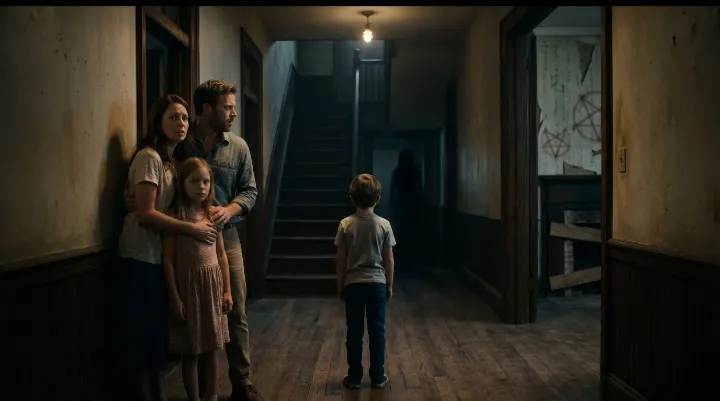
The fireplace in this room had been completely boarded up with thick planks of wood. Someone had taken a can of black spray paint and drawn a crude, jagged pentagram across the boards. Scattered across the floorboards nearby were the melted, waxy remains of dozens of candles. Scrawled next to the star was the full first and last name of a boy.
Jaime stood in the doorway, her arms crossed, looking at the mess. She sighed. She didn’t feel a deep sense of supernatural dread. She felt the annoyance of a mother mentally adding scrape wax and paint over teenage vandalism to her growing to-do list. When a big, historic house sits empty in a rural town, local kids break in. They drink cheap beer, try to scare each other, and play around with gothic aesthetics. It was a nuisance.
Ben looked at it, shrugged, and pointed out the size of the closet. They didn’t care about a spray-painted star. They cared about the price, the porch, and the space.
They bought the house.
Moving with an infant is a blur of cardboard boxes and packing tape. For the first few weeks, the house was just a labyrinth of unpacking.
To make their brutal schedules work, they hired a close family friend named Desta to come to the house during the weekdays. Desta would watch eight-month-old Jackson while Tori and Bridger were at school. This allowed Ben to come home from his night shift at 7:00 AM, crash in the master bedroom, and actually get a few hours of unbroken sleep before his college classes.
One Tuesday morning, Ben was dead asleep. The blackout curtains were drawn, the room was quiet, and his exhausted body was finally resting.
He was pulled out of a deep sleep by a sharp, tinny crackle.
It was the baby monitor sitting on his nightstand. Through the static of the cheap plastic speaker, he heard Jackson crying.
Ben kept his eyes closed, his face pressed into the pillow. He waited for Desta to handle it. He waited thirty seconds. The crying didn’t stop. It wasn’t a fuss; it was a steady, rhythmic, distressed wail.
Frustration flared in his chest. Ben was operating on a severe sleep deficit, the kind of exhaustion that makes your eyes burn and your joints ache. He sat up, rubbing his face, wondering why Desta wasn’t picking the baby up. He swung his legs over the edge of the bed, annoyed that his narrow window for sleep was being eaten up.
He walked out into the hallway and pushed the nursery door open.
“Desta, I got him—” Ben started to say.
He stopped. The room was perfectly quiet. The crib was empty. The blanket was folded over the railing.
Ben stood there for a second, his tired brain struggling to process the visual information. He turned around and walked heavily down the wooden stairs. The living room was empty. The kitchen was clean. He looked out the front window. Desta’s car wasn’t in the driveway.
He found out later when Jaime got home that Desta had taken Jackson out to run errands specifically so the baby wouldn’t wake him up. They had been miles away at the grocery store.
Ben looked at the baby monitor sitting on his nightstand. He picked it up, turned the power switch off, and tossed it into a drawer. He figured it had picked up interference from a neighbor’s cordless phone or a trucker’s CB radio out on the highway. He didn’t tell Jaime. It wasn’t worth talking about. He just wanted to go back to sleep.
The real strain started with five-year-old Bridger.
Kids go through phases, especially after a big move, but Bridger’s transition into the new house was rough. His bedroom was the one down the long hall, right next to the room with the boarded-up fireplace.
Within a month, Bridger started refusing to sleep in his own bed. He would wake up in the middle of the night, pad quietly down the long, dark hallway, and climb into bed with Jaime and Ben, wedging himself between them.
“Bridger, you have to sleep in your room,” Jaime told him one morning, standing in the kitchen and pouring a cup of coffee. She looked down at him. He looked tired, rubbing his eyes. “Do you not like the new room? We can paint it.”
Bridger shook his head. He looked down at the linoleum floor. “I keep hearing people talking.”
Jaime paused, holding the coffee pot. “Is Tori on the phone in her room?”
“No,” Bridger said. He looked genuinely frustrated, trying to explain a complex auditory experience with a five-year-old’s vocabulary. “It sounds like a bunch of people talking all over each other. I can’t understand what they’re saying. They just talk.”
Jaime set the pot down and smoothed his hair. “It’s an old house, buddy. The walls are thin. You’re probably hearing the neighbors outside, or maybe you’re just dreaming. Dreams can sound really loud sometimes.”
Bridger didn’t argue, but he wouldn’t go back to his room.
Part of the problem was the hallway itself. It was long, narrow, and always inexplicably dark. The overhead light fixture leading to his room was completely unreliable. Ben would screw in a brand-new bulb, test it, and within a day, it would pop. They went through a dozen bulbs in a week.
Assuming the 19th-century wiring was a fire hazard, they called a professional electrician. The man spent two hours checking the breaker box, pulling the fixture out of the ceiling, and testing the lines with a multimeter.
He came down the stairs, wiping his hands on a rag. “Everything looks fine,” he told Ben. “The voltage is steady. The wiring isn’t frayed. I don’t have an explanation for you.”
Desperate for a solution, Jaime went to the hardware store and bought a pack of those cheap, battery-operated touch lamps. She stuck them to the drywall along the corridor so Bridger could just tap them on his way to the bathroom at night.
They failed within a day. She put fresh, brand-name AA batteries into the plastic housings. They drained completely within an hour. The hallway actively consumed energy, maintaining its darkness.
They eventually just stopped replacing them. The hallway stayed dark.
You can ignore a lot when you’re busy. You explain things away because dealing with the alternative takes too much energy, and energy is a luxury you don’t have when you’re raising three kids and working full-time.
When Jaime hosted a yard sale to get rid of moving boxes and old furniture, it was a bright, normal Saturday. She dragged folding tables out onto the lawn, displaying the items they no longer needed, sitting on the grand front porch while locals stopped by to browse.
A woman walked up the long dirt driveway. She didn’t look at the clothes. She didn’t look at the old dishes. She walked straight past the tables, her eyes scanning the facade of the colonial home. She walked up the steps to the porch, reaching out to rest her hand against the old wooden railing.
She looked directly at Jaime. She didn’t say hello.
“There are a lot of spirits in this house,” the woman said quietly. Her face was entirely serious. “There’s a lot of energy going on here. I can just feel it.”
Jaime just stared at her, offering an awkward, tight smile. She knew about the small, forgotten Confederate cemetery sitting about a hundred yards behind their property line. Living next to old graves made people weird. She brushed the comment off, assuming the woman was just eccentric.
A few weeks later, Jaime was running errands at the local Walmart. She was pushing a shopping cart through the sliding glass doors, mentally ticking off a grocery list, when the store greeter stopped her.
“Hey,” the greeter asked, looking at her face. “Are you Jamie?”
“Yes,” Jamie replied, confused.
“Do you live in that big house in Lamar?”
“Yeah. We just moved in a few months ago.”
The greeter didn’t smile. She leaned closer to the shopping cart. “My family used to live in that house. I grew up there.”
“Oh, really?” Jaime said, expecting a story about the old trees or the porch.
“Yeah,” the greeter stated, completely deadpan. “It’s haunted.”
Jaime stopped pushing her cart. The bluntness of it caught her off guard. “What do you mean?”
The woman told her a town story passed down through her family, who had owned the property for generations. Sometime in the late 1800s, a young boy had been playing upstairs. He had fallen to his death out of a second-story window.
The greeter described the location of the window perfectly. It was the window in Bridger’s room.
Jaime felt a cold knot form in her stomach. She took the woman’s phone number, intending to call her later to ask exactly what her family had experienced. But in the chaos of managing the kids and unloading the groceries, the small slip of paper got lost in the bottom of her purse. By the time Jaime went back to the store a few weeks later to find her, management told her the woman had quit. Jaime couldn’t remember her name.
At home, the house was getting louder.
Ben and Jaime slept in the master bedroom. Some nights, just as the exhaustion was finally pulling them under, there would be a sharp, hard noise against the wall right behind their headboard.
Thud.
It wasn’t a creak. It didn’t sound like wood settling. It sounded exactly like a person knocking on a door with a closed, heavy fist.
They would lay there in the dark, eyes open, staring at the ceiling.
Thud. Thud.
Ben would shift in the bed. “It’s just the house settling,” he would whisper. “Temperature dropping outside. The wood is shrinking.”
Jaime didn’t argue. But neither of them went back to sleep quickly.
Because Jaime occasionally brought office work home so she could pick the kids up from school, she often sat at the desktop computer in the living room after the children had been put to bed. The house would be completely quiet, save for the hum of the refrigerator.
Then, she would hear the heavy, distinct sound of footsteps coming down the wooden stairs.
It wasn’t a quick, light patter. It was the slow, deliberate tread of someone walking. Creak. Thud. Creak. Thud.
She’d turn around in her desk chair. “Tori? Go back to bed.”
Silence.
She’d stand up, walk over to the bottom of the stairs, and look up into the dark hallway. Nobody was there. When she walked up to check, all three kids were fast asleep, their chests rising and falling evenly.
Ben experienced the exact same thing when he was home alone studying. Heavy, deliberate steps on the wood, followed by empty space. He would tell himself it was an acoustic trick of the old floorboards, echoing the sound of the wind.
Then Tori started complaining.
The ten-year-old would stomp downstairs annoyed, saying Bridger was playing with his loud electronic toys in his room and waking her up.
“Tell him to turn them off,” Tori complained, crossing her arms in the kitchen. “They keep beeping and making noises.”
Jaime looked at her daughter. “Tori, Bridger isn’t upstairs.”
Tori frowned. “I just heard his toys.”
“He fell asleep on the couch an hour ago,” Jaime said, pointing to the living room where the five-year-old was currently drooling on a throw pillow.
The denial was getting harder to maintain.
One evening, Ben and Jaime were sitting on the couch watching TV. The kids were asleep. The staircase was located in the hallway directly behind where they were sitting.
Thwack.
They both paused.
Thwack. Thwack. Thwack. Roll.
It sounded exactly like a heavy, solid rubber ball being bounced down the wooden treads. They could hear it drop from step to step, gaining momentum, before finally hitting the floor at the bottom and rolling across the hardwood.
Ben muted the television. They sat in absolute silence.
They both turned around and looked at the hallway. The stairs were empty. There was no ball. There was no child at the top of the landing.
Ben looked at Jaime. He didn’t talk about the foundation settling this time.
When you are deprived of sleep, your mind begins to fray at the edges. When your home doesn’t feel safe, your body never fully relaxes. Cortisol floods your system constantly. You snap at your spouse over unwashed dishes. The kids get cranky, prone to sudden tears and tantrums. The sheer mental exhaustion of trying to ignore the sounds of your own home turns every single day into a physical chore.
Ben started seeing things. Not clearly, and never straight on.
He was walking through the kitchen one afternoon when he caught a sudden, fluid movement out of the corner of his eye. He turned his head just in time to see the distinct tail-end of a heavy, Victorian-era gown sweeping up the top of the stairs, the thick fabric dragging across the wood before vanishing into the second-floor hallway. He blinked, rubbed his eyes, and blamed the graveyard shifts.
A few days later, while Ben was standing at the kitchen counter, the air was suddenly permeated by a rich, heavy scent. It smelled like sweet pipe tobacco. He looked down and watched as a thin, distinct stream of gray smoke curled upward into the air, twisting exactly as if it were rising from a freshly lit pipe resting on the laminate counter.
There was no source. No draft. Nobody in the house smoked. He waved his hand through the smoke, and the smell dissipated, leaving him standing alone in a cold kitchen.
The incident that finally broke Jaime’s ability to rationalize happened on a quiet weeknight.
She and Bridger were sitting at the computer desk. It was around 8:00 PM. Bridger was leaning against her arm, watching her click through some files.
In the reflection of the dark, glossy computer monitor, Jaime saw a shadow move.
It wasn’t a blur. It looked like the solid silhouette of a tall person walking directly behind their chairs.
Jaime gasped and spun around. Bridger turned too. The room was empty. The hallway was empty.
“Did you see that?” Jaime asked, her voice tight.
Bridger just nodded slowly. A few minutes later, he quietly got up, walked out of the room, and headed toward the stairs.
Jaime stayed at the computer, her heart beating a little too fast, trying to focus on the screen. Ten minutes passed. She heard the heavy sound of small feet coming back down the wooden steps.
Bridger walked into the room and stopped.
“What’s wrong, buddy?” Jaime asked, swiveling in her chair.
Bridger didn’t answer. He just stood there in the center of the room. His arms hung loosely at his sides. He was staring straight ahead, but he wasn’t looking at her. His eyes were wide and glassy. He looked completely vacant, like a child caught deep in a sleepwalking episode.
“Bridger?” Jaime said, keeping her voice low so as not to startle him. “Are you asleep?”
Bridger’s face contorted. And then, he started laughing.
It wasn’t a child’s giggle. It wasn’t his laugh. It was a deep, chesty, horrifying sound. It was the laugh of an adult. He took a step forward, leaning in until his face was uncomfortably close to Jaime’s, maintaining that dead-eyed stare, and just kept laughing. The sound echoed in the room, cold and utterly devoid of joy.
Panic seized Jaime’s chest. “Bridger,” she said, her voice rising. She reached out and grabbed his small shoulders, shaking him. “Bridger! Wake up. Stop it.”
He didn’t blink. The laugh didn’t break.
Suddenly, the family dog, who had been sleeping quietly on a rug nearby, scrambled to its feet. The fur on the animal’s back stood straight up in a rigid ridge. The dog bared its teeth, let out a vicious, aggressive snarl, and bolted past them, running frantically out of the room and up the wooden stairs.
Jaime let go of Bridger and ran after the dog.
She took the stairs two at a time. She found the dog in Bridger’s bedroom. It had jumped onto the bed and backed itself into the far corner against the wall. The dog was barking furiously, snapping its jaws and snarling at the empty space at the foot of the mattress. It looked exactly like an animal that had a physical intruder backed into a corner.
Jaime stared at the empty space. The room was freezing. There was nothing there, but the hair on her arms stood up.
She grabbed the dog by the collar, pulled it forcefully off the bed, and walked quickly back out to the hallway.
When she reached the top of the stairs, she stopped.
Lying perfectly draped across the middle of the staircase was the dog’s heavy nylon leash.
Ten minutes ago, that leash had been securely hanging on a high metal hook by the front door. Nobody had been on the stairs. Bridger hadn’t been holding it.
Jaime stood looking at the leash, the exhaustion finally giving way to a cold, sinking terror. She couldn’t explain this away with drafts, old pipes, or sleepwalking. Something was actively moving objects. Something was in the house with them, and it was focusing on her son.
A few days later, the cumulative stress of the house caught up with them. When you are pushed to the absolute edge of your physical and mental limits, small mistakes become catastrophes.
It had been raining heavily for a week in Lamar. The ground was saturated, turning the dirt along the highways into soft, deep mud. Jaime had just picked the kids up from school in the family minivan. Tori was sitting in the front passenger seat. Bridger and Jackson were buckled securely into their car seats in the back.
Jaime was driving. Her brain was fogged by weeks of fragmented sleep, the constant underlying anxiety of the house, and the sheer fatigue of keeping three children alive. They were only a few miles from home.
The road was under construction. As she came around a slight bend, she saw that a large orange construction barrel had been knocked out of place. It was sitting directly in the middle of her lane.
Reacting with the slowed, sluggish reflexes of deep exhaustion, Jaime jerked the steering wheel to dodge it.
The heavy minivan swerved sharply on the wet asphalt. She overcorrected.
The tires lost their grip entirely. The van spun violently, sliding off the shoulder of the highway and plunging down a steep, grassy embankment.
It flipped. The sound was deafening—the explosive shattering of safety glass, the awful crunch of collapsing metal, the terrifying weightlessness of the rollover. They went completely head over heels.
When the van finally came to a crushing halt, it was resting completely upside down at the bottom of the ditch.
Jaime hung suspended from her seatbelt. She was bleeding, scraped by flying glass, her ears ringing with a high-pitched whine. She blinked, trying to orient herself.
She looked to her right. The passenger window was gone.
Tori wasn’t in her seat.
Panic, absolute and primal, flooded Jaime’s system, cutting through the shock. She twisted violently in her seat, looking into the rear of the crushed van. By some miracle, Bridger and Jackson were still strapped into their car seats, hanging upside down, crying in terror.
But Tori was gone.
Jaime hit the seatbelt release and dropped to the roof of the van. She crawled out through the shattered window into the wet grass. Up on the highway, cars had pulled over. A woman was running down the muddy embankment at full speed, pointing frantically at the crushed metal of the minivan.
“There’s someone underneath the van!” the woman screamed.
During the violent rollover, Tori had been ejected through the shattered passenger window. The massive weight of the minivan had rolled directly over her, pinning the ten-year-old girl completely beneath the crushed metal chassis.
First responders arrived with sirens blaring. Fire crews worked frantically in the mud to lift the heavy vehicle off the child. She was rushed to General Hospital, the paramedics working desperately in the back of the ambulance.
Miraculously, Tori survived.
She had suffered severe, life-threatening injuries, including deep compression fractures that broke her back. She spent time in the Intensive Care Unit, enduring a total of ten agonizing days in the hospital before she was finally stabilized enough to be released.
The doctors later told Jaime a sobering fact. The only reason Tori hadn’t been crushed to death instantly by the weight of the van was the rain. Because it had rained so heavily for several days prior to the crash, the earth at the bottom of the embankment was incredibly soft. When the van rolled over her, Tori’s small body was pushed deep into the mud, creating just enough space to prevent the metal from crushing her internal organs completely. The mud had saved her life.
Looking back, Jaime did not blame the house for the crash. She didn’t think a ghost took the wheel. She didn’t think a phantom stepped out in front of the car.
But she knew exactly why she had crashed. She had crashed because she was fundamentally broken by fatigue. The house had drained her capacity to function. It had ruined their sleep, frayed their nerves, and pushed the family to the absolute physical edge. The exhaustion made her overcorrect. The exhaustion almost cost her daughter’s life.
Ironically, on the very day of the crash, the activity in the house had been aggressive. Just hours before the wreck, they had clearly seen the outline of a dark, shadowy figure standing in the upstairs window, looking out over the yard.
The car crash forced a hard pause on their lives. The focus shifted entirely to Tori’s recovery, nursing her broken back, and keeping the family afloat.
But you can’t ignore the house forever. Months later, when Tori was finally healing and the immediate medical trauma had subsided, Jaime’s focus returned to the reality of their living situation. They were still hearing the knocking. The footsteps hadn’t stopped.
Desperate for answers, Jaime wrote a short article for a local newspaper detailing the bizarre, unexplainable events occurring in their historic Lamar home.
The article caught the attention of the Central Arkansas Society for Paranormal Research (CASPR). The group reached out to Jaime, offering to investigate the property. Exhausted, terrified, and out of options, Jaime agreed.
The team arrived on a scheduled evening. They were led by an investigator named Karen Schillings, and included a technical specialist named Alan Low, his wife Angela—a psychic medium—and their daughter Violet, who also claimed to be sensitive to spirits.
Ben and Jaime didn’t know what to expect. They didn’t really believe in ghost hunters. They just wanted someone, anyone, to tell them they weren’t crazy.
The investigation yielded immediate results.
The moment Angela and Violet crossed the threshold of the century-old home, their demeanor changed. They both looked visibly uncomfortable. The air in the house felt heavy, they said, saturated with an electric, chaotic energy.
As the team moved through the house, Violet walked up the wooden stairs. She walked down the dark hallway, the one where the lightbulbs always died, and stepped into Bridger’s bedroom.
She immediately stopped and wrapped her arms around herself.
She turned to the team and described the feeling not as a single ghost, but as a suffocating crowd. She told them she felt entirely surrounded by a “sea of people.”
Jaime felt a cold chill run down her spine. It was the exact concept her five-year-old had tried to explain months prior, when he complained that he couldn’t sleep because of “a bunch of people talking all over each other.” The psychic was independently confirming the crowded, noisy reality of Bridger’s room.
Seeking direct communication, the CASPR team decided to set up a Ouija board in the living room.
Jaime stood in the doorway, watching. She didn’t like the idea of the board. It felt like inviting something in, but the team insisted it was a tool for gathering information.
The session began quietly. The investigators placed their fingers lightly on the planchette.
“Is there a spirit in this house?” they asked. “Do you have a name?”
The planchette moved smoothly across the board.
S – E – T – H.
“Seth,” the investigator noted. “When were you alive, Seth?”
The planchette slid across the board with deliberate purpose.
N – E – V – E – R.
A heavy silence fell over the living room. “Never alive” implies an entity that has never possessed a human body. An inhuman spirit.
“Can we see you?” the investigator asked. “Have we seen you?”
In response, the planchette began to move rapidly, tracing a frantic, continuous figure-eight pattern across the center of the board. The motion grew faster and faster, until the planchette suddenly stopped, jerked forward, and pointed the tip directly at the video camera Alan had set up on a tripod in the corner of the room.
Alan immediately stepped behind the camera and reviewed the digital monitor.
He played back the last few minutes of tape. In the upper corner of the frame, near the ceiling, the footage showed a tall, blurred, semi-transparent shape slowly coalescing out of the empty air. It looked like a large silhouette, but it lacked defined features. It lingered for several seconds, faded out slightly, and then reformed, watching the group from above before vanishing entirely.
The mood in the house shifted immediately after the session.
Whatever they had been communicating with didn’t like the attention. The ambient temperature in the living room plummeted, turning the air ice cold. A heavy, malicious pressure pressed against their chests. Jaime felt a deep, primal panic that she had never experienced in the house before. The knocking and the footsteps were creepy, but this felt actively hateful.
Recognizing the dangerous shift in the environment, Angela and Violet immediately intervened. They retrieved bundles of dried white sage, lit the herbs, and allowed the thick, pungent smoke to fill the rooms. They walked through the entire house, performing a cleansing to push back the oppressive energy.
The smoke helped. The heavy, freezing feeling slowly dissipated. But before the team packed up their equipment to leave, they gave Jaime a sobering assessment.
They told her the Lamar house was one of the most active locations they had ever investigated. There wasn’t one spirit. Violet estimated there were at least a dozen distinct entities occupying the property. Some were likely harmless residual echoes of the past, but others were actively malicious and wanted them gone.
You can’t burn enough sage to empty a house that doesn’t belong to you.
The cleansing bought them a few weeks of relative quiet. But a house that has absorbed centuries of human misery, stagecoach transients, Prohibition drinkers, and jail inmates doesn’t stay quiet for long.
The activity eventually crept back in. The exhaustion returned. Ben and Jaime started quietly looking for jobs out of state. They didn’t want to break the lease, they didn’t want to uproot the kids again, but they couldn’t stay.
The final night in the house was surprisingly mundane. It didn’t happen in the middle of the night. It wasn’t a dark and stormy evening.
It was around 6:00 PM. The sun was still up. The entire family was gathered in the kitchen, sitting around the table playing a game of cards. The atmosphere was light, a rare moment of connection and normalcy amidst the chaos of the preceding months.
To provide background noise, they had placed a burned CD into the kitchen stereo system on the counter. It was just a custom mix of standard, popular music they had listened to dozens of times. The music played softly as Ben dealt the cards.
In the middle of a hand, the music abruptly cut out.
The digital display on the CD player blinked rapidly. It skipped forward past all the recorded songs, landing on an impossible track number.
The display read: TRACK 99.
From the speakers, a clear, distinct voice began to play. It wasn’t a lyric. It was just a voice, repeating on a loop.
“You need to help. You need to help. You need to help. You need to help.”
Ben stared at the radio. Jaime dropped her cards on the table. She felt physically sick. The kids went dead silent.
It looped continuously, over and over, filling the bright kitchen with an urgent, desperate plea. It was a direct, targeted communication occurring right in front of them.
Ben stood up, walked over to the stereo, and hit the power button. The kitchen fell into a heavy, suffocating silence.
Later, trying to find a rational explanation, they would put the CD into a computer and check the files. There was no Track 99. There was no audio file with those words anywhere on the disc. The stereo had acted simply as a conduit.
That was the end.
They didn’t wait for out-of-state jobs to finalize. They didn’t wait to pack moving boxes or hire a truck. That very evening, Ben and Jaime grabbed trash bags and stuffed them with clothes, toiletries, and whatever the kids needed for school.
They loaded Tori, Bridger, and Jackson into the minivan, backed out of the long dirt driveway, and drove away.
They never slept in the house again.
They left it sitting in the dark, next to the Confederate cemetery, with the long hallway and the boarded-up fireplace. It had stood there since the 1700s, absorbing the lives of everyone who passed through its doors. The Shea family had just been the latest visitors, pushed to the brink, realizing a terrifying truth: a house is only yours if you are the only ones living inside it.